
EPAL Pallet Price: Price Barometer, Specifications, and 2026 Logistics Standards
EPAL Pallet Price management has become a critical performance lever for Procurement Departments operating in a European market marked by structural wood price instability. The pallet is no longer a simple commodity, but a financial and logistics asset whose management directly impacts your Total Cost of Ownership (TCO).
An Industrial Trusted Third Party
Flat Cargo acts as an Industrial Trusted Third Party to streamline your load support flows. Facing the arrival of the 2026 PPWR standard, the requirement for traceability and reuse mandates a break from traditional, opaque brokerage models.
Operational Resilience
Whether you are in a price benchmarking phase or facing operational urgency to avoid line shutdowns, Flat Cargo provides the infrastructure necessary to secure your supplies. We transform your logistics flows into an open and optimized system, far from the costly rental constraints of traditional poolers.
Radical Market Transparency
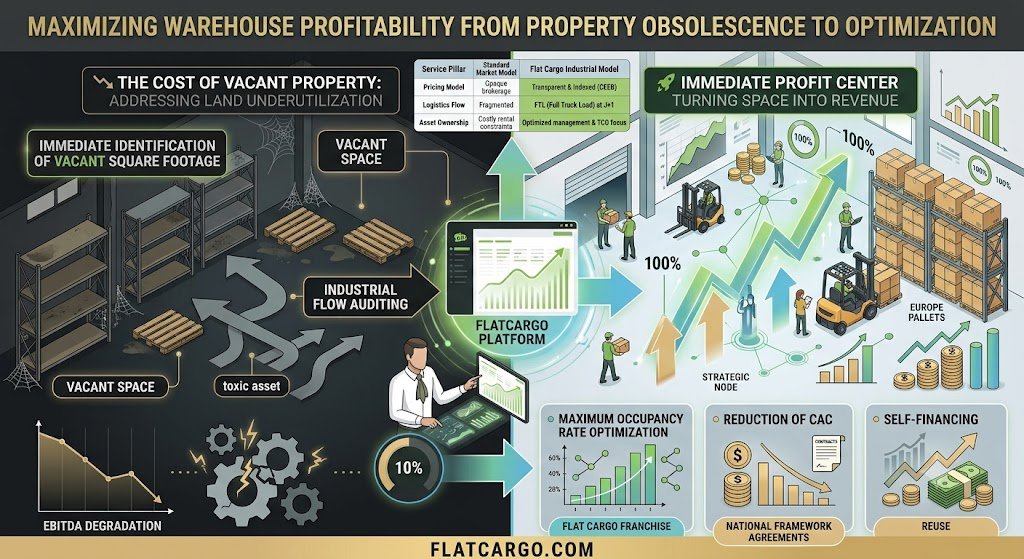
Our model is based on radical transparency: we display market prices indexed to the CEEB Index. Thanks to a territorial network of over 500 franchise partners, we guarantee immediate availability and Full Truck Load (FTL) delivery at J+1 or J+2. You can follow weekly trends through our pallet price barometer services.
| Service Pillar | Standard Market Model | Flat Cargo Industrial Model |
|---|---|---|
| Pricing Model | Opaque brokerage | Transparent & Indexed (CEEB) |
| Logistics Flow | Fragmented | FTL (Full Truck Load) at J+1 |
| Asset Ownership | Costly rental constraints | Optimized management & TCO focus |
EPAL Pallet Technical Specification: Engineering, Dimensions, and Load
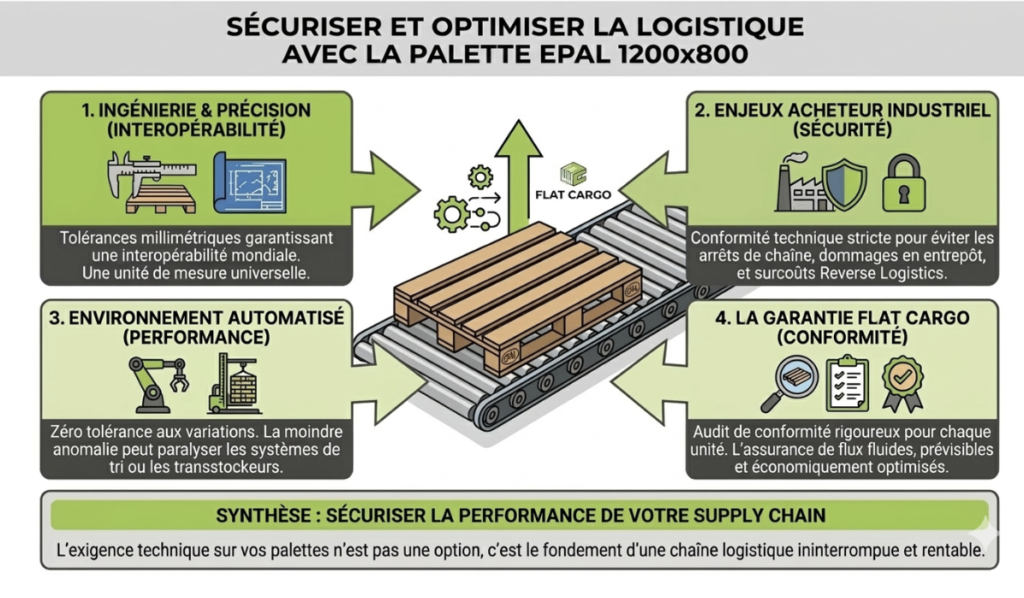
The 1200x800 EPAL pallet is the universal unit of measurement in European logistics. Far more than a simple handling support, it is the result of precision engineering whose official standards guarantee interoperability across all global production chains.
📏 1. Dimensional Architecture and Tolerances
| Asset Component | Nominal Specification | Industrial Tolerance |
|---|---|---|
| Overall length | 1,200 mm | +/- 3 mm |
| Overall width | 800 mm | +/- 3 mm |
| Fork entry height | 144 mm | +/- 2 mm |
| Board thickness | 22 mm (minimum) | Rigidity threshold |
| Block dimensions | 145 x 100 x 78 mm | High density |
🌲 2. Materials Analysis and Compliance
Structure & Assembly
- Species: Softwood (Pine, Spruce) or soft hardwoods.
- Moisture: Residual rate strictly below 22%.
- Nailing: 78 twisted nails according to the certified EPAL pattern.
Safety & Export
- ISPM15 Treatment: Required for international transport (NIMP15).
- Neutrality: Stabilized wood with no biological risk.
- Weight: Constant tare of approximately 25 kg (depending on species).
⚖️ 3. Load Capacities and Safety Analysis
Secured for active forklift handling on all massified loads.
High-density storage on a rigid, flat surface (maximum floor stacking).
Secure storage in warehouse on standard racks (racking on beams).
ISPM15 Standard & Export: Legal and Operational Guide for Industry
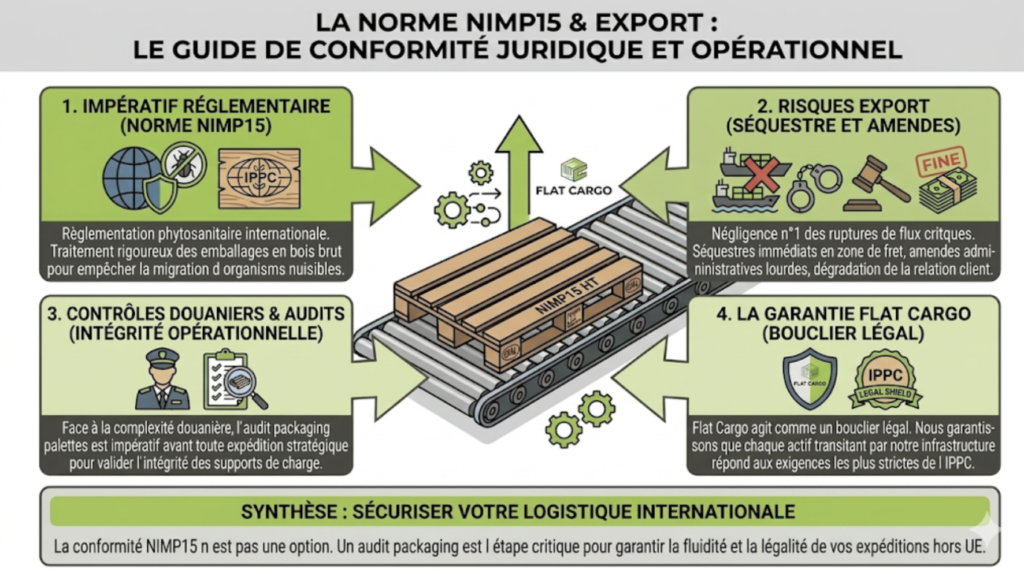
In the context of trade outside the European Union, compliance with the ISPM15 standard is a logistical sovereignty imperative. This regulation imposes rigorous treatment of raw wood to prevent the migration of harmful organisms. Facing the complexity of inspections, Flat Cargo acts as a legal shield guaranteeing your customs integrity.
🔥 1. The Heat Treatment Protocol (HT)
The core of the wood is maintained at a minimum temperature of 56°C for at least 30 uninterrupted minutes. This process eradicates pests at all stages of development.
The kiln-drying process reduces the moisture content to below 22%, stabilizing the weight of the EPAL pallet to optimize your transport costs.
Each unit receives an indelible branded mark including the country code (FR), approval number, and the official HT stamp.
For flows in humid environments or with extreme sanitary constraints, our export plastic pallets completely bypass this regulatory requirement.
🔍 2. Customs and Financial Risk Matrix
| Incident Type | Operational Consequence | Financial Impact (TCO) |
|---|---|---|
| Non-compliant marking | Cargo rejected at the border. | Penalties and re-shipment costs. |
| Presence of mold | Qualitative rejection by the final customer. | Loss of goods and dispute. |
| Lack of traceability | Prolonged administrative blockage (sequestration). | Storage fees (Demurrage). |
🌱 3. Integration into CSR and PPWR Strategy
With the entry into force of the PPWR 2026 directive, the reuse of treated packaging becomes a lever for tax optimization. Flat Cargo allows you to shift from a purchase-destruction model to a high-performance open-loop system.
Your treated and certified pallets are collected and valorized through our network, ensuring a prolonged lifecycle and an auditable reduction of your Scope 3 carbon footprint.
FTL Flow Optimization and Loading Engineering as a Profitability Lever
In a high-frequency industrial model, the load support is an adjustment variable for global payload. Optimization of Full Truck Load (FTL) transport is the most powerful lever to maximize your EBITDA and reduce your carbon footprint.
The 33/66 Pallet Standard
The configuration of a tautliner semi-trailer imposes strict constraints. Floor loading (33 pallets) is ideal for heavy industry, while double-stack loading (66 pallets) doubles the capacity for lighter products.
Operational Agility
Flat Cargo infrastructure secures your needs for full loads. By connecting your forecasts to our logistics network, you anticipate pressure and reduce approach distances for an optimal weight/volume ratio.
This agility transforms your shipping support management into a tangible competitive advantage from the very first batch shipped.
Logistics Performance Comparison
| Flow Configuration | Capacity (Units) | Dead Weight (Estimated Tare) | Recommended Usage |
|---|---|---|---|
| Europe Standard (Floor) | 33 EPAL Pallets | 726 kg - 825 kg | Dense products / Heavy industry |
| Europe Standard (Double-Stack) | 66 EPAL Pallets | 1,452 kg - 1,650 kg | FMCG / Mass Market |
| Half-Pallet Optimization | 66 Units (Floor) | ~ 594 kg | Retail / Last-mile delivery |
EPAL Pallet Price and the Impact of Full Truckload Purchasing
The EPAL pallet price is an essential purchasing indicator for industrial manufacturers, logistics companies and distribution centers managing high-volume pallet requirements. The unit cost of a certified 1200 × 800 mm EPAL Euro pallet depends on several factors, including whether the pallet is new or used, its condition, raw material costs, order quantities and delivery location. For professional buyers, purchasing EPAL pallets in full truckload quantities can reduce transportation costs per unit by consolidating deliveries and maximizing vehicle utilization. However, comparing supplier quotations requires evaluating the complete delivered cost rather than the purchase price alone. Freight charges, unloading requirements, pallet quality, availability and recurring delivery schedules all influence the total cost of pallet procurement. By coordinating bulk purchases with loading capacity and warehouse demand, Flat Cargo helps businesses structure their sourcing strategy, improve cost predictability and identify purchasing solutions adapted to their industrial logistics requirements.
Securing Territorial Coverage
The performance of a loading plan depends on the upstream availability of material. Our network of 500 partner hubs guarantees permanent capacity reserves. Anticipate market pressures and lock in your J+1 deliveries before your competitors.
Price Barometer and Index Analysis: Understanding the Pallet Market
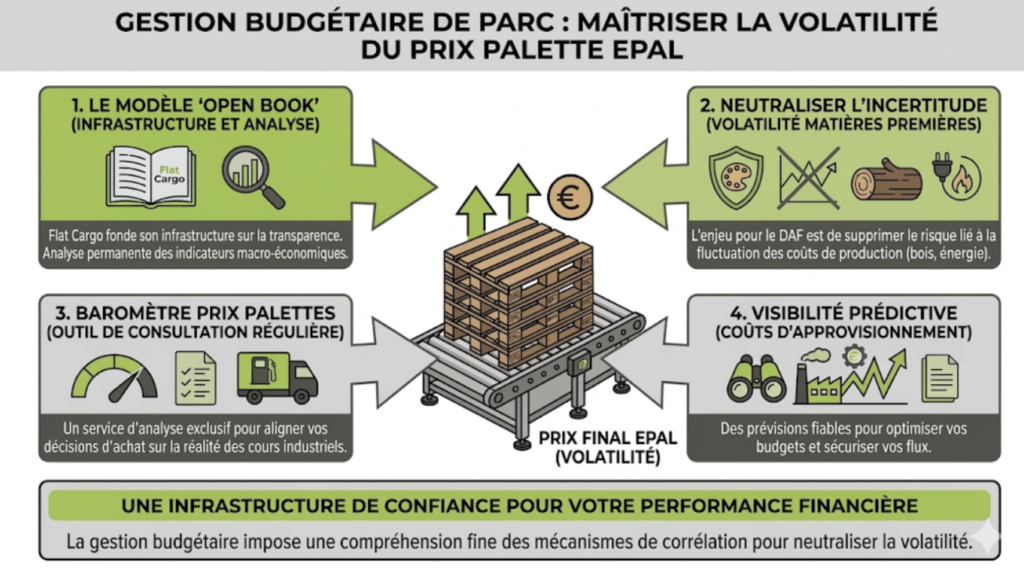
Budget management for a logistics fleet requires a nuanced understanding of the mechanisms governing EPAL pallet pricing. Flat Cargo bases its infrastructure on the Open Book model to provide predictive visibility into your 2026 supply costs.
📈 The CEEB and HPE Indices
Sawn timber accounts for 65% to 75% of a pallet's final price. The CEEB index tracks these prices monthly in France, while the HPE Index measures volatility in European production costs.
A 10% variation in these indices impacts the spot price within 30 to 45 days. Anticipating these cycles is the key to a procurement strategy.
📊 Budget Optimization
Beyond procurement, our de-consignment and fleet buyback levers transform your idle inventory into immediate liquidity (Cashback).
Aligning your decisions with market reality allows you to move from a passive cost center to high-performance liquid asset management.
🏛️ Trading Floor: Spot Quotes vs Market Price
| Logistics Reference | Average Market Price (Q1 2026) | Flat Cargo Spot Quote (FTL Lots) |
|---|---|---|
| New EPAL Pallet (Certified) | €13.80 - €15.20 | 🔑 Access Restricted |
| Used Europe Pallet (Grade A) | €11.50 - €12.80 | 🔑 Access Restricted |
| EPAL 3 Pallet (1200x1000) | €16.50 - €18.00 | 🔑 Access Restricted |
Directive PPWR 2026 et RSE : Le Nouveau Paradigme de la Palette Europe
L'entrée en vigueur de la directive européenne PPWR marque la fin de l'ère de l'emballage à usage unique. Pour les industriels, cette réglementation impose des objectifs de réemploi drastiques. La palette EPAL, réparable et standardisée, devient un actif circulaire stratégique, véritable levier de réduction de votre fiscalité environnementale.
Standardisation EPAL
Seul un support universel permet une mutualisation à grande échelle, réduisant drastiquement le besoin de production de bois neuf dans la supply chain.
Reporting Scope 3
Flat Cargo facilite la collecte de données sur le nombre de rotations, une métrique indispensable pour vos bilans de décarbonation audités et certifiés.
Fiscalité RSE
Le passage au réemploi permet d'anticiper et de réduire les éco-contributions liées à la Responsabilité Élargie du Producteur (REP) appliquées aux emballages tertiaires.
Interopérabilité
Nos services de durabilité et de conformité RSE garantissent un alignement total avec les trajectoires normatives fixées par Bruxelles à l'horizon 2030.
Analyse du Cycle de Vie (ACV) : Valorisation
| Étape du Cycle de Vie | Action Stratégique Flat Cargo | Bénéfice Environnemental & Économique |
|---|---|---|
| Diagnostic du Parc | Audit packaging et conformité | Identification précise des gisements d'optimisation. |
| Maintenance Curative | Collecte, tri et réparation certifiée | Prolongation de la vie de l'actif (préservation des forêts). |
| Fin de Vie Utile | Rachat et valorisation énergétique | Transformation en biomasse ou recyclage matière (Zéro Déchet). |
Le Circuit Ouvert : L'Alternative Durable au Pooling
Contrairement aux modèles de location fermés qui imposent des retours centralisés (et donc des milliers de kilomètres parcourus à vide), le circuit ouvert Flat Cargo offre une flexibilité totale. Vos palettes réintègrent le marché localement via notre réseau de proximité, réduisant instantanément les émissions de CO2 liées au transport.
Industrial Procurement Guide: Securing Supply and Auditing Providers
In a fragmented market, purchasing load supports should no longer be limited to unit price. For a high-performing Industrial Buyer in 2026, the real cost includes operational risks. A supplier without traceability becomes a center of hidden costs (production line stops, billing disputes, non-compliance).
Checklist: EPAL Technical Compliance
Require a valid EPAL license number. Without this registration number, the asset has no exchange value in the pool and will be refused by your 3PL clients.
Any delivery with a rate above 22% must be immediately noted in your records to avoid mold and deformation of your primary packaging.
Verify the presence of the 78 certified nails. "Unauthorized" nailing reduces the asset's torsional strength by more than 40%.
Crumbling wood blocks indicate prolonged outdoor storage, which is strictly prohibited to guarantee industrial flow performance.
Comparative Analysis: Brokerage vs Flat Cargo Infrastructure
| Selection Criteria | Local Reseller / Broker | Flat Cargo Infrastructure |
|---|---|---|
| FTL Availability | Random (limited physical stock) | Guaranteed (500 connected depots) |
| Price Indexing | Opaque / Variable margins | Transparent (CEEB Index) |
| ISPM15 Compliance | Self-declaration (Risk) | Systematic HT marking & Tracked |
| Technical Support | None | Design office and 3D engineering |
Securing the Contract: Responsiveness & Audit
Do not navigate blindly. For your specific load configurations or to reorganize your logistics flows, use our expertise service before any massive order.
Logistics Buyer's FAQ: Compliance and Strategy
Managing a load support fleet raises issues at the intersection of transport law, industrial safety, and financial optimization. This guide compiles critical questions to secure your purchasing decisions in 2026.
EPAL Authentication: How to identify original pallets from counterfeits? +
Alternatives to EPAL: Solutions for sensitive environments +
Actual lifespan: Performance in open-loop systems +
Financial Valorization: Managing idle or damaged stock +
| Asset State | Flat Cargo Recommended Action | Financial Impact (CFO View) |
|---|---|---|
| Surplus stock | Buyback and de-consignment | Immediate cash flow (Cashback) |
| Repairable pallets | ISPM15 certified repair | Avoidance of new wood purchases |
| Unusable pallets | Energy valorization / Biomass | Waste tax reduction / Scope 3 |