
Pallet Fleet Buyout: Recover Value from Surplus Pallets
A pallet fleet buyout allows businesses to recover residual value from surplus, underused or unwanted wooden pallets. Instead of leaving reusable load carriers in storage, manufacturers, distributors and logistics operators can assess whether selected pallets qualify for collection and resale.
For procurement and finance teams, the objective is to evaluate the commercial value of these assets against the costs of collection, sorting, handling and transport. A well-structured pallet buyback programme may release warehouse space, improve inventory visibility and recover cash from equipment that is no longer required.
Flat Cargo supports businesses with pallet asset recovery by assessing recoverable pallets and organising collection through its European logistics network. The financial outcome depends on ownership, pallet condition, available volumes, location and the terms of the agreed buyback arrangement.
How a Pallet Fleet Buyout Converts Surplus Stock into Value
A successful pallet buyout starts with an accurate inventory of pallets that the company owns and can legally sell.
Businesses should distinguish reusable pallets from damaged units, identify any equipment belonging to a third-party pooling provider and determine whether the available stock has resale value.
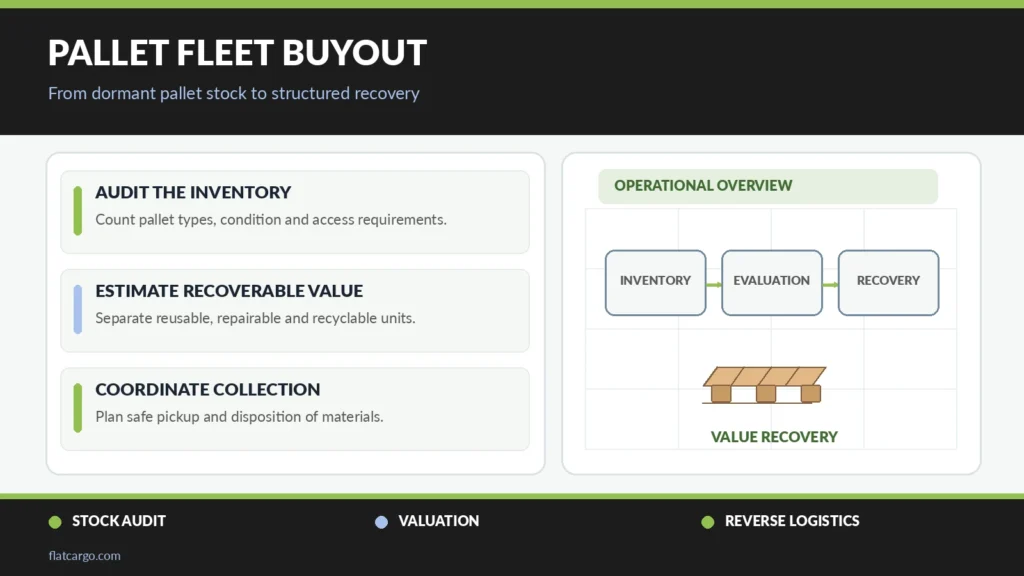
The process generally includes inventory assessment, condition grading, a commercial offer, collection, final quantity verification and settlement under the agreed terms.
Identify Which Pallets Can Be Collected and Bought Back
A surplus pallet valuation should consider dimensions, recognised pallet grades, structural condition and local demand. These factors can affect the price offered for a used pallet.
Procurement teams should document pallet dimensions, estimated quantities, visible damage, storage conditions and collection accessibility before requesting an assessment.
A transparent grading process helps distinguish pallets suitable for immediate reuse from those requiring repair or material recovery, which can affect pallet resale value.
Compare Pallet Buyout, Pooling and In-House Fleet Management
| Evaluation factor | Rental or pooling | Owned fleet with buyout |
|---|---|---|
| Ownership | Typically retained by the pooling operator | Owned pallets may be sold under an agreed arrangement |
| Operating costs | Rental, handling and return charges depend on the contract | Collection, grading and transport costs affect recovery value |
| Residual value | Usually retained by the asset owner | The seller may recover value from accepted pallets |
| Operational control | Depends on provider network and contractual terms | Depends on inventory visibility and recovery arrangements |
| Financial outcome | Requires analysis of costs per rotation | Requires analysis of net sale proceeds and replacement requirements |
Neither model is automatically more economical. A pallet fleet management review should compare the total cost of ownership, utilisation rates, recovery expenses and the availability of suitable pallets before selecting a strategy.
Calculate Pallet Recovery Value Before Signing an Agreement
The financial value of a pallet fleet buyout should be assessed using an explicit calculation rather than a general savings estimate.
Net Recovery Value = Accepted Pallets × Agreed Unit Price − Collection, Sorting, Repair and Transport Costs
The calculation should include the expected acceptance rate, any applicable handling charges and the commercial terms used to determine the final quantity.
Where pallets are required for ongoing operations, the cost of replacing the sold units should also be considered when assessing the overall business impact.
How Pallet Recovery Affects Cash Flow and Working Capital
Surplus pallets can occupy valuable storage space while providing limited operational benefit.
Selling company-owned pallets that are no longer required may generate cash receipts and reduce associated handling or storage expenses. However, the effect on working capital depends on the company's accounting treatment, payment terms, replacement needs and contractual obligations.
Financial teams should distinguish gross resale revenue from net recovery value and avoid treating potential savings as guaranteed income.
PPWR Obligations and Evidence for Reusable Transport Packaging
Regulation (EU) 2025/40 on packaging and packaging waste applies in the European Union from 12 August 2026, with different implementation dates for specific requirements.
Businesses using transport packaging should assess the obligations relevant to their activities, packaging formats and reuse arrangements.
A pallet buyout transaction does not automatically establish regulatory compliance. Appropriate documentation may include pallet ownership records, quantities collected, condition assessments, transfer records and information about reuse or material recovery.
Environmental performance claims should be based on a documented methodology, including transport distances, vehicle characteristics and relevant lifecycle assumptions.
Review Your Surplus Pallet Fleet with Flat Cargo
If your company manages surplus pallets across several industrial or distribution sites, a structured inventory and recovery assessment can help identify commercially viable collection opportunities.
Flat Cargo can evaluate available pallet quantities, collection conditions and potential resale arrangements.
Frequently Asked Questions about Pallet Fleet Buyout
What is a pallet fleet buyout?
A pallet fleet buyout is an arrangement in which a business sells eligible surplus or unwanted pallets to a specialist buyer. The agreed value depends on pallet type, condition, quantity and collection requirements.
How is the buyback price calculated?
Buyback offers generally consider dimensions, grade, repair requirements, market demand, location and transport costs. The final amount depends on the agreed commercial terms and accepted quantities.
Is pallet buyout better than pallet pooling?
Not necessarily. A buyout can be useful for recovering value from company-owned pallets, whereas pooling may suit businesses that prefer access to a managed pallet network. The appropriate model depends on ownership, operating conditions and total costs.
Does selling used pallets guarantee PPWR compliance?
No. A buyout can support inventory management and provide useful documentation, but compliance must be evaluated against the legal requirements applicable to each business and packaging operation.