
How Used Grade B EPAL Pallets Reduce Logistics Costs
How Reconditioned Pallets Protect Operating Margins
Adopting used Grade B EPAL pallets is one of the most effective ways for businesses to protect operating margins. In today’s logistics environment, where volatile timber prices and transport costs weigh heavily on the cost base, choosing certified used pallets is no longer a fallback option. It is a strategic financial decision.
Grade B Structural Integrity and Industrial Appearance
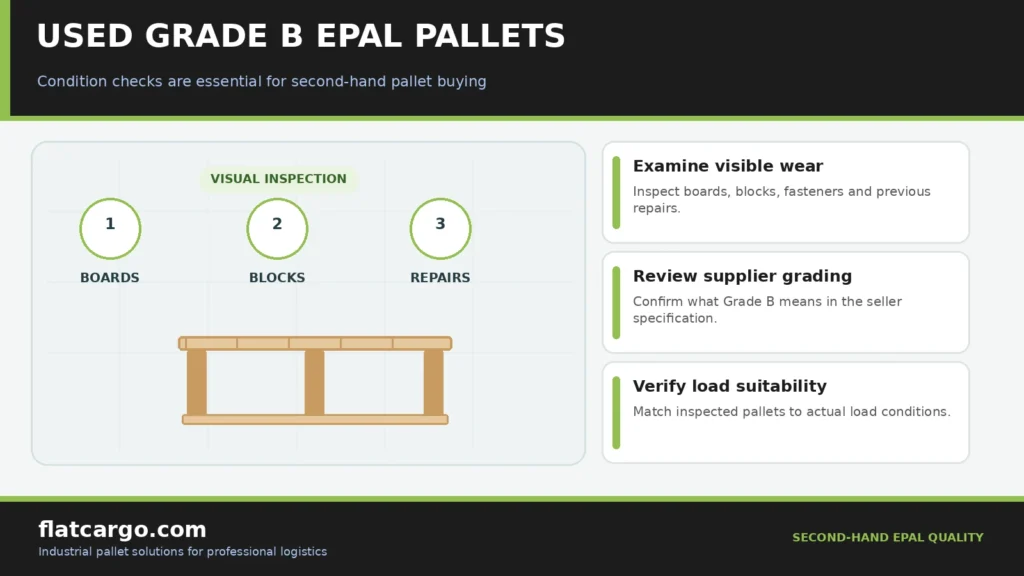
Grade B pallets have completed several rotations. They may show greyed timber and signs of use while retaining their original structural properties. For your unit loads, this stability supports reliable integration into your wider pallet logistics and helps maintain continuity of flow.
How Grade B Pallets Change the Cost Structure for 2026
Flat Cargo profitability analysis
Flat Cargo analyses how adding reconditioned load carriers can change the cost structure of current shipments while meeting 2026 performance requirements. Choosing Grade B helps protect your logistics budget from market uncertainty while supporting long-term transport total cost of ownership (TCO) optimisation.
In logistics, every euro saved on a load carrier is a euro that can be reinvested in service performance. Choosing Grade B reduces the fixed cost per shipment. This approach is especially valuable in 2026, when businesses continue to seek greater energy efficiency. The durability of the EPAL Euro pallet standard supports longer amortisation and a stronger return on investment than lower-grade alternatives, helping to secure transport TCO.
Strategic Audits and Maintenance for Used Pallet Fleets
| Quality indicator | Grade B inspection criterion | Flat Cargo verification |
|---|---|---|
| Structural integrity | No broken boards or missing blocks | Check the condition of load-bearing parts and joints |
| Markings and traceability | Legible EPAL licence marking and any marks required for the pallet type and treatment status | Verify markings against the applicable EPAL specification; do not treat an EUR mark as a universal requirement |
Fleet audits and asset protection
Used equipment requires closer monitoring to prevent disruptions to goods flows. Flat Cargo uses inspection protocols that assess timber wear and the strength of pallet joints. Regularly auditing your pallets helps maximise the service life of your used Grade B EPAL pallets while stabilising your logistics budget.
Careful maintenance supports a smooth transition to efficient pallet logistics, with each reconditioned pallet retaining reliability comparable to new equipment for your current shipments.
Protect your pallet rotations with a professional Grade B compliance audit
EPAL Technical Specifications and Reliability
The strength of used Grade B EPAL pallets lies in their standardised design. Unlike one-way pallets, whose quality can vary by manufacturer, an EPAL pallet follows a consistent technical specification whether new or used. This standardisation provides the interoperability modern logistics requires.
Standard Dimensions and Operational Interoperability
Each pallet follows the standard dimensions of 1,200 × 800 mm. This precision supports compatibility with automated handling equipment, including conveyors, automated storage and retrieval systems, and forklifts. Integrating Grade B pallets into existing flows helps avoid mechanical blockages. It supports consistent operations without the higher acquisition cost of new pallets, helping to optimise your logistics budget.
Structural Strength After Use
Safe working load and unit-load stability
For an EPAL 1 Euro pallet that remains fit for use, EPAL lists a safe working load of 1,500 kg. Although the timber may be darker, the boards and joints must remain structurally sound. Flat Cargo inspects every Grade B pallet it supplies to ensure that structural defects do not compromise load stability or the pallet’s safe working load.
Protect your goods with reconditioned EPAL pallets.
Environmental Impact and ESG Commitment for 2026
In 2026, supply-chain environmental performance is a selection criterion as important as price. Using used Grade B EPAL pallets is a practical way to reduce the need for replacement production without making complex structural changes to your pallet logistics.
Extending Service Life and Reducing the Carbon Footprint
Reuse, service life and carbon impact
Manufacturing a new pallet uses forest resources and energy. Reconditioning and reuse can extend a wooden pallet’s service life and may reduce the need to produce replacement pallets. The net emissions impact is not a fixed saving per cycle. It depends on pallet design, the number of trips, repairs, return transport and end-of-life treatment.
Make logistics a driver of sustainability.
Conclusion: Lower Logistics Costs Through Reuse
Choosing used Grade B EPAL pallets is a practical way to manage an agile supply chain in 2026. They combine mechanical strength with potential acquisition savings of up to 60%. This is an estimate, not a guaranteed saving; actual results depend on pallet condition, order volume, availability and purchase terms.
EPAL standardisation supports interoperability with your equipment, while reconditioning and reuse can extend pallet service life. Flat Cargo can support your move towards more circular and efficient logistics. Optimise your logistics budget and protect your transport TCO.
Reduce equipment costs without compromising the safety of your shipments.
FAQ
Can Grade B EPAL Pallets Be Used for International Export?
Used Grade B EPAL pallets can be used for shipments outside the European Union when their treatment and markings meet the applicable ISPM 15 requirements. Heat treatment addresses phytosanitary risks and makes the wood suitable for international transport. Flat Cargo checks that its stock meets these requirements to help secure export flows without additional administrative costs.
What Is the Difference Between Grade A and Grade B Pallets?
The difference is mainly visual. Grade A pallets have lighter timber and look closer to new, while Grade B pallets have a natural grey appearance from previous rotations. Load-bearing components must not be damaged. For industrial shipments, Grade B offers a strong performance-to-price ratio and can reduce transport TCO through reuse.