
Plastic Pallets for Construction Site Material Handling
Plastic pallets for construction are used to handle, transport and store building materials across industrial supply chains and construction sites. Depending on their design, they may be suitable for distributing bricks, bagged materials, construction components and other packaged loads.
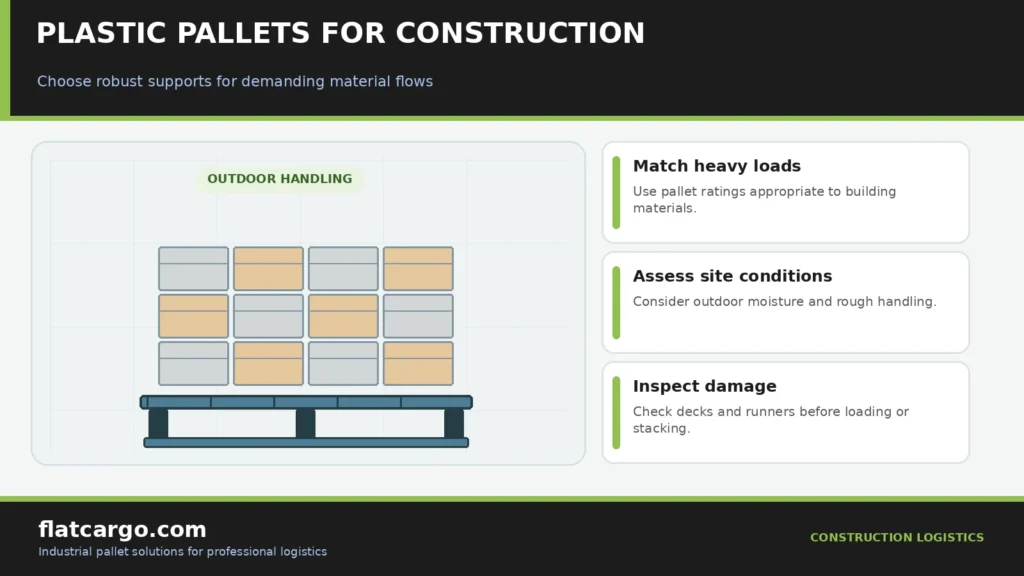
However, not every plastic pallet can withstand the same weight or handling conditions. Choosing a suitable model requires an assessment of load capacity, pallet dimensions, material specifications, outdoor exposure and compatibility with lifting or handling equipment.
Flat Cargo helps professional buyers compare pallet options through its European logistics network. The objective is to select load carriers that meet operational requirements while keeping purchasing, transport and recovery costs under control.
Choose Plastic Pallets for Different Construction Material Loads
Construction materials place different demands on pallets.
Bricks and concrete blocks may create concentrated or uneven loads. Bagged cement and dry construction products require attention to load stability and moisture protection. Plasterboard components and other large-format materials may need dedicated support arrangements.
Buyers should specify the actual material weight, unit dimensions, load distribution, transport method and planned storage conditions before selecting a pallet.
When evaluating heavy duty plastic pallets, consult the manufacturer's specifications for the intended application rather than relying solely on a general product category. For a broader comparison of load carrier designs, see our heavy-duty plastic pallet buying guide.
Check Static and Dynamic Load Ratings Before Ordering
Pallet load ratings depend on the individual model and its support conditions.
Static capacity describes performance under specified stationary support conditions.
Dynamic capacity concerns handling under the conditions defined by the manufacturer.
Racking capacity applies to specified rack support configurations and must not be inferred from a static load rating.
A supplier's published maximum load does not automatically apply to every building material or handling situation. Weight distribution, pallet deflection, temperature and equipment compatibility can affect performance.
Buyers should request technical documentation for the exact pallet model. Test information based on ISO 8611-1:2025 may help evaluate flat pallet performance under defined conditions, but application-specific validation remains necessary.
A transport pallet should not be used as a crane-lifting accessory unless the complete lifting arrangement is specifically designed, rated and approved for that purpose.
Match Outdoor Storage Conditions to Pallet Material Specifications
Construction site pallets may be exposed to rain, sunlight, temperature fluctuations, dirt and repeated mechanical handling.
Plastic pallets can offer advantages in moisture resistance and cleaning compared with certain wooden designs. However, resistance to ultraviolet exposure, temperature changes and impact depends on the polymer formulation and the pallet's construction.
Where long-term outdoor storage is expected, buyers should request manufacturer information on UV stabilisation, operating temperature range and inspection requirements.
Pallets should also be inspected for cracks, deformation and damage before reuse. Weather resistance does not eliminate the need for routine inspection or safe handling procedures.
Compare Pallet Ownership, Repairs and Cost per Rotation
| Evaluation factor | Wooden pallets | Plastic pallets |
|---|---|---|
| Initial price | Varies by specification and grade | Varies by material and design |
| Moisture exposure | Requires assessment of condition and treatment | Depends on polymer and construction |
| Repair options | May be repairable under applicable requirements | Vary by design and manufacturer |
| Load capacity | Must be checked for the specific model | Must be checked for the specific model |
| Reuse and recovery | Depend on condition and collection arrangements | Depend on condition and collection arrangements |
The total cost of ownership should include acquisition, transport, inspection, handling, repair or replacement and recovery costs.
Cost per Rotation = (Acquisition + Handling + Maintenance + Recovery Costs − Residual Value) / Completed Rotations
This calculation can help businesses compare realistic operating scenarios. It should use actual company data rather than assumed pallet lifespans or guaranteed savings.
For a more detailed financial analysis, consult our plastic pallet logistics cost guide.
Use RFID Tracking and Custom Features Where Appropriate
Track Pallet Movements Across Distribution and Construction Sites
RFID technology can help identify pallets and record movements when compatible tags, readers and data systems are installed.
Tagged pallets do not automatically provide continuous geolocation. Visibility depends on the reader network, software integration and the tracking technology used.
For businesses managing returnable pallets across several sites, a suitable identification system can help reconcile dispatched and returned quantities, identify missing equipment and improve inventory records.
Before investing in RFID pallet tracking, buyers should verify the availability of compatible tags, reader coverage and integration with their existing systems.
Specify Pallet Designs for Different Construction Materials
Some construction material flows may benefit from modified pallet dimensions, additional supports, anti-slip features or protective accessories.
For bricks, packaged products or large-format building components, the chosen design should reflect the load dimensions, weight distribution, handling method and transport conditions.
Custom features must be assessed together with the complete load securing arrangement. Edges or retaining features alone do not guarantee that a load will remain secure during transport.
Where a specific design is required, procurement teams should provide a technical specification and request confirmation of suitability before ordering.
Plan Site Deliveries and Recover Empty Pallets Efficiently
The costs associated with construction pallets do not end when materials reach the delivery site. Businesses should plan where empty pallets will be stored, how reusable units will be collected and which conditions determine whether equipment can return to circulation.
For recurring projects, regional collection arrangements may help consolidate returns and reduce unnecessary transport movements. The appropriate recovery model depends on ownership, pallet condition, available quantities and transport distances.
These considerations are also relevant when pallets return to central warehouses. See our warehouse plastic pallet selection guide for storage and handling requirements.
Review Plastic Pallet Requirements for Your Construction Projects
Need to source pallets for bricks, packaged building materials or recurring site deliveries?
Flat Cargo can help assess pallet specifications, sourcing requirements and potential collection arrangements.
Frequently Asked Questions
Can plastic pallets carry concrete blocks and bricks?
Some models may be suitable, depending on the total load, weight distribution, pallet design and handling conditions. Buyers should verify the manufacturer's rated capacity for the intended application.
Are plastic pallets suitable for outdoor construction sites?
Certain models are designed for outdoor exposure. Their suitability depends on UV resistance, operating temperatures, impact resistance and inspection requirements.
Does RFID provide continuous construction pallet tracking?
Not automatically. RFID can support identification and movement records where readers are installed. Continuous location tracking requires an appropriate tracking solution.
Can plastic pallets be lifted directly by a crane?
A standard transport pallet should not be assumed suitable for crane lifting. The complete lifting arrangement must be specifically designed, rated and approved for the intended operation.
How can companies compare plastic and wooden pallet costs?
Compare acquisition, handling, maintenance, recovery, replacement needs and expected completed rotations using actual operating data.