
How Plastic Pallet Costs Affect Total Logistics Spending
Plastic pallet costs extend far beyond the initial purchase price. For industrial businesses managing complex supply chains, the true cost of a pallet includes transportation, handling, cleaning, maintenance, replacement and operational interruptions.
Reusable plastic pallets can offer advantages in logistics environments where consistent dimensions, moisture resistance and cleaning procedures are important. However, these benefits must be assessed against acquisition costs, load requirements and the expected number of pallet uses.
Businesses looking to reduce logistics operating costs should evaluate how their load carriers perform throughout the supply chain. Pallet condition, handling compatibility and replacement frequency can directly influence warehouse productivity and distribution expenditure.
A broader approach to pallet logistics optimisation and hidden operating costs helps procurement teams identify where packaging choices may create avoidable expenses. This perspective is essential when comparing plastic and wooden pallets over multiple operating cycles.
Flat Cargo approaches plastic pallet selection through a comprehensive assessment of technical performance and total cost of ownership.
The objective is not simply to select a lower-priced load carrier, but to evaluate the relationship between initial investment, operational reliability, maintenance requirements and long-term logistics costs.
Depending on the application, plastic pallets may help reduce certain recurring expenses. Their financial value should nevertheless be demonstrated through actual operating data and shipment-specific requirements.
How Plastic Pallets Reduce Maintenance and Replacement Costs Over Time
The financial value of reusable plastic pallets depends on their performance throughout the operating lifecycle, not simply on their initial acquisition price. For companies managing high-volume logistics operations, maintenance requirements and replacement frequency can have a substantial impact on operating expenditure.
Unlike traditional wooden pallets, plastic pallets do not contain wooden boards or nails that may require replacement during routine maintenance. Many models also offer resistance to moisture absorption and can be cleaned using suitable procedures.
However, these characteristics do not eliminate the need for inspections or guarantee a longer service life. Actual performance depends on pallet design, operating conditions, loading practices and material quality.
Which Plastic Pallet Maintenance Expenses Can Businesses Reduce?
Plastic pallet maintenance may involve fewer wood-specific repair activities. Nevertheless, procurement teams should account for inspection, cleaning, sorting and damaged-unit handling when calculating ongoing expenditure.
Plastic pallets do not require replacement of wooden deck boards or protruding nails. Structural damage must still be assessed before reuse.
Suitable plastic models can support repeatable cleaning procedures, although cleaning costs depend on contamination, pallet design and sector requirements.
Reusable plastic pallets may support repeated handling cycles, but their lifespan depends on operating conditions and the type of damage they experience.
When Should Damaged Plastic Pallets Be Replaced?
Plastic pallet replacement costs should be assessed alongside structural safety. Damaged runners, cracked deck surfaces, distorted supports or weakened load-bearing components may affect pallet performance.
Where damage compromises load capacity or handling compatibility, the pallet should be removed from active operations until its suitability has been assessed.
Inspection and Replacement Decision
Before returning a damaged plastic pallet to service, verify its structural condition, intended load, equipment compatibility and manufacturer guidance.
Repair options vary by pallet construction. Some designs allow specific components to be replaced, while others may require complete unit replacement. Unauthorised modifications should not be assumed to preserve the original load rating.
How Does Pallet Service Life Influence Logistics Operating Costs?
The cost-effectiveness of plastic pallets depends heavily on the number of successful uses achieved before replacement. A higher purchase price may be economically justified when a pallet completes enough operating cycles at an acceptable maintenance cost.
Businesses should compare their actual fleet performance with the expected cost of alternative load carriers. This includes pallet losses, cleaning expenses, storage requirements and reverse logistics.
A structured approach to reusable pallet management and circular logistics can help businesses evaluate return flows, asset recovery and long-term replacement requirements.
Flat Cargo Lifecycle Cost Assessment
At Flat Cargo, evaluating plastic pallet expenditure involves comparing purchase costs with the operational performance achieved throughout the pallet lifecycle.
Useful indicators include the number of verified pallet uses, maintenance expenditure, unit losses, replacement frequency and any recoverable residual value.
This approach helps purchasing teams determine whether reusable plastic pallets offer a suitable financial advantage for their specific logistics operations, without assuming savings that have not been measured.
How Plastic Pallet Weight Affects Freight and Handling Costs
Plastic pallet weight is an important factor when evaluating transport efficiency, warehouse handling and overall logistics expenditure. The weight of each load carrier contributes to the total shipment mass and may influence the available payload for transported goods.
However, plastic pallets are not automatically lighter than wooden alternatives. Their actual weight depends on dimensions, polymer type, structural reinforcement and intended load capacity. Industrial buyers should compare specific pallet models rather than relying on general material assumptions.
Why Does Pallet Tare Weight Matter in Freight Planning?
Pallet tare weight is the weight of the empty load carrier. It must be considered when calculating the total weight of a palletised shipment.
In weight-constrained transport operations, heavier pallets can reduce the available payload for goods. Where shipment volume is the limiting factor, pallet dimensions, stackability and loading arrangements may be more important than small differences in pallet weight.
Pallet Tare Weight
Compare the actual weight of each pallet model, including any reinforcement required for the intended load.
Vehicle Payload
Evaluate how pallet weight contributes to the shipment's gross mass and the vehicle's permitted payload.
Loading Efficiency
Review pallet dimensions, load stability and stacking limitations to determine how effectively available transport capacity can be used.
Can Plastic Pallets Improve Weight Consistency Across Shipments?
Wooden pallets may absorb moisture from their surroundings, which can influence their weight under certain storage conditions. Many plastic pallet materials absorb relatively little moisture, potentially providing more predictable tare weight measurements.
Nevertheless, actual shipment weight can still vary because of water retained on surfaces, contamination, accessories and differences between pallet models. Businesses should use verified weights for freight calculations rather than treating plastic pallet mass as completely invariable.
How Do Nestable Plastic Pallets Affect Empty Return Costs?
Nestable plastic pallets are designed so that compatible empty units can fit partially inside one another. This design can reduce the space required to store or transport empty pallets.
For businesses operating closed-loop logistics systems, improved empty-pallet consolidation may reduce the volume occupied during return journeys. The resulting savings depend on transport arrangements, return distances and the number of pallets being collected.
Choosing the Right Pallet Construction
Nestable designs can be useful for empty return transport, but they may not offer the same racking capabilities as reinforced rackable pallets.
Buyers should verify the required load rating, handling equipment and storage configuration before selecting a pallet based on nesting efficiency.
Can Plastic Pallets Reduce Transport Energy Consumption?
Transport energy consumption depends on several factors, including total shipment weight, route characteristics, vehicle efficiency, loading density and the number of journeys.
A plastic pallet model that reduces shipment weight or improves empty-return utilisation may contribute to lower transport expenditure in certain operating conditions. These benefits should be confirmed using actual shipment data.
Procurement teams can connect pallet specifications with broader pallet transport and vehicle loading optimisation to evaluate whether a change in load carriers can improve the efficiency of their distribution network.
Flat Cargo Transport Efficiency Assessment
Flat Cargo recommends evaluating plastic pallet performance using measurable transport indicators rather than assuming that a particular material will automatically reduce costs.
Relevant factors include actual pallet tare weight, loading capacity, vehicle utilisation, empty return volumes and freight expenditure per completed shipment.
Comparing these indicators across equivalent operating conditions helps businesses identify whether their pallet configuration offers a practical financial advantage.
How to Audit Plastic Pallet Total Cost of Ownership
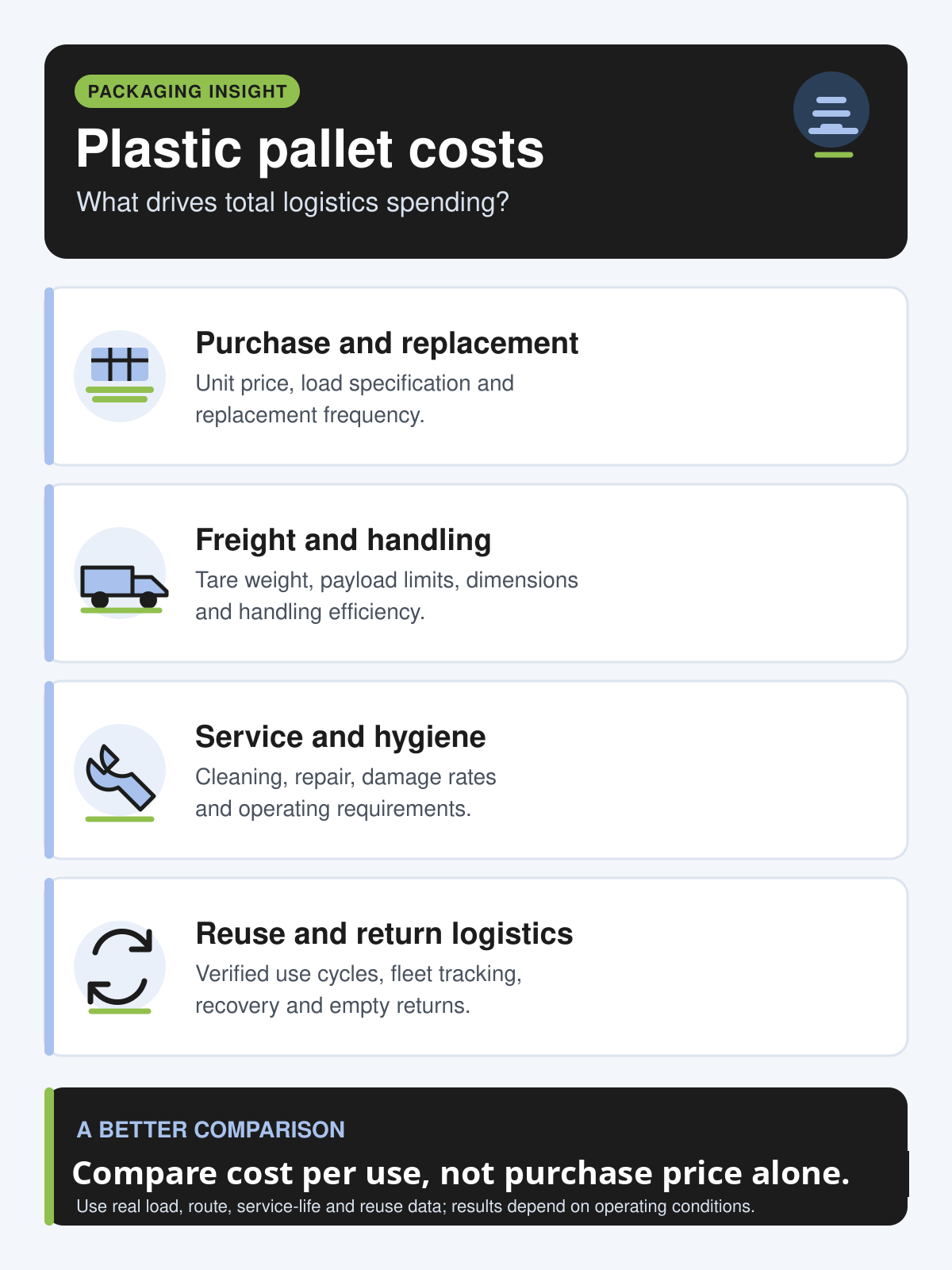
Understanding plastic pallet total cost of ownership is essential when comparing load carrier options for industrial logistics. A purchasing decision based exclusively on unit price may overlook the recurring costs associated with transportation, cleaning, handling and replacement.
A structured audit allows procurement teams to compare plastic and wooden pallets under equivalent operating conditions. The objective is to identify which solution delivers the most appropriate balance between technical performance and total expenditure.
Which Costs Should Businesses Compare Between Plastic and Wood Pallets?
Plastic vs wooden pallet costs should be evaluated using actual operational data. Differences in acquisition prices, maintenance, reuse frequency and return logistics can influence the overall financial result.
| Cost Indicator | Wooden Pallets | Plastic Pallets |
|---|---|---|
| Initial Purchase | Often lower for common wooden pallet formats. | Can require a higher initial investment, depending on construction and load capacity. |
| Maintenance | May require inspection, sorting and replacement of damaged components. | Avoids wood-specific repairs, but still requires inspection and appropriate damage management. |
| Cleaning | Cleaning suitability depends on pallet condition and operating requirements. | Many models support repeatable cleaning, but water, labour and energy costs must be included. |
| Service Life | Depends on handling conditions, damage rates and repairs. | Depends on material quality, design, loading and operating conditions. |
| Transport | Costs depend on pallet weight, dimensions and delivery arrangements. | Costs depend on pallet weight, nesting ability, load requirements and return flows. |
| Replacement | Replacement or repair is required when pallets are no longer suitable for use. | Replacement is required when structural damage or wear makes a unit unsuitable. |
| End-of-Life Value | Recovery value depends on condition, material markets and collection costs. | Recovery value depends on polymer type, recyclability, local facilities and collection costs. |
This comparison is qualitative. Neither material guarantees lower costs in every application.
How Can Procurement Teams Calculate Plastic Pallet Cost per Use?
The cost per pallet use provides a practical way to compare load carriers over a defined operating period. It relates the total costs of owning and operating a pallet fleet to the number of completed uses.
Include the cost of initial pallets, replacement purchases, delivery and purchasing-related handling expenses.
Include inspections, cleaning, sorting, maintenance, storage and routine fleet management activities.
Account for empty pallet transport, collection, consolidation and recovery arrangements where applicable.
Deduct only confirmed or reasonably evidenced recovery proceeds, net of collection and processing costs.
Practical Cost per Use Formula
Cost per pallet use = (total pallet purchases + delivery + operating costs + return logistics - net recoverable value) / total recorded pallet uses
Apply the same period and cost boundaries to both pallet options. Avoid counting replacement purchases or transport costs twice. Record actual pallet movements rather than assuming a fixed number of rotations.
When Do Plastic Pallets Become More Economical Than Wooden Pallets?
Plastic pallet ROI depends on the balance between additional investment and the operating expenses avoided over time.
In a controlled, high-frequency logistics network, repeated use may help distribute the initial purchase cost across more completed movements. However, pallet losses, cleaning requirements and replacement costs can affect the financial outcome.
Businesses evaluating a material transition should also review the financial criteria involved in switching from wooden pallets to plastic pallets and calculating ROI before committing to fleet-wide changes.
A break-even point should be calculated from actual purchase prices, operating costs and fleet performance. No universal number of annual rotations guarantees that plastic will be less expensive than wood.
Flat Cargo Logistics Cost Audit
Flat Cargo approaches pallet purchasing assessments by comparing technical suitability with measurable operating costs.
Procurement teams should monitor unit acquisition prices, maintenance expenditure, cleaning requirements, pallet losses, return logistics and recorded uses over a consistent assessment period.
This method helps identify whether plastic pallets can reduce total logistics expenditure in a specific operating environment, without relying on unsupported savings estimates.
How Do Plastic Pallets Support Hygienic and Automated Logistics?
Industrial plastic pallets can support logistics operations where cleaning, handling safety and automated equipment compatibility are important. Their practical value depends on pallet design, material selection and the requirements of each operating environment.
For businesses evaluating plastic pallet logistics costs, hygiene procedures, packaging damage, inventory tracking and automated handling should be considered alongside purchasing and transportation expenditure.
Why Are Hygienic Plastic Pallets Used in Sensitive Industries?
Many hygienic plastic pallets are manufactured with surfaces that are easier to clean than some traditional wooden pallet designs. Their resistance to moisture absorption can also be valuable where cleaning procedures are frequent.
However, material selection alone does not establish hygiene compliance. Food and pharmaceutical operations must assess contamination risks, cleaning protocols, material suitability and applicable site requirements.
Food Processing and Distribution
Plastic pallets may be suitable for food logistics environments requiring regular cleaning and controlled hygiene procedures. Buyers should confirm the intended application, product design and relevant hygiene requirements before placing an order.
Pharmaceutical Supply Chains
Pharmaceutical facilities may require pallet designs compatible with defined cleaning, material control and storage procedures. Acceptance depends on site-specific qualification requirements and the area in which pallets will be used.
Understanding H1 Plastic Pallets
H1 is a recognised pallet design commonly associated with hygienic logistics applications. Nevertheless, an H1 designation does not automatically certify that a pallet is suitable for every food-processing or pharmaceutical environment.
Purchasing managers should confirm relevant product documentation, cleaning compatibility and application-specific requirements. The suitability of hygienic plastic pallets for controlled logistics environments should be assessed according to the intended use.
Can Plastic Pallets Improve Operator Safety and Packaging Protection?
Plastic pallets do not contain wooden splinters or traditional pallet nails. This can eliminate certain wood-specific hazards during handling operations.
However, damaged plastic components may still develop sharp edges, cracks or weakened load-bearing areas. Regular inspections remain necessary to protect operators and reduce the risk of packaging damage.
Packaging failures, damaged products and handling incidents can create additional operating expenditure. Businesses should record these events and assess whether pallet design contributes to their frequency.
How Does RFID Tracking Improve Plastic Pallet Fleet Visibility?
RFID pallet tracking can help businesses identify and monitor individual load carriers through equipped logistics checkpoints. Suitable plastic pallet models may accommodate RFID tags within protected areas of their construction.
When connected to compatible warehouse management software, these identification systems can support inventory records and help reduce dependence on manual scanning.
Automated Identification
RFID readers can capture pallet identifiers at designated checkpoints, helping operators record movements through the logistics network.
Inventory Records
Digital identification can help associate pallets with stock movements, inspection information and operational asset records.
Pallet Loss Analysis
Recorded pallet movements may help businesses investigate missing assets and assess the effectiveness of return procedures.
RFID technology does not automatically provide continuous GPS tracking or live temperature monitoring. These functions require additional compatible devices, connectivity and supporting infrastructure.
What Makes Plastic Pallets Compatible with Automated Warehouses and AGVs?
Automated warehouses may use conveyors, robotic handling systems and automated guided vehicles (AGVs) to move palletised goods. Such equipment often requires load carriers that meet defined dimensional, structural and handling specifications.
Certain plastic pallet designs offer consistent manufacturing dimensions and may be suitable for automated handling applications. However, compatibility must be verified for each system.
Industrial buyers should examine pallet geometry, runner configuration, bending behaviour, load capacity and positioning requirements before introducing a new pallet model into automated operations.
Pallet damage, inappropriate load distribution or unsuitable construction can still cause equipment interruptions. No pallet material guarantees completely uninterrupted automation.
Flat Cargo Technology and Operating Cost Assessment
Flat Cargo evaluates plastic pallet suitability by considering technical specifications, handling requirements and the cost implications of each logistics process.
Relevant indicators include cleaning expenditure, pallet damage rates, automated handling incidents, asset losses and the operating costs associated with tracking infrastructure.
Measuring these factors helps businesses determine whether hygienic or technology-enabled plastic pallets provide practical advantages in their specific supply chain.
How to Control Plastic Pallet Costs Across Logistics Operations
Reducing plastic pallet logistics costs requires an assessment of the entire operating lifecycle. Purchase prices alone cannot determine whether plastic pallets are more economical than traditional wooden load carriers.
For industrial businesses, the main cost factors include maintenance, cleaning, handling, transportation, replacement frequency and empty pallet returns. Each of these expenses should be evaluated against the requirements of the supply chain.
Reusable plastic pallets may offer financial advantages in operations involving repeated handling, regular cleaning or controlled pallet return systems. Their suitability depends on pallet construction, operating conditions and the number of successful uses achieved.
A well-structured purchasing assessment should also consider hygiene requirements, employee safety, inventory visibility and compatibility with automated warehouse systems. These factors can influence operating expenditure beyond the direct cost of the pallet.
Flat Cargo helps industrial buyers assess their load carrier requirements using technical specifications and measurable logistics costs. Businesses can also examine their wider plastic pallet procurement and sourcing strategy when planning purchasing volumes and future fleet needs.
Looking to evaluate the operating costs of your plastic pallet fleet? Contact Flat Cargo to discuss your purchasing requirements, handling conditions and logistics expenditure.
Request a Plastic Pallet Cost AssessmentFAQ
Are Plastic Pallets More Expensive Than Wooden Pallets?
Plastic pallets can have a higher initial purchase price than common wooden pallet alternatives. However, their total operating cost depends on maintenance, cleaning, transportation, replacement frequency and the number of completed uses. A higher purchase price does not automatically mean higher long-term logistics expenditure.
How Many Times Can a Plastic Pallet Be Reused?
There is no universal number of uses applicable to every reusable plastic pallet. The service life depends on material quality, structural design, load weight, handling conditions and maintenance. Businesses should monitor actual pallet movements and damage rates to estimate realistic replacement requirements.
What Is the Racking Load Capacity of a Plastic Pallet?
Plastic pallet racking capacity varies according to the pallet model, reinforcement, support configuration and load distribution. Some pallets are designed for floor stacking only, while reinforced rackable models support specified loads in suitable racking systems. Buyers must verify the manufacturer's stated racking load rating before use.
Are Plastic Pallets Suitable for Food and Pharmaceutical Logistics?
Some hygienic plastic pallets are suitable for food and pharmaceutical logistics applications because their design can support defined cleaning procedures. However, suitability depends on pallet construction, cleaning compatibility and sector-specific requirements. Plastic material alone does not guarantee hygiene compliance.
Can RFID Technology Reduce Plastic Pallet Losses?
RFID pallet tracking can help businesses record pallet movements and identify missing assets at equipped checkpoints. When connected to a compatible inventory management system, RFID may improve fleet visibility. Actual savings depend on implementation costs, operational procedures and the effectiveness of pallet recovery.
How Can Businesses Calculate Plastic Pallet Cost per Use?
Divide the total relevant pallet costs over a defined period by the number of recorded uses. Costs may include acquisition, delivery, cleaning, inspection, return logistics and replacement, less any confirmed recoverable value. The same calculation method should be applied when comparing plastic and wooden pallet fleets.