
Pallet Fleet Management: The Financial Shift from CAPEX to OPEX in 2026
Pallet Management is becoming a strategic priority for European industry, as traditional pallet fleet management remains a passive cost center that is increasingly difficult to sustain. Heading into 2026, the capital locking (CAPEX) tied to buying logistics load carriers runs directly into the regulatory requirements of the PPWR regulation. Facing the risk of a skyrocketing Total Cost of Ownership (TCO), transitioning to a flexible operational expense (OPEX) model is becoming an increasingly attractive option. Flat Cargo deploys a pallet return infrastructure designed to transform this latent liability into improved cash flow while supporting your environmental compliance.
The PPWR Packaging Framework and its Impact on Financial Statements
Pallet Management is becoming increasingly important for industrial businesses adapting to the European Packaging and Packaging Waste Regulation (PPWR). As the European regulatory framework evolves, companies must reassess how they manage, recover, and reuse their logistics packaging. The shipping pallet is no longer viewed solely as a disposable consumable but increasingly as a reusable logistics asset whose lifecycle requires careful monitoring. For finance departments, adapting pallet management strategies can help control operational costs, improve asset visibility, and reduce exposure to regulatory and financial risks.
Anticipating the Packaging Tax and Environmental Penalties
The PPWR regulation (Packaging and Packaging Waste Regulation) introduces requirements that encourage the reduction of packaging waste and the development of reuse systems. Supply chains operating under a linear model of purchasing and discarding pallets may face additional compliance challenges and operational costs.
- Potential exposure to applicable national packaging taxes, extended producer responsibility fees, and regulatory penalties where relevant.
- Possible impacts on the company's environmental performance indicators and ESG reporting, which may influence stakeholder assessments.
- Increased carbon footprint (Scope 3) associated with the repeated production, transport, and disposal of timber resources.
Reuse Certificates and Legal Protection of the Supply Chain
Compliance increasingly requires reliable documentation and monitoring of packaging flows. Digital traceability and reverse logistics can help businesses demonstrate how pallets are recovered, inspected, reused, or recycled. The Circul-R infrastructure supports this approach by organizing pallet recovery and reintegration into logistics circuits, helping companies maintain records relevant to their environmental and operational objectives.
| Identified Risk | Status Quo (Purchase and Discard) | Circul-R Model (OPEX Shift) |
|---|---|---|
| PPWR Compliance | Limited traceability and potential compliance risks | Structured reuse tracking and supporting documentation |
| Tax Exposure | Potential exposure to applicable packaging fees and taxes | Improved recovery management through the reverse logistics network |
| Carbon Impact (Scope 3) | Repeated packaging purchases and waste generation | Potential footprint reduction through pallet reuse and optimized recovery circuits |
Unlocking Working Capital
Financing the Transition to Outsourced Fleet Management
Transitioning to an OPEX model immediately frees up cash flow tied to load carrier procurement (CAPEX). Unlike a traditional capital investment, this service operates as a deductible operational expense that self-funds through the systematic reduction of your overall TCO.
The Economic Equation of Reverse Logistics
Transitioning from a pure purchase model (CAPEX) to usage-based management (OPEX) is not merely a matter of logistics simplification, but a financial steering necessity. In a traditional model, every acquired pallet represents a capital lock-up that depreciates instantly, where any loss or destruction constitutes a straight write-off for the company.
Pallet Management for Cost Control and Supply Chain Efficiency
Effective pallet management enables manufacturers, distribution centers and logistics operators to monitor, control and optimize their pallet fleets throughout the entire supply chain. A structured pallet management system combines inventory tracking, pallet collection, condition assessment, repair coordination and redistribution to minimize unnecessary purchases and reduce operational losses. For industrial businesses managing large volumes of wooden pallets, EPAL pallets and reusable load carriers, implementing clear return procedures and accurate stock monitoring helps improve pallet availability while limiting capital tied up in unused equipment. Technologies such as RFID identification, barcode scanning and warehouse management system (WMS) integration can strengthen traceability and provide better visibility into pallet movements between production sites, warehouses and logistics partners. Procurement and Supply Chain departments should also track key performance indicators, including pallet rotation rates, loss rates, repair costs, recovery efficiency and total cost of ownership (TCO). By integrating pallet recovery and reverse logistics into its operational approach, Flat Cargo helps professional buyers develop more efficient fleet management strategies, improve resource utilization and support cost-effective circular logistics operations.
Pallet Rental vs. Purchase: An Objective Analysis of Industrial TCO
Total Cost of Ownership (TCO) calculations reveal that the initial purchase price accounts for only 40% of a pallet's true cost over a 3-year period. The remaining 60% is hidden in the administrative management of returns, inventory shrinkage, unbudgeted repairs, and the storage of idle carriers. The Circul-R infrastructure neutralizes these hidden costs by pooling them across our network.
Pallet Debt and Immediate Optimization of Working Capital Requirements
We define "pallet debt" as the value of tied-up fleet assets that generate zero added value. The financial goal is simple: transform this dormant asset into available cash flow (Cashback).
| Financial Indicator (10,000-Unit Fleet) | Industrial Purchase Model (CAPEX) | Flat Cargo Model (OPEX) |
|---|---|---|
| Initial Capital Lock-up | €200,000 (Upfront Purchase) | €0 (Service Included) |
| Annual Loss Rate | 15% to 20% (Straight Loss) | Limited Liability (Open Loop) |
| Accounting Treatment | Depreciation (Fixed Asset) | Immediate Deductible Expense |
| End-of-Cycle Valuation | Zero (Wood Waste) | Cashback via Pallet Return Frameworks |
Is Your Pallet Fleet Compliant with the PPWR 2026 Regulation?
Non-compliance exposes your supply chain to immediate financial and reputational risks. Conduct your compliance audit to secure your balance sheet and identify your pockets of hidden savings.
Access the Compliance and TCO Optimization Audit(Risk) Proactive
FC Audit
What is the true impact of the PPWR regulation on logistics costs?
The PPWR regulation mandates strict traceability and binding reuse quotas. Proactive auditing is the single lever to transform this risk into a competitive advantage.
FAQ: Pallet Fleet Management
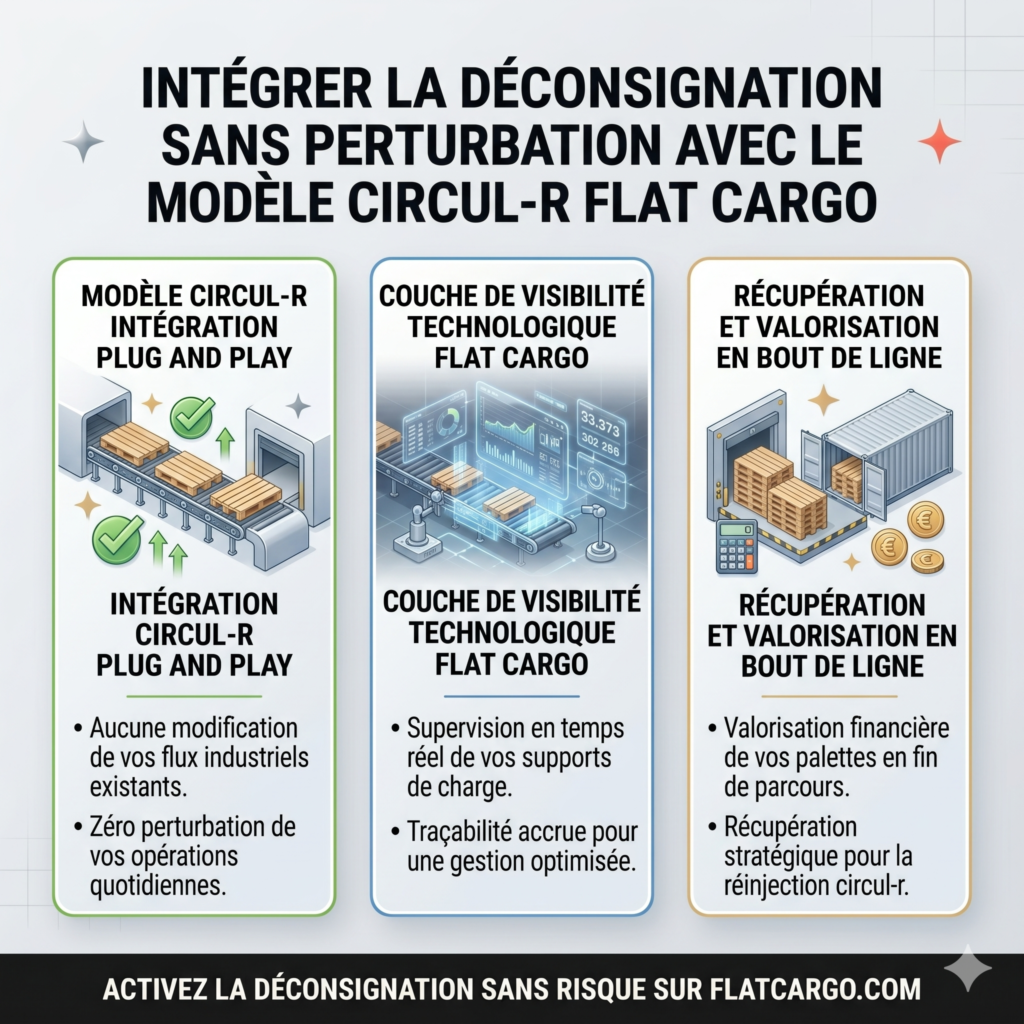
Are pallet return programs compatible with existing supply flows?Yes. The Circul-R model is designed for plug-and-play integration. We do not alter your industrial workflows; instead, we overlay a layer of technological visibility that allows you to recover and extract value from your load carriers at the end of the line, without disrupting your daily operations.
How do you finance the transition to outsourced fleet management?Transitioning to an OPEX model immediately frees up cash flow tied to the procurement of new carriers (CAPEX). This working capital (WCR) improvement structurally funds the transition. Unlike a traditional capital expenditure, our service is a deductible operational expense that self-funds through the systematic reduction of your overall TCO.
What is the true impact of the PPWR regulation on logistics costs?The PPWR regulation mandates strict traceability and binding reuse quotas. For companies remaining on a linear purchasing model, costs will now include environmental taxes, non-compliance penalties, and the straight loss of value from abandoned assets. Proactive planning via a fleet audit is the single lever to transform this risk into a competitive advantage.