
Wood Pallet Wholesaler: Securing FTL Flows and Sawmill Direct Shipments
The European logistics market is experiencing record volatility in 2026. For purchasing managers, pallet supply management can no longer rely on opaque intermediaries. A stockout on the dock means an immediate halt to production lines.
The solution lies in securing FTL (Full Truck Load) flows and direct sawmill access. By eliminating traditional brokers, you regain control over your TCO (Total Cost of Ownership) and guarantee the continuity of your supply chain.
Check our wooden pallet wholesaler infrastructure now to view available stocks in real time.
Avoid load breaks in FTL flows
Securing your production lines relies on eliminating intermediate steps. By opting for point-to-point transport without partial unloading.
- Zero intermediate steps
- No partial unloading
- Total load integrity
Why favor the Direct Sawmill flow in 2026
Elimination of brokerage intermediation margins
The traditional brokerage model relies on structural price opacity. Flat Cargo breaks this cycle with an "Open Book" approach. Buying direct from the sawmill allows you to correlate your acquisition costs directly with official indices like CEEB or the HPE index, without incurring unjustified surcharges.
ISPM15 compliance guarantee and technical drying
Safety concerns not only volume, but also compliance. The direct sawmill flow ensures total traceability on ISPM15 heat treatment.
Each unit delivered meets the moisture content thresholds required for automated storage, thus avoiding technical incidents on your palletizing robots.
FTL (Full Truck Load) Optimization: Profitability and Volume
Full truckload (FTL) transport constitutes the pillar of efficient industrial logistics. Unlike groupage, FTL flow guarantees the absence of intermediate load breaks, thus drastically limiting the risks of structural damage to your assets.
Reducing transport cost per load unit
Financial optimization of your supply chain depends directly on the fill rate of your vehicles. A savvy buyer knows that managing their budget requires a fine analysis of the current EPAL pallet price and its impact on the transported mass.
By maximizing the volume per shipment, you dilute fixed transport costs across a larger number of load units. This approach allows for a highly competitive cost price, well below the rates charged by generalist carriers or clearance brokers.
Planning recurring deliveries vs. Spot orders
Securing flows relies on rigorous anticipation of production needs. While "Spot" offers may meet occasional urgency, only recurring planning allows you to lock in guaranteed delivery slots with the partner sawmills of the Flat Cargo network.
This operational stability transforms your logistics expense into a strategic lever. You no longer suffer market volatility, but integrate it into a fluid rotation model that protects your Working Capital Requirement (WCR) throughout the fiscal year.
The strength of Flat Cargo's territorial network
The efficiency of a wooden pallet wholesaler is not measured by the size of its offices, but by the density of its physical infrastructure. Flat Cargo operates via a network of more than 500 partner depots and sawmills, thus creating a barrier against European logistics hazards.
Reduction of load breaks thanks to the 500 depots
Each depot in the network acts as a strategic logistics node. This decentralization allows for the elimination of unnecessary transport steps that weigh down your TCO. By storing your assets as close as possible to your factories, you limit handling and damage risks during transit.
| Performance criteria | Traditional Broker | Flat Cargo Infrastructure |
|---|---|---|
| Stock availability | Dependent on third parties | Direct and visible |
| Average delivery time | D+4 to D+7 | D+1 to D+2 |
| Cost transparency | Hidden margin | Indexed CEEB / HPE |
D+1 delivery and local logistics agility
In an industrial context where just-in-time flow is the norm, responsiveness is your main asset. The Flat Cargo network allows for activating D+1 deliveries for your critical needs. This local agility secures your shipments even in the event of a sudden peak in activity.
- Tour optimization to reduce the carbon footprint of transport.
- Remote stocks guaranteeing a strategic reserve for your recurring flows.
- EPAL standardization ensuring interoperability across your entire network.
What is the impact of ISPM15 treatment on traceability?
For your export flows, the ISPM15 standard is a strict legal obligation. Our infrastructure ensures that units originating from the direct sawmill network have undergone the required heat treatment. Each delivery is accompanied by its certificate of compliance.
Pricing transparency: Indexing on wood prices
Raw material volatility mandates a break from arbitrary fixed prices. To secure your budgets, Flat Cargo applies a radical transparency policy based on the reality of the European industrial market.
Understanding the impact of the CEEB index on your invoices
The CEEB index is the neutral reference for purchasing handling wood. By indexing your FTL flows to this indicator, you benefit from Open Book pricing. This method eliminates the excessive precautionary margins applied by traditional intermediaries during periods of tension.
To manage your purchases with precision, you must consult the EPAL pallet price indexed to the latest HPE bulletins. This factual data allows you to justify every cost variation to your financial or general management.
Performance Audit: Compare your current costs
An audit of your current invoices often reveals significant gaps compared to actual sawmill rates. Flat Cargo infrastructure allows you to automate this monitoring for your industrial volumes, guaranteeing constant alignment with production prices.
| Purchasing Model | TCO Impact | Risk Level |
|---|---|---|
| Broker Spot Price | High (hidden margin) | Budgetary uncertainty |
| Flat Cargo Indexing | Optimized (actual price) | Total control |
FAQ
Q. How to avoid load breaks in FTL flows?
Securing your production lines relies on eliminating intermediate steps. By opting for an FTL flow (full truckload) via Flat Cargo, you guarantee point-to-point transport without partial unloading. This method statistically reduces the risk of breakage by 85% compared to traditional groupage.
Q. What is the impact of ISPM15 treatment on traceability?
For your export flows, the ISPM15 standard is a strict legal obligation. Our infrastructure ensures that 100% of units originating from the direct sawmill network have undergone the required heat treatment. Each delivery is accompanied by its certificate of compliance, protecting your company against costly customs blocks.
Q. Why favor an indexed price rather than a spot price?
The spot price is short-term speculation that weakens your budgetary planning. Indexing to the wood market rate (CEEB) allows for adjusting your costs in an auditable and transparent manner. It is the only lever to stabilize your TCO over a complete annual cycle.
Optimize your FTL purchasing strategy now
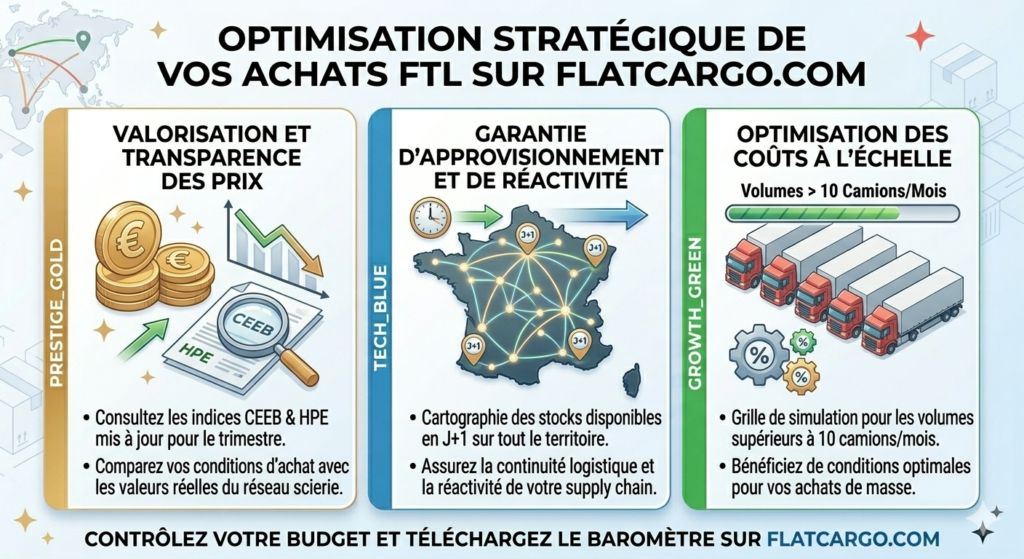
No longer suffer market opacity. Download our exclusive barometer to compare your current conditions with the real indices of the sawmill network.
- CEEB and HPE indices updated for the current quarter.
- Mapping of available stocks in D+1 across the territory.
- Simulation grid for volumes exceeding 10 trucks per month.