
Wood Pallet Treatment and Logistics Performance Optimization
Combining mechanical strength with phytosanitary compliance
Turning wooden pallets into reliable logistics assets
Flat Cargo evaluates wooden pallet specifications, treatment requirements, and export constraints to help you select a suitable solution for your logistics operations. By aligning pallet treatment with your destinations and handling conditions, you can improve packaging reliability and reduce potential compliance issues when shipping internationally.
Advantages of custom pallets for increased agility
Structural customization for demanding logistics applications
Selecting the right wood and protective treatment
International regulations and sanitary compliance
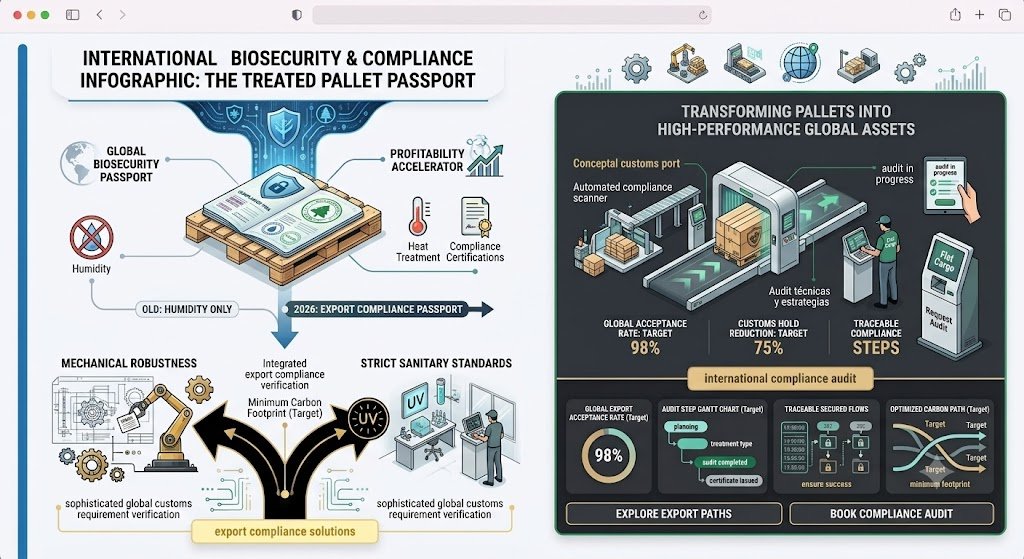
ISPM 15 and heat treatment for export
Supporting international customs compliance
Heat treatment, commonly identified as HT under ISPM 15, involves heating wood packaging material according to the standard's prescribed requirements. The treatment is intended to eliminate specified pests associated with the wood rather than simply protect the pallet from environmental conditions. For international shipments, Flat Cargo can help ensure that wooden supports are prepared according to the applicable export requirements and correctly marked where required. This helps reduce the risk of phytosanitary compliance issues during international transport.
Flat Cargo performance and sustainability audit
| Performance Indicator | Standard Untreated Wooden Pallet | Flat Cargo 2026 Optimized Pallet |
|---|---|---|
| Export Compliance | High risk of customs blockage | Complete ISPM 15 Certification |
| Lifespan (Rotations) | 5 to 8 cycles (fragile) | More than 15 cycles (HT treatment) |
| Sanitary Impact | Potential for mold and pests | Zero biological risk |
Sustainable management and recycling in the modern supply chain
Circular economy and energy recovery of your supports
Transforming your used supports into strategic resources
For your current flows, Flat Cargo deploys high-performance recovery and refurbishment programs. A wooden pallet that has undergone quality HT treatment can be repaired several times before being recycled into biomass or particle board. In 2026, this circular management reduces your demand for virgin wood and improves your Scope 3 carbon footprint. You thus transform potential waste into a true energy or industrial resource for your current shipments. Optimize your lifecycle with our planned sustainability audit.
FAQ on the treatment and optimization of wooden supports
How to verify that a pallet has undergone HT treatment?
Each compliant support must bear the ISPM 15 marking indelibly, including the country code, producer code, and HT symbol. For your current shipments, Flat Cargo also provides dematerialized treatment certificates accessible via RFID chips or QR codes. This ensures total traceability for you in current logistics.
Does heat treatment affect mechanical strength?
Quite the opposite. By eliminating excessive humidity and pathogens, HT treatment stabilizes the wood durably and reduces your risk of structural deformation. For your current flows of heavy loads, it is an additional guarantee of safety during forklift handling in 2026. Access our stabilized supports.
Conclusion on securing your global shipments
The optimization and treatment of wooden pallets in logistics are the pillars of a resilient and responsible supply chain in 2026. By combining the precision of your custom designs, the rigor of the ISPM 15 standard, and your commitment to the circular economy, you secure your current flows in all global markets.
With Flat Cargo, transform your regulatory constraints into a true strategic advantage. By protecting your current shipments and rationalizing your packaging costs, you guarantee your company's success in an increasingly demanding and sustainable current logistics environment.
Secure your international logistics for the 2026 horizon
Opt for treated, ISPM 15 certified wooden pallets optimized for your flows.