
Used Pallet Price Index and Purchasing Guide for Q2 2026
In a context of strong pressure on operational costs, the purchase of used pallets stands out as the most effective budgetary rationalization lever for Procurement departments. Far from being a fallback solution, the reconditioned carrier offers a robust industrial alternative, allowing for a drastic reduction in cost per rotation without compromising flow security.
Flat Cargo provides its quarterly analysis here to help you arbitrate between new and used [pallets] based on the current evolution of the European market.
Stock de proximité : neutralisez le coût transport.
Le transport représente souvent plus de 20% du prix final. Flat Cargo s'appuie sur un maillage territorial dense pour vous livrer depuis le dépôt le plus proche de votre usine.
Adoptez une approche hybride : l'occasion pour vos circuits internes et le neuf pour l'export. C'est le pilier d'une performance budgétaire qui valorise aussi votre bilan RSE.
Used wooden pallet prices and European market trends
The second-hand market in the second quarter of 2026 benefits from a relative stabilization of volumes in circulation. After a period of volatility linked to tensions on new sawn timber, the price of used wooden pallets is returning to an attractive competitiveness zone, showing an average gap of 35% to 45% compared to supports fresh from the sawmill.
Several major factors support this favorable trend for your purchases.
- Fluidity of returns Better organization of reverse logistics at distributors allows for the reinjection of significant volumes of EPAL pallets into the reconditioning circuit.
- Decarbonization demand Key accounts now favor reuse to improve their CSR indicators, which maintains high liquidity in the second-hand market.
- Tension on new supplies Slight increases in the CEEB index are pushing agile buyers to switch massively to premium grades of second-hand pallets to secure their margins.
Grade A used European pallet: why choose it for your automated lines
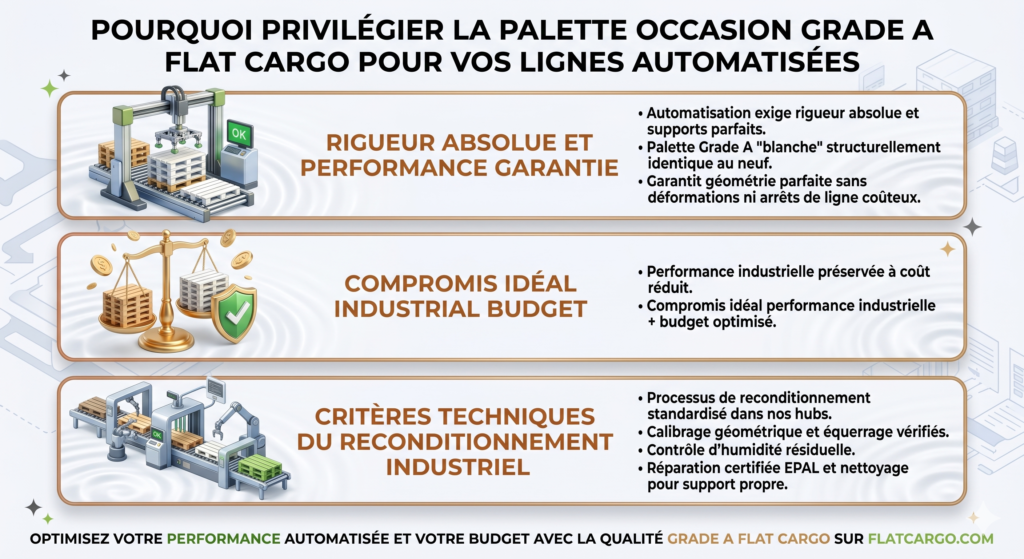
The growing automation of distribution centers imposes absolute rigor on carrier quality. A Grade A used European pallet, also known as a "used white pallet", is a carrier that has completed only a few rotations. Its structural integrity is identical to that of a new one, but its cost is significantly lower.
For your stacker cranes and palletizing robots, choosing Grade A guarantees perfect geometry and the absence of deformations that could cause costly line stoppages. It is the ideal compromise between industrial performance and budget optimization.
Wooden pallet reconditioning and technical criteria at Flat Cargo
The secret to our reliability lies in a standardized industrial wooden pallet reconditioning process within our hubs. Each incoming unit undergoes a rigorous audit before being re-injected into the market.
- Geometric calibration Verification of squareness and block alignment to ensure smooth insertion into forklift forks and conveyors.
- Moisture control Measurement of residual moisture content to prevent any risk of mold during prolonged storage in dry environments.
- Certified repair Systematic replacement of damaged elements with components compliant with EPAL standards, ensuring the maintenance of dynamic load capacity.
- Cleaning and appearance Elimination of debris and residual markings to offer a clean carrier, compatible with the requirements of the cosmetics or agri-food sectors.
Used pallet purchase and cost comparison versus new
For a finance department, the face price is only a partial indicator. The true metric is the Total Cost of Ownership (TCO). By opting for the purchase of premium used pallets, you reduce your initial investment while maintaining a product lifespan almost equivalent to new ones.
| Quality Standard | Savings vs New | Automated Reliability |
|---|---|---|
| New European Pallet | 0% (Reference) | 100% |
| Grade A Used (White) | -30% to -40% | 98% |
| Grade B Used (Mixed) | -50% to -60% | 75% (Manual use) |
Note: Savings percentages are based on averages observed in the second quarter of 2026 on the Flat Cargo network.
Used pallet supplier: finding a reliable local stock
Transport costs often represent more than 20% of the final price of a batch of wooden carriers. Choosing a used pallet supplier with a dense territorial network is the only method to neutralize the impact of fuel prices on your invoices.
Flat Cargo relies on its partner hubs to deliver to you from the depot closest to your factory, thus guaranteeing maximum responsiveness and a reduced carbon footprint.
Circular purchasing economy and impact on your budgetary performance
Integrating used items into your flows is not just a question of financial survival. It is the pillar of a circular purchasing economy that enhances your CSR report. By reusing an industrial asset that has already been produced, you avoid the CO2 emissions linked to processing new wood while preserving your cash flow.
This hybrid approach (New for export, Used for internal circuits) optimizes every euro spent while meeting the growing requirements of non-financial auditors regarding resource management.
Volumes and availability outlook for the end of the season
Anticipation is the only effective protection against the volatility of second-hand stocks. For the end of the second quarter of 2026, we foresee a tightening of volumes for Grade A due to increased industrial demand for summer stock preparation.
Our strategic advice is to secure your supplies now via scheduled volume contracts. This allows you to lock in your used wooden pallet price and avoid service interruptions during peak seasonal activity. Don't suffer the market, lock in your rotations.
Absolute rigor for your automated lines.
The automation of distribution centers imposes absolute rigor on the quality of carriers. The Grade A used Europe pallet (or "white pallet") has completed only a few rotations: its structural integrity is identical to a new one for a significantly lower cost.
Performance
Perfect geometry guaranteeing the absence of deformations for robots and stacker cranes.
Optimization
The ideal compromise between industrial requirements and controlling your annual budget.
STANDARDIZED RECONDITIONING AUDIT
Used Pallet Price Q2 2026 and Strategic Barometer
Verify if your current supplier respects real market indices.
Access our quarterly analysis of wood prices and optimize your TCO thanks to our exclusive sawmill data.
- Comparison of CEEB indices vs Flat Cargo Spot Prices
- Analysis of available volumes by region
- Supply forecasts for the coming semester
*Document reserved for supply chain professionals. Data updated Q2 2026.
FAQ
Q. What is the major difference between a Grade A and Grade B pallet
The distinction is mainly based on aesthetics and usage history. A Grade A used pallet is almost new (called "white"), without major chips, ideal for automated lines. Grade B features grayer wood and more marked signs of wear, while retaining intact load capacity, making it perfect for static storage or manual transport.
Q. Are used pallets compatible with automated warehouses
Only Grade A is recommended for use on conveyors and stacker cranes. At Flat Cargo, every partner used pallet supplier follows a strict sorting charter ensuring that the dimensions and squareness of Grade A supports meet the tolerances necessary for the proper functioning of sensors and automatic guidance systems.
Q. How to ensure the solidity of a reconditioned wooden pallet
Solidity is guaranteed by compliance with EPAL standards during the repair process. A pallet reconditioned by our hubs undergoes replacement of broken elements (blocks, bottom boards, or deck boards) with certified parts. This ensures that the dynamic load capacity remains identical to that of a new product, thus offering total safety for your operators.
Q. Are there any health risks with purchasing used pallets
For sensitive sectors like agri-food or cosmetics, we recommend supports that have undergone ISPM15 heat treatment. Our selection processes systematically exclude pallets showing traces of contamination or mold. Human inspection during sorting is the first line of defense to guarantee the cleanliness of your logistics flows.