
Used Euro Pallets and Logistics Cost Optimization
Adopting used Euro pallets has now become a major management decision for companies looking to balance immediate profitability with environmental responsibility. In current logistics, where operating margins are under constant pressure, the load carrier should no longer be viewed as a simple variable cost, but as a lever to optimize working capital. Choosing reconditioning means choosing efficiency without sacrificing the standardization essential for transport network interoperability.
Far from the image of a degraded product, certified used Euro pallets offer structural performance identical to new ones at a fraction of the cost. Flat Cargo analyzes how integrating these reconditioned carriers transforms the cost structure of your current shipments.
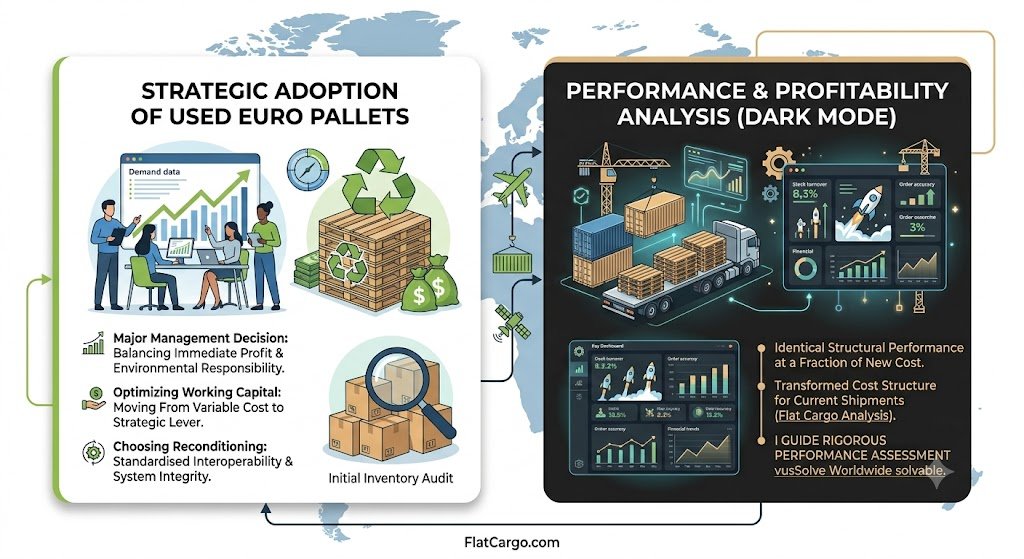
Economic advantages of integrating reconditioned load carriers
Immediate reduction in equipment acquisition expenses
A competitive price differential
The most direct impact of used Euro pallets is on the purchase price, which is generally 30% to 50% lower compared to new units. For a fleet manager handling thousands of rotations, this economy of scale amounts to tens of thousands of euros in the very first year. This lower unit cost makes it easier to absorb the inevitable losses associated with exchanges on unloading docks. In your current flows, this lower entry cost mechanically improves your logistics profitability threshold without compromising the safety of your load units.
Impact on the overall supply chain budget
Quality and compliance of Euro pallets in the circular economy
Compliance with the EPAL standard to secure your flows
Carrier classification based on actual condition
| Usage category | Visual and structural condition | Recommended application |
|---|---|---|
| New Euro Pallet | White wood, no marks of use | Sterile zones, premium export |
| Grade A (Light used) | Light wood, few handling marks | Retail, visible storage |
| Grade B (Dark used) | Greyish wood, repaired impact marks | Heavy industry, closed loops |
Environmental impact and CSR commitments of current flows
Massive carbon footprint reduction through reconditioning
Natural resource preservation and the circular economy
Did you know?
An EPAL Euro pallet can be repaired on average 5 to 7 times before reaching the end of its technical life, making it one of the most durable logistics assets on the global market in 2026.
Operational management and maintenance of used pallet fleets
Inspection and sorting protocols for operational safety
Corrective maintenance and compliance with repair standards
Repairing a used Euro pallet is not a simple DIY task; it must comply with the strict guidelines of the European Pallet Association (EPAL). The use of certified nails and the replacement of boards with elements of identical dimensions are imperative to retain the certification marking.
At Flat Cargo, reconditioning is carried out by qualified technicians who restore the carrier's original mechanical strength. In your current shipments, this maintenance rigor allows you to reintroduce "like-new" pallets into your logistics loop, maximizing your fleet's efficiency without reinvesting in brand-new equipment.
| Management action | Recommended frequency | Performance indicator |
|---|---|---|
| Visual inspection and sorting | At each return rotation | Fleet availability rate |
| Structural repair | Upon detection of an anomaly | Maintenance cost per carrier |
| End-of-life repurposing | If repair is impossible | Material recycling rate |
FAQ on the purchase and reliability of reconditioned pallets
Standard dimensions and interoperability of used Euro pallets
The used Euro pallets strictly comply with the universal dimensions of 1200 x 800 mm. This absolute standardization guarantees complete compatibility with all modern material handling equipment — forklifts, pallet jacks, and automated conveyors — used in current logistics. By integrating these carriers into your current flows, you eliminate any risk of technical blockage or incompatibility with the high-density storage systems (racks) of your clients or providers.
Selection criteria to guarantee the safety of current shipments
Choosing a used pallet must not come at the expense of safety. For your current shipments, it is essential to check for broken boards, missing blocks, or protruding nails that could damage your products or injure operators. At Flat Cargo, each reconditioned unit undergoes a rigorous quality audit. We also ensure the absence of mold or chemical contamination, thereby guaranteeing impeccable transport hygiene, which is particularly critical for the retail and manufacturing sectors.
Conclusion on logistics optimization through reconditioning
Opting for used Euro pallets represents a winning strategy on all supply chain fronts in 2026. By combining a drastic reduction in acquisition costs with a positive environmental impact, this solution allows businesses to gain budget agility while asserting their leadership in CSR.
The legendary robustness of the EPAL standard, coupled with professional maintenance, makes certified used options the most rational load carrier to manage your current flows. Flat Cargo supports you in this transition toward a more circular, safer, and economically efficient logistics.
Optimize your logistics budget today
Access our stock of certified used Euro pallets and sustainably reduce your operational costs.