
Logistics Asset Matrix: Types of Wooden Pallets and 2026 Standards
Types of Wooden Pallets play a fundamental role in high-precision industrial logistics, where choosing the right load support is no longer a simple operational decision but a strategic factor in cost control and supply chain efficiency. These different pallet formats form the backbone of global logistics flows, ensuring goods protection, storage unit stability, and transport network interoperability.
🤖 Robotic machining and precision
The production process relies on automated nailing lines and CNC machining centers. This technology imposes strict geometric tolerances, essential for smooth flow on automatic conveyors or high-density storage systems. By validating your specifications with our technical design office, you ensure invariant machining quality.
📦 Lean flows and Buffer stock
Supply management should not weigh on your working capital. Flat Cargo deploys buffer stock strategies and Just-in-Time (JIT) deliveries to absorb demand spikes. This resilience guarantees price stability. Budget steering is facilitated by consulting our market price barometer and quotes.
| Performance Criteria | Craft Approach | Flat Cargo Industrialization |
|---|---|---|
| Execution speed | Limited by labor | High output (Automated lines) |
| Repeatability | Variable (Human error) | Absolute (Laser / CNC control) |
| Traceability | Manual or non-existent | Inkjet marking / RFID optional |
| Volume Management | Small batches only | FTL capacity (Multi-site) |
Industrial performance is built on trust. Delegating the management of your specific supports to an expert capable of aligning their production with your schedules allows you to free up internal resources. It is recommended to request a technical audit to evaluate the productivity gains linked to a standardization of your formats.
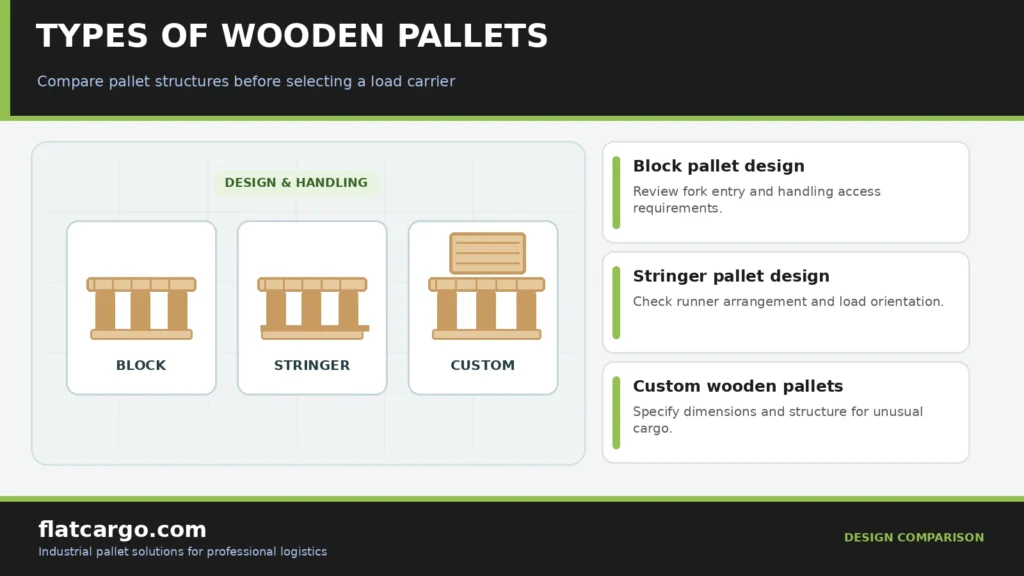
Technical classification by load capacity and industrial use
The performance of a load unit rests on a fundamental triptych: the nature of the wood species, the top deck configuration, and the assembly type (blocks or runners). In an industrial context, confusion between different types of wood pallets can lead to critical load failures or workplace accidents. It is paramount to distinguish three types of mechanical resistance for each asset.
Resistance of a pallet placed on the ground, serving as a base for floor stacking.
Constraint endured during handling by forklift, including acceleration forces.
The most demanding: the pallet rests only on two lateral supports at height.
Types of Wooden Pallets for Industrial Transport and Storage
Understanding the different types of wooden pallets is essential for manufacturers, warehouse operators and logistics companies seeking reliable load carriers adapted to their operational requirements. The main categories include EUR/EPAL pallets, widely used for standardized European transport, industrial wooden pallets designed for larger or heavier loads, CP pallets developed for chemical industry applications, and lightweight disposable pallets commonly selected for one-way shipments. Wooden pallets can also be classified according to their construction, particularly two-way entry stringer pallets and four-way entry block pallets, which offer different handling possibilities. For professional procurement, choosing between new, used and reconditioned wooden pallets requires evaluating load capacity, dimensions, material condition, durability and compatibility with warehouse equipment. Flat Cargo supports industrial buyers in identifying suitable pallet configurations for recurring shipments, high-volume storage and specialized handling operations. Selecting the appropriate pallet type helps improve transport efficiency, control purchasing costs and reduce the risk of damage throughout the supply chain.
| Wood Pallet Type | Recommended Usage | Rack Capacity (kg) | Wood Species Used |
|---|---|---|---|
| EPAL-type pallet | Standard European logistics, pooling | 1500 kg (Standard) | Softwood (Pine, Spruce) |
| 2-way entry pallet (Runners) | Heavy loads, heavy industry | 2000 kg+ | Hardwood (Oak, Beech) |
| Disposable pallet (Lightweight) | Direct export, single use | Not recommended | Poplar, light softwood |
Accessibility: 4-way entry (blocks)
The 4-way entry architecture offers total accessibility for forks, facilitating lateral truck loading and fluid intralogistics.
Rigidity: 2-way entry (runners)
Preferred for its superior rigidity when transporting machinery or massive industrial components. Our design office creates custom solutions adapted to your needs.
The choice of wood species directly impacts the friction coefficient and durability. While softwoods are optimal for the EPAL standard, using hardwood is imperative for intensive rotation cycles in humid environments.
Dimensional standards: EUR 1200x800 and FTL logistics formats
In modern logistics, dimensional standardization is the cornerstone of global interoperability. Choosing the size of wood pallets does not depend solely on the product's morphology, but also on the configuration of transport (trucks, containers) and storage infrastructures. An error of a few millimeters can reduce a vehicle's fill rate by 15%. Optimization through a packaging audit makes it possible to maximize the loading plan and reduce your carbon footprint per ton transported.
Euro (800x1200 mm): The European Unit
The Euro pallet (EPAL) is optimized to fit perfectly into standard trailers. In full truckload (FTL) transport, a 13.6-meter semi-trailer holds exactly 33 pallets on the floor. To anticipate costs for this standard, you can consult our pallet price barometer.
1200x1000 mm Format: Industry & Chemicals
The industrial format offers 25% more surface area than the Euro. It is the reference standard for CP-type chemical pallets (CP1, CP3, CP6, CP9), specifically designed for heavy industry, available via our expert catalog.
| Pallet Format | Dimensions (mm) | Truck Capacity (FTL) | Typical Usage |
|---|---|---|---|
| Euro / EPAL | 1200 x 800 | 33 on floor | Retail, Mass distribution |
| Industrial Standard | 1200 x 1000 | 26 on floor | Heavy Industry, Chemicals |
| Half-pallet | 800 x 600 | 66 on floor | POS display, Urban deliveries |
| Quarter-pallet | 600 x 400 | 132 on floor | In-store presentation |
VNA compatibility and automated warehouses
The rise of Very Narrow Aisle (VNA) warehouses and automated systems requires total compliance. An out-of-spec or sagging pallet can block an automated storage and retrieval system (AS/RS). At Flat Cargo, we ensure that every asset meets EPAL-certified dimensional tolerance requirements, guaranteeing total fluidity in your intralogistics.
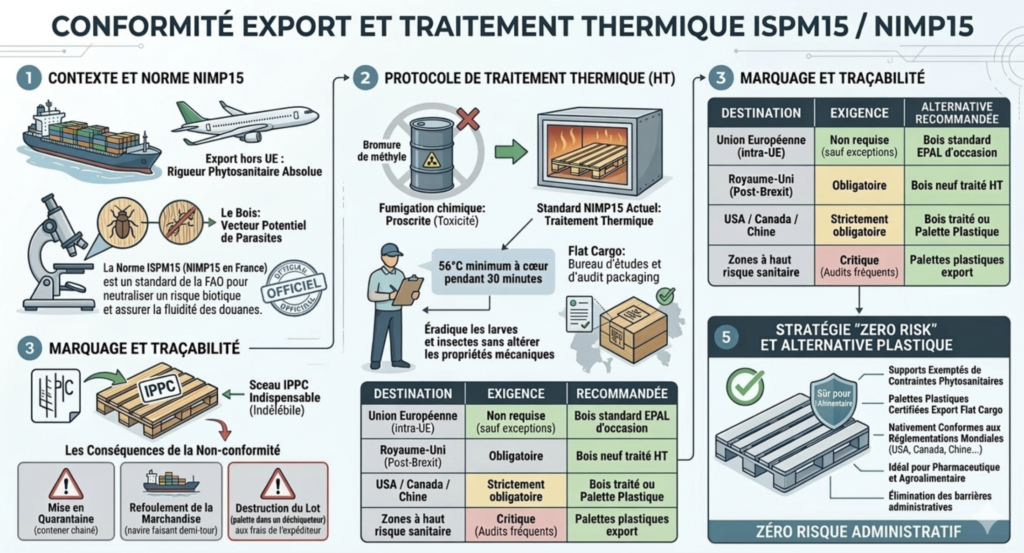
Export compliance and ISPM15 heat treatment
Exporting goods outside the European Union requires absolute rigor regarding the phytosanitary nature of load supports. Wood, as an organic and porous material, is a potential vector for parasites. To neutralize this biotic risk, the international standard ISPM15 (or NIMP15) was established. Any wood pallet treated according to this standard ensures the fluidity of your customs clearance.
Types of Wooden Pallets and Their Export Compliance Requirements
Understanding the different types of wooden pallets is essential for manufacturers, exporters and logistics operators seeking reliable transport solutions for international shipments. The main categories include EUR/EPAL pallets for standardized European distribution, industrial wooden pallets for heavy or oversized goods, CP pallets for chemical industry applications, and lightweight wooden pallets commonly used for one-way exports. Their construction also varies between two-way entry stringer pallets and four-way entry block pallets, depending on handling requirements. When these pallets are manufactured from solid wood, procurement teams must verify whether the destination country requires ISPM15-compliant heat treatment and valid IPPC markings. This verification applies to both new and used pallets, while certain processed wood materials, such as plywood, may qualify for exemptions under the standard. Selecting the appropriate pallet type helps businesses optimize transport capacity, control packaging costs and reduce the risk of customs delays caused by non-compliant wooden packaging.
The heat treatment protocol (HT)
Unlike former chemical processes that are now prohibited, the current ISPM15 standard is based on heat treatment. The wood must be heated to the core at a constant temperature of at least 56°C for at least 30 consecutive minutes. This process eradicates pests without altering the asset's mechanical properties. Our design and packaging audit office systematically verifies the validity of your fleet's markings to prevent any international dispute.
Marking and traceability: Avoiding customs blocks
A compliant pallet must mandatorily bear the indelible IPPC marking. The absence of this seal can lead to immediate sanctions: quarantine, rejection of the goods, or destruction of the batch at your expense. To secure your cross-border flows, you can rely on our network map of certified depots to source compliant assets as close as possible to your consolidation centers.
| Destination / Zone | ISPM15 Requirement | Recommended Alternative |
|---|---|---|
| European Union (Intra-flow) | Not required | Standard EPAL wood, used |
| United Kingdom (Post-Brexit) | Mandatory | New HT treated wood |
| USA / Canada / China | Strictly mandatory | Treated wood or Plastic Pallet |
| High sanitary risk zones | Critical (Frequent audits) | Export plastic pallets |
For your most demanding destinations or sensitive products (pharmaceuticals, agri-food), switching to plastic supports is a "Zero Risk" strategy. Our export-certified pallets require no heat treatment and eliminate all global administrative barriers.
TCO optimization and lifecycle: Multi-rotation vs Single-use
For a financial management team, acquiring a pallet fleet should not be analyzed as an isolated expense (CAPEX), but through the prism of Total Cost of Ownership (TCO). The true profitability of a logistics asset is measured by its capacity to support multiple rotations while retaining residual value at the end of its life.
The hidden cost of a single trip
The "lost" pallet is designed for a single trip. While its face price is attractive for occasional shipments, its cost per rotation is actually 100%. The financial performance gap can reach 40% over a full fiscal year compared to certified assets.
Modeling: Cost per rotation
An EPAL or heavy industrial pallet is designed to perform between 10 and 15 rotations. By integrating our pallet management and consignment program, you dilute the initial investment over an extended lifecycle, thus optimizing your working capital requirements (WCR).
Circul-R Strategy: Cash-back on used assets
Flat Cargo reinjects cash into your Supply Chain through our used pallet buyback and value creation service. This "Cash-back" mechanism allows you to transform your old fleets into credit for purchasing new assets, while improving your CSR balance sheet and environmental compliance.
| Performance Indicator (KPI) | Single-Use Pallet (Lost) | Multi-Rotation Pallet (EPAL/Heavy) |
|---|---|---|
| Initial investment | Low | Moderate to High |
| Average number of rotations | 1 (High breakage risk) | 10 to 25 (depending on maintenance) |
| Buyback value (Cash-back) | Almost zero (Biomass) | High (Reconditioning) |
| TCO impact per rotation | 100% of purchase price | ~15% of purchase price |
Instantly access the best market opportunities for your pallet fleets.
Logistics Buyer's FAQ
Purchasing and industrial management teams regularly ask us about the technical specifications of standard wood pallets. Here are some market insights.