
Asset-Light Focus: Logistics Business Setup: Launching an Asset-Light Hub
The European logistics market is undergoing a structural shift in 2026. Creating a logistics business, based on the acquisition of heavy fleets, is now facing eroding margins and exploding fixed costs.
For the investor, the pivot toward the Asset-Light model allows transforming a passive warehouse into a strategic logistics node. Flat Cargo offers you the technological infrastructure to operate a Hub without the financial risks linked to road transport.
Start a business without owning trucks?
Yes. By adopting a model centered on the logistics Hub. Rather than managing physical transport, you become a strategic distribution node. Flat Cargo manages the technological infrastructure and the flows for you.
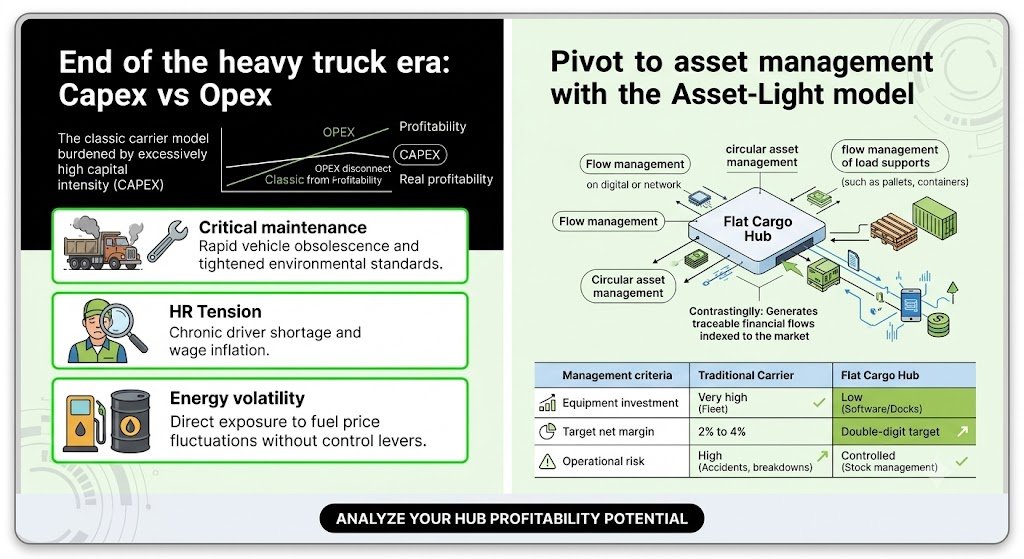
End of the heavy truck era: Capex vs Opex
The classic carrier model is burdened by excessively high capital intensity (CAPEX). The initial investment in a fleet and operating expenses (OPEX) are no longer correlated to the real profitability of the sector.
- Critical maintenance Rapid vehicle obsolescence and tightened environmental standards.
- HR Tension Chronic driver shortage and wage inflation.
- Energy volatility Direct exposure to fuel price fluctuations without control levers.
Pivot to asset management with the Asset-Light model
Operating a Flat Cargo Hub allows you to focus on the flow management of load supports. Unlike the physical transport of goods, circular asset management generates traceable financial flows indexed to the market.
| Management criteria | Traditional Carrier | Flat Cargo Hub |
|---|---|---|
| Equipment investment | Very high (Fleet) | Low (Software/Docks) |
| Target net margin | 2% to 4% | Double-digit target |
| Operational risk | High (Accidents, breakdowns) | Controlled (Stock management) |
The Asset-Light logistics business model to maximize profitability per m²
In a logistics business creation scheme, real estate often represents an under-optimized fixed cost. The Asset-Light model transforms this constraint into a growth lever. Warehouse storage profitability no longer relies solely on long-term physical occupancy, but on the rotation velocity of load supports.
Flat Cargo's operational optimization relies on three fundamental pillars.
- Reverse Logistics Collection and valuation of circular assets to generate immediate revenue via pallet logistics.
- Indexation on real value Unlike transport subject to diesel prices, the Hub relies on the EPAL Pallet Price index to protect its margins.
- Zero rolling stock Elimination of maintenance and insurance costs linked to a truck fleet for a more agile model.
Profitability comparison between traditional carrier and Logistics Hub
The traditional logistics business model is structurally limited by the depreciation of its tangible assets. The table below exposes the financial superiority of a decentralized Hub.
| Financial Indicator | Traditional Carrier | Flat Cargo Hub |
|---|---|---|
| Initial CAPEX | > 150,000 € (Fleet) | ~ 2,500 € |
| Target EBITDA Margin | 3% to 6% (Saturated) | 12% to 18% |
| Break-even point | 18 to 36 months | Less than 6 months |
| Inflation Exposure | Critical (Fuel) | None (Flow management) |
Ready to launch your structure without the constraints of a fleet?
Access the Investor MasterclassWhat is the average return on investment?
By eliminating expenses linked to a truck fleet, the Flat Cargo model optimizes your WCR. The target net profitability is in the double digits from the first year of full operation.
Access the MasterclassTransport and Logistics EBITDA: Profitability analysis of a storage warehouse
The revenue structure: Royalties vs. Volume
The financial performance of a decentralized Hub relies on the duality of its revenue streams. Unlike traditional logistics business creation, where revenue is dependent on equipment usage, the Flat Cargo model generates hybrid income.
- Recurring Revenue (SaaS-like) Storage fees and asset lifecycle management fees. These flows ensure coverage of fixed costs.
- Flow Margin (Transactional) Commission on direct sales volumes and handling fees per rotation.
- Asset Valuation Income from the repair and de-consignment of pallets, damaged or otherwise.
Financial forecasts and ROI: the 12-month plan
The transport and logistics EBITDA for an average Hub stabilizes between the 4th and 6th month of operation. The absence of bank debts linked to a truck fleet allows you to reach a critical break-even point quickly.
| Activity Phase | Operational Objective | EBITDA Impact |
|---|---|---|
| Months 1-3 Startup | Setup of processes. | Operational break-even. |
| Months 4-8 Growth | Activation of national business generation. | Net margin > 10% |
| Months 12+ Cruising | Saturation of m² and flow optimization. | EBITDA 15-18% |
To refine this data based on your geographical area
Profitability simulator for Logistics HubLogistics business leads: The Flat Cargo advantage to fill your warehouse
The Flat Cargo promise: "We fill your fridge"
The main barrier to logistics business creation lies in client acquisition. Flat Cargo reverses this paradigm by injecting its national flows directly into the warehouses of its Network partners. Logistics business leads come from the synergy of the infrastructure's three silos:
- HUB Silo (Supply) : Orders for new and reconditioned pallets placed by national industrial buyers are routed to the nearest local Hub (D+1).
- CIRCUL-R Silo (Asset Management) : De-consignment and reverse logistics contracts signed with major accounts (Vicat, BASF, etc.) guarantee recurring inbound flows.
- Framework Contracts : The network centralizes European negotiations, preventing the local partner from being exposed to the unfair competition of opaque brokers.
The end of cold calling (Avoiding the commercial impostor syndrome)
The entrepreneur who is a member of the network is not a salesperson; they are an operator. Flat Cargo handles the "Closing" phase upfront. This architecture allows maintaining an absolute focus on operational excellence and real estate profitability.
By joining the network, the investor does not just buy a brand; they gain access to a captive market share. To quantify the impact of these flows on your area, access our provisional business lead calculator.
| Volume Source | Flow Type | Frequency |
|---|---|---|
| Marketplace Sales (HUB) | Outbound (Direct sale) | Daily / Spot |
| Fleet Management (CIRCUL-R) | Inbound (Buyback/Valuation) | Weekly / Recurring |
| Network Transfers | Stock optimization | Occasional / Seasonal |
Operational criteria: The minimum infrastructure
To ensure the efficiency of the Network, each logistics node must meet precise physical standards. A profitable logistics investment begins with a strategic location allowing you to fulfill the D+1 delivery promise.
- Land area : Minimum 500 m² of covered storage, with ceiling height adapted for stacking.
- Accessibility : Industrial zone (IZ) with heavy goods vehicle access (functional unloading docks).
- Handling equipment : Compliant forklifts and staff trained in pallet flows.
The entry ticket and investor profile
Logistics business creation via Flat Cargo is accessible to independent logisticians and entrepreneurs with a capacity for rapid deployment. The Asset-Light model reduces the working capital requirement (WCR), but requires financial stability for the initial local stock.
| Investment element | Amount / Criteria | Nature of the cost |
|---|---|---|
| Network entry fee | ~ 2,500 € | CAPEX (One-time) |
| Monthly royalty | ~ 250 € | OPEX (Tech subscription) |
| Profile sought | Builder / Operator | Industrial mindset |
| Exclusivity zone | Defined by sector | Territorial guarantee |
Secure your logistics market share
Launching a Hub without a truck fleet is no longer a hypothesis; it is an operational reality that redefines the sector's EBITDA. By delegating transport management and focusing on the value of assets, you transform your warehouse into a sovereign profit center.
Frequently asked questions about creating a logistics business without a fleet
Q. Is it possible to create a transport company without owning trucks?
Yes. By adopting an Asset-Light model centered on the logistics Hub. Rather than managing physical transport, you become a strategic distribution node. Flat Cargo manages the technological infrastructure and the flows, allowing you to operate without investment in rolling stock (trucks, maintenance, heavy transport licenses).
Q. What is the minimum surface area to open a profitable logistics Hub?
To guarantee a positive EBITDA and absorb national Flat Cargo flows, a minimum surface area of 500 m² of covered storage is required. The location must be situated in an industrial zone with direct access for heavy goods vehicles thanks to optimized warehouse management.
Q. How are business leads generated for network partners?
The logistics business leads are automated via the synergy of Flat Cargo's silos. Pallet orders (HUB Silo) and major account fleet management contracts (CIRCUL-R Silo) are injected directly into the partner's local Hub according to their exclusive geographical zone.
Q. What is the average return on investment (ROI) for a franchisee?
Thanks to a reduced CAPEX (entry ticket at ~€2,500) and the absence of costs linked to a truck fleet, the operational break-even point is generally reached in less than 6 months. The target net profitability is in the double digits from the first year of full operation.