
Standard Plastic Pallets: 2026 Logistics Buying Guide
Sanitary safety and profitability imperative in 2026
Sustainable optimization of your logistics flows
Flat Cargo helps you assess the technical and financial advantages of standard plastic pallets according to your logistics requirements. By investing in assets with consistent dimensions and predictable performance, you can improve fleet management, control logistics costs, and maintain operational efficiency across your shipments in 2026.
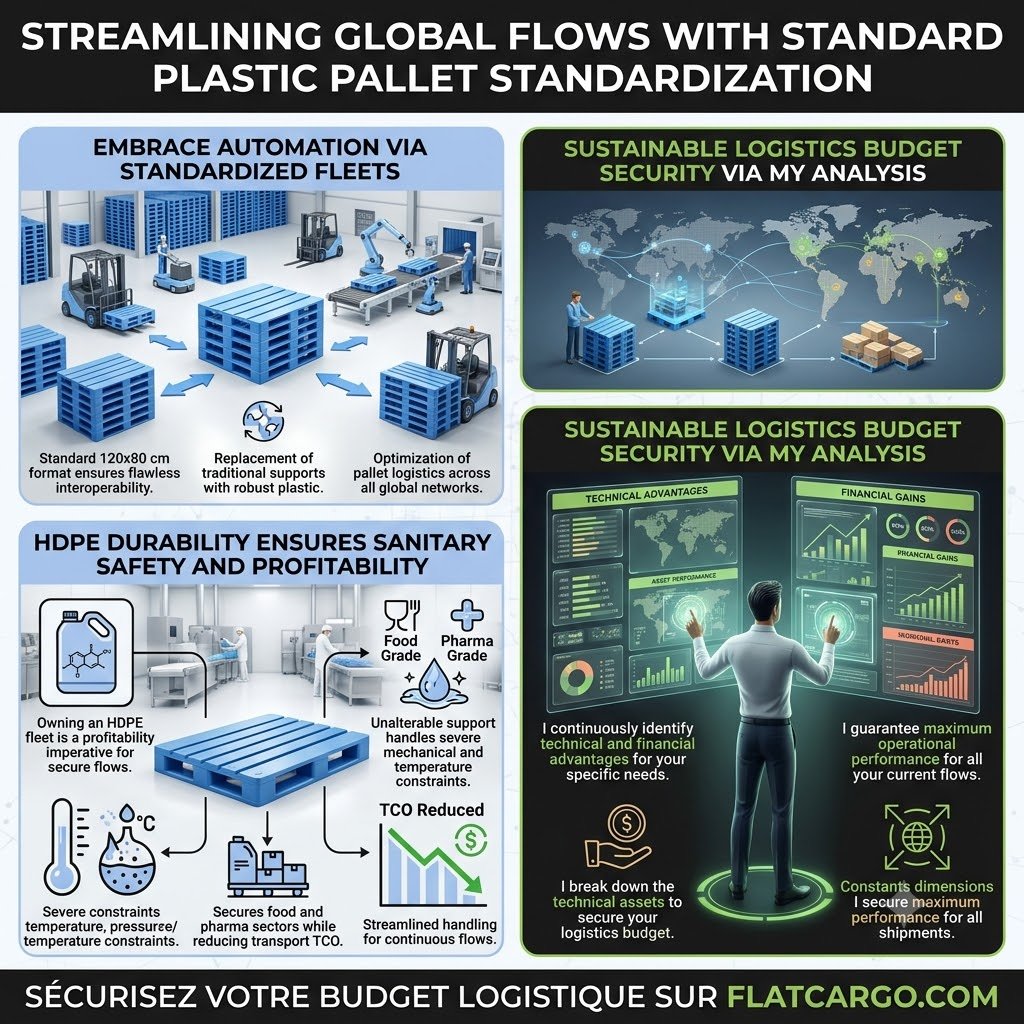
Comparative advantages over traditional wooden solutions
Sanitary compliance and hygiene
ISPM 15 exemption for global export
Administrative efficiency for international shipments
International shipments using solid wood packaging can be subject to ISPM 15 phytosanitary requirements , including treatment and compliance marking. Plastic pallets are exempt from ISPM 15 because the standard applies to qualifying wood packaging materials. For shipments crossing international borders, using plastic can therefore simplify phytosanitary compliance and reduce the administrative steps associated with wooden packaging.
Flat Cargo profitability and performance audit
| Performance Indicator | Conventional Wooden Pallet | Flat Cargo Standard Plastic Pallet |
|---|---|---|
| Estimated longevity | 10 to 15 rotations (fragile) | More than 100 rotations (warp-resistant) |
| Maintenance costs | Frequent repairs (nails, boards) | Zero structural maintenance |
| Operator safety | Splinters and protruding nails | Safe and ergonomic handling |
The strategic audit above demonstrates why investing in a plastic fleet financially outperforms the repeated purchase of wooden pallets for the 2026 horizon. By eliminating maintenance costs and handling risks, you directly optimize your transport TCO. This approach secures your logistics budget by perfecting your pallet logistics for all your current flows.
RFID technology integration for automated tracking
Recycling and carbon footprint reduction
Circular economy and enhancement of your CSR policy
Current logistics demands strong commitments to sustainability. Our standard plastic pallets are made from recycled materials and are fully recyclable. In 2026, Flat Cargo recovers your end-of-life load supports to reinject them into the production cycle. This virtuous loop drastically reduces the carbon footprint of your current flows and secures your logistics budget through the valuation of your used assets.
FAQ on selecting and maintaining plastic pallets
How to repair a damaged plastic pallet
Although very robust, minor cracks can be repaired using hot plastic welding techniques. For your current flows, this extends the support's lifespan without altering its mechanical resistance. In 2026, if the damage is too severe, the pallet is sent to our recycling facility for full recovery of your current shipments, thereby protecting your pallet logistics.
Using a plastic pallet in a cold room
Absolutely. The HDPE polymers used in manufacturing withstand temperatures ranging from -40°C to +70°C. For your current shipments of frozen products, the plastic does not become brittle or freeze, making it essential for the cold chain in current logistics in 2026. This reliability secures your transport TCO and your logistics budget.