
Pallet Reverse Logistics for Smarter Recovery and Returns
Pallet reverse logistics is the process of recovering, inspecting, repairing and redistributing pallets after their initial delivery. For manufacturers, transport operators and distribution centres, an efficient return system can help reduce unnecessary purchases, improve pallet availability and control the cost of reusable load carriers.
Without a structured recovery process, empty pallets may accumulate at customer facilities, disappear from inventory or require expensive return journeys. These inefficiencies increase handling costs and make it harder for supply chain managers to understand the true cost of each pallet rotation.
Flat Cargo supports businesses through a European network of regional logistics partners. By coordinating pallet collection, sorting, repair and local redistribution, companies can improve asset recovery while reducing avoidable transport movements. The most effective approach depends on pallet ownership, collection volumes, transport distances and the condition of returned equipment.
How Pallet Recovery and Redistribution Work
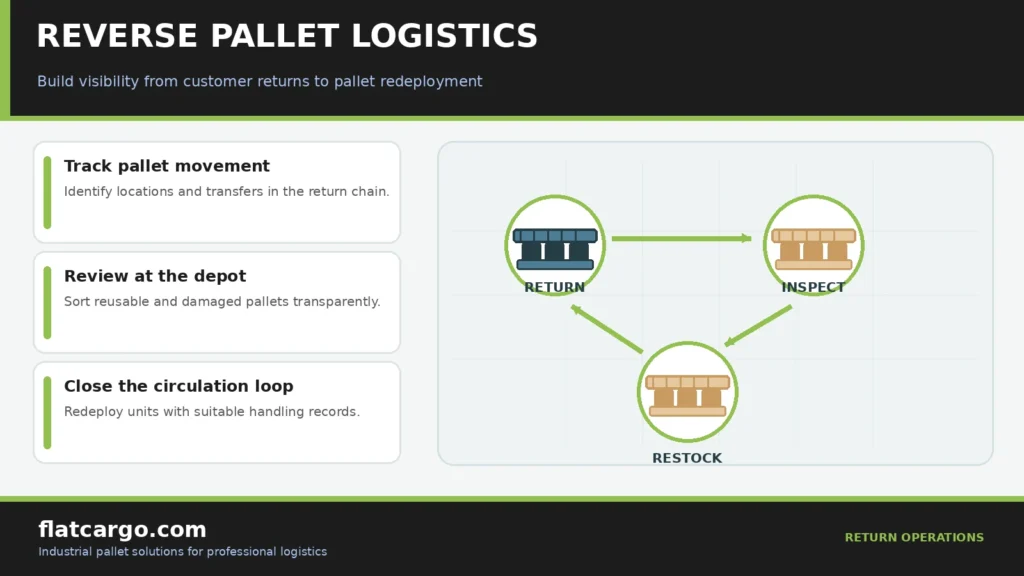
An effective pallet recovery programme begins with identifying the location, quantity and condition of pallets after delivery. Companies then arrange collection, inspect returned units and determine whether they can be reused directly, repaired or sent to an appropriate recovery channel.
Regional collection points can help consolidate return flows and redirect usable pallets towards nearby industrial demand. This reduces the need to send every empty load carrier back to its original dispatch location.
For procurement and supply chain teams, effective returnable pallet management relies on pallet tracking and clear performance indicators, including pallet return rates, recovery costs, average transport distance, repair rates and the cost per completed rotation. These measures help teams assess closed-loop pallet logistics and improve visibility across pallet returns.
Eradicating the "Logistics Black Hole".
The physical disappearance of load carriers during unloading at the retailer is no longer inevitable. By replacing theoretical declarations with rigorous digital exchange recording, we secure your wooden pallet fleet.
ANOMALY DETECTION
Instant identification of discrepancies between shipped volumes and hub returns. Act before the trail goes cold.
EXACT ACCOUNTING VISION
A reliable inventory of your circular assets, a cornerstone for justifying your CSR performance during audits.
END OF DISPUTES
Certified digital proof holds carriers and receivers accountable, ending endless discussions.
Assess Pallet Return Costs Before Estimating Savings
Local collection can reduce unnecessary transport distances when a suitable recovery hub is available. However, financial savings depend on actual routes, pallet quantities, handling fees and transport conditions. Businesses should compare these operational variables before estimating the benefits of a regional recovery model.

Regional Collection for Pallet Return Logistics
Regional collection points can help consolidate return flows and redirect usable pallets towards nearby industrial demand. Pallet recovery outcomes depend on network coverage, actual routes, pallet quantities, handling fees and transport conditions.
How Reverse Pallet Logistics Can Work
An effective pallet reverse logistics programme coordinates collection schedules, inspection, sorting, repair and local redistribution. Supply chain teams can use pallet tracking to monitor return rates, recovery costs, transport distances, repair rates and the cost per completed rotation.
How Local Collection Can Shape Pallet Return Flows
Regional collection can help consolidate pallet returns near delivery points when a suitable hub is available. The effect on empty journeys and operating costs depends on route design, pallet quantities, handling requirements and transport conditions.
Pallet return cost review
Compare the variables in your recovery model
Review actual routes, pallet quantities, handling fees and transport conditions before estimating savings from regional collection.
Securing Return Management to Eradicate Asset Loss
The physical disappearance of load carriers is a fatality that companies no longer have to endure. The logistics "black hole", which often occurs at the time of unloading at the distributor, is eliminated by rigorous digitalization of exchanges. To secure your wooden pallet fleet, we replace theoretical declarations with transactional traceability.
Each movement of carriers between your factory, the end client, and our hub network is recorded in real-time. This method provides three immediate benefits.
- Anomaly identification The system instantly detects discrepancies between shipped volumes and hub returns, allowing for action before the trail is lost.
- Exact accounting vision You have a reliable inventory of your circular assets, essential for justifying your CSR performance during audits.
- End of disputes Certified digital proof holds every actor (carrier, receiver) accountable and puts an end to endless discussions about the number of wooden pallets actually returned.
How to Evaluate a Closed-Loop Pallet Management Model
In a closed-loop model, businesses retain ownership of their pallets and coordinate recovery, repair and redistribution. Pooling provides access to shared pallets, while asset control and operating costs depend on the contract and service model.
Compare the options using purchase or rental fees, pallet quantities, completed rotations, repair and handling costs, loss rates and network coverage.
- Cost per rotation Calculate it from purchase price, repairs, handling and the actual number of completed uses.
- Pallet availability Review return rates, pallet condition, stock locations and local demand before relying on recovered inventory.
- Repair requirements Check repaired pallets against your production and transport specifications.
Assessing Transport Emissions from Pallet Returns
Reducing empty journeys may also lower transport-related emissions. Any environmental performance claim should be based on recorded distances, vehicle characteristics, load factors and an appropriate calculation methodology.
Review Your Pallet Return Flows
Identify opportunities to improve pallet recovery, organise regional collection and control logistics costs.
Explore Flat Cargo's Pallet Recovery ServicesFAQ
Q. What is reverse pallet logistics?
Reverse pallet logistics refers to all processes for retrieving empty load carriers from the final delivery point to a reconditioning center or production site. The goal is to create an efficient return flow to reintroduce wooden pallets into the sales cycle instead of letting them accumulate at distributors.
Q. Empty kilometers: how to reduce them in your network?
The main lever is decentralization. Instead of forcing a truck to bring back empty carriers over long distances, the Flat Cargo system allows you to drop off wooden pallets at a partner hub located in the immediate vicinity of the unloading point. This pooling transforms unnecessary return journeys into ultra-short local loops.
Q. Wooden pallets: why do they disappear from traditional circuits?
Asset loss is generally due to a lack of transactional traceability at the time of load break. Without certified digital proof between the sender, carrier, and recipient, responsibility becomes diluted. Flat Cargo secures this flow by recording every exchange, thereby preventing carriers from leaving the legal circuit.
Q. Closed-loop logistics: what are the advantages compared to pooling?
Unlike pooling (rental) where you pay daily fees for carriers that do not belong to you, the closed-loop logistics system allows you to remain the owner of your assets. You control the quality of your wooden pallet fleet and achieve massive economies of scale as soon as your carriers exceed their break-even point after a few rotations.