
Chemical Pallet Procurement: Standard Sizes & Guaranteed Supply
Chemical Pallet supply is a critical concern for the chemical industry, which faces a permanent risk of supply chain disruption, exacerbated by the volatility of the CEEB index. The shipping of hazardous or sensitive materials imposes strict compliance with CP format standards. To overcome the opacity of the traditional market, Flat Cargo is deploying its logistics infrastructure. We guarantee manufacturers direct access to the sawmill to secure material flows and stabilize supply costs.
Ensuring Availability Despite Market Disruptions
Our infrastructure distinguishes itself from traditional brokerage models by operating without virtual management. We secure your flows through a massive physical presence across the territory.
A decentralized presence that absorbs local shocks and guarantees stock continuity, regardless of tensions in the wood industry.
Our inventory is physically positioned near your sites. This operational proximity allows for rapid turnover and immediate availability.
CP Pallet Supplier: Securing Your Supply Chain
In a context of constant tension regarding raw materials, dependency on a traditional broker exposes the supply chain to critical disruptions. The chemical industry tolerates no approximations: a production line stoppage due to packaging defects immediately translates into tens of thousands of euros in operating losses.
As an Industrial Trusted Third Party, Flat Cargo is redefining the CP pallet supplier standard by replacing isolated transactions with a decentralized logistics infrastructure. We bypass classic intermediation through a direct sawmill access model, connecting chemical plants directly to European manufacturing sources. This disintermediation eliminates hidden margins and ensures continuous availability of load carriers.
Our mesh network relies on a system of remote inventory distributed across over 500 operational hubs. This territorial grid allows us to guarantee Day+1 delivery, absorbing demand spikes or unforeseen emergencies at production sites. The buyer benefits from total visibility on volumes in real time and secures shipments without burdening Working Capital Requirements (WCR).
To effectively manage these bulk purchases, it is imperative to rely on transparent market data. We invite you to consult our barometer to analyze the price of industrial wooden pallets in real time and validate the competitiveness of your supply against official quotes.
Chemical Pallet Formats (CP1 to CP9): Technical Specifications
The Association of Plastics Manufacturers in Europe (APME) has standardized load carriers for the chemical industry to harmonize continental logistics flows and mitigate industrial risks. Chemical pallets come in 9 official formats (CP1 to CP9), each meeting strict load, packaging, and export constraints. Selecting the appropriate format is critical: it determines the optimization of full truckload (FTL) shipments, warehouse handling safety, and the integrity of hazardous or sensitive goods.
| Format | Dimensions (mm) | Main Industrial Use | Max Dynamic Load (kg) |
|---|---|---|---|
| CP1 | 1000 x 1200 | Goods in bags, boxes | 1190 kg |
| CP2 | 800 x 1200 | Euro-format - Boxes, drums | 1530 kg |
| CP3 | 1140 x 1140 | Drums, octabins, big bags | 1030 kg |
| CP4 | 1140 x 1140 | Chemical bags | 1580 kg |
| CP5 | 760 x 1140 | Goods in bags (reduced format) | 1380 kg |
| CP6 | 1200 x 1000 | Double deck - Bags | 1460 kg |
| CP7 | 1300 x 1100 | Bags (Export) | 1570 kg |
| CP8 | 1140 x 1140 | Double deck - Drums, big bags (Export) | 1490 kg |
| CP9 | 1140 x 1140 | Double deck - Big bags, drums (Export) | 1020 kg |
CP1, CP2, CP3: Standards for drums, octabins, and big bags
CP1, CP2, and CP3 formats form the foundation of intra-European chemical logistics. The CP1 model (1000x1200 mm) offers a wide seating surface, sized for packing generic loads in bags or boxes, with limited overhang. The CP2 aligns with the standard Euro-pallet footprint (800 x 1200 mm), facilitating frictionless integration into conventional automated racks and traditional logistics circuits.
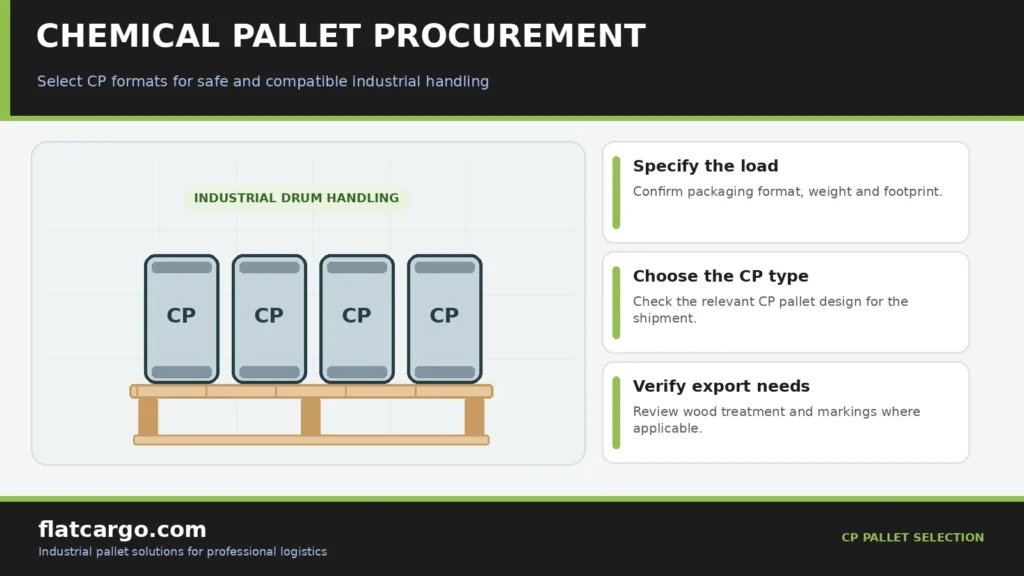
The CP3 format, with its exclusive square design (1140x1140 mm), represents the backbone of industrial bulk transport. Its dimensions are precision-engineered to accommodate exactly four standardized 200-liter drums or a high-tonnage octabin. This geometry guarantees perfect mass distribution and maximizes floor occupancy in Tautliner trailers, eliminating unnecessary blocking and bracing and optimizing unit transport costs.
CP4, CP5: Solutions for bagged loads
Handling bags of plastic granules, chemical powders, or special cements presents a high mechanical risk: the collapse of the container under its own weight. Packaging rupture leads to total losses, contamination risks, and dock cleaning penalties.
CP4 and CP5 pallets provide a structural solution to this problem. Their top deck is designed with closely spaced boards, minimizing empty space to prevent bags from being pinched or pierced under the static pressure of upper layers. The CP5 offers a narrower variant (760x1140 mm), optimized for small-format maritime container stacking or storage on specific racks, while maintaining a dynamic load capacity exceeding 1.3 tons.
CP6 to CP9: Specific formats for containers and export
Large-scale export operations, particularly maritime freight, subject packaging to extreme dynamic stresses (rolling, pitching, successive port transfers). The CP6 to CP9 models are distinguished by a double-deck architecture (perimeter base or cross base). This construction provides structural rigidity and torsional resistance significantly superior to single-deck pallets.
This design is essential for secure stacking in ship holds or ISO containers (20 or 40 feet). The CP9 format (1140x1140 mm) is the absolute benchmark for the heavy export of drums and big bags: its reinforced lower deck distributes pressure onto the load below, preventing any crushing deformation. It ensures total integrity of the goods upon arrival, avoiding customs disputes or customer rejection.
ISPM15 Export Wooden Pallets: The Essential Customs Shield
International shipping of chemical products allows for no compliance failures. The use of non-certified raw wood pallets for export outside the European Union exposes the supply chain to critical operational and customs risk. The sanction is binary: acceptance or destruction at the shipper's expense.
To neutralize this financial risk, the application of phytosanitary standards is not an option; it is a legal safety barrier. Legislation requires ISPM15 (NIMP15) heat treatment, neutralizing any pests.
| Indicator | Non-Compliant Pallet | Flat Cargo Shield (ISPM15) |
|---|---|---|
| Customs Risk | Quarantine blockage, refusal | Guaranteed clearance, zero friction |
| Financial Impact | Demurrage, destruction costs | Securing WCR and margins |
| Traceability | Absent or falsified | Official IPPC marking on blocks |
Our logistics infrastructure provides you with three absolute technical guarantees:
- Regulatory heat treatment: Treatment validated at 56°C for a minimum of 30 minutes.
- International compliance: Immediate acceptance by all global port authorities.
- Continuous sawmill audit: A network of production partners systematically certified and controlled by independent bodies.
Flat Cargo integrates this requirement at the root of the supply chain. By sourcing through our decentralized network, you secure immediate access to ISPM15-compliant CP pallets. Your high-value shipments leave your docks with total legal coverage.
Securing International Export via the ISPM15 Standard
Heat treatment is the essential shield to preserve the integrity of your exported flows. Any failure to comply with this phytosanitary rule turns a standard shipment into a major operational risk.
Lack of certification immediately leads to the seizure of the supports, blocking all merchandise at the border.
Forced disinfection (often costly) or rejection of packages are the standard sanctions applied by customs authorities.
Purchasing Full Truck Load (FTL) Pallets: Logistics Optimization and Pricing
Fragmented supply (LTL - Less than Truck Load) constitutes invisible margin destruction. In the chemical pallet market, transport costs can represent up to 40% of the ex-works price. Purchasing pallets in full truckloads (FTL - Full Truck Load) is the unavoidable mathematical lever to crush this ratio.
By consolidating your flows via the Flat Cargo infrastructure, switching to FTL allows you to reduce unit transport costs by 15% to 25% compared to standard shipments. Logistics optimization is mechanical: a full load of CP3 or CP9 pallets maximizes trailer volume, instantly amortizing the fixed cost of road freight.
Unlike the opaque model of traditional brokers, our approach is based on radical price transparency. Our purchasing algorithms index raw material costs against official quotes (CEEB Index). The Buyer pays the fair market price, plus an infrastructure operational margin displayed in Open Book.
To secure your margins and lock in your industrial volumes, we invite you to consult our remote inventory in real time. Our platform instantly connects your needs to the production capacities of our European network.
Access the Flat Cargo Live Market
Stop suffering from hidden margins and supply disruption risks. Connect to our infrastructure to analyze the official index and secure your chemical pallet supply.
See Spot Prices and Day+1 AvailabilityFAQ
Why is ISPM15 treatment mandatory for exported chemical pallets?
ISPM15 treatment is an essential international phytosanitary standard to prevent the spread of pests via wood packaging. Any shipment outside the European Union with an untreated pallet systematically leads to blocking, forced disinfection, or the rejection of the goods at the borders. Flat Cargo guarantees total compliance for its chemical pallet fleet.
Which CP format should be chosen for transporting 200-liter drums?
The CP3 format (1140 x 1140 mm) is the industry standard for transporting drums. Its square dimension allows for optimizing the loading of four standard drums without wasting space, ensuring maximum stability during road or maritime transport.
How does Flat Cargo guarantee availability despite stock volatility?
Our infrastructure relies on a network of 500+ partners and remote inventory across the entire territory. Unlike brokers who operate on "virtual just-in-time" models, we physically manage local stocks. This decentralization allows us to ensure Day+1 delivery, even in the event of major tension in the sawmill market.
Is it possible to integrate CP pallets into a return/deposit program?
Absolutely. If your chemical flows use CP pallets, our Circul-R silo is designed to industrialize their collection and recovery. We transform your packaging fleets, even specific ones, into recoverable financial assets instead of treating them as waste, thanks to our return/deposit (de-consignment) program.