
Optimizing Reverse Pallet Logistics for a Profitable Circular Supply Chain
La performance d'une boucle fermée ne se juge pas à l'expédition, mais à la maîtrise chirurgicale de son retour. Pour un Directeur Supply Chain en 2026, la logistique inverse n'est plus une simple ligne de coût inévitable, c'est le dernier gisement de marge brute. Transporter du vide est devenu une hérésie financière. Chaque kilomètre parcouru par un camion transportant des supports de charge non optimisés ronge directement votre EBITDA.
Flat Cargo ne se contente pas de gérer vos retours. Nous déployons une infrastructure territoriale qui transforme votre logistique retour emballage en un actif stratégique, capable d'éliminer les pertes d'actifs et de diviser vos coûts de transport de retour par une réduction massive des distances de collecte.
Eradicating the "Logistics Black Hole".
The physical disappearance of load carriers during unloading at the retailer is no longer inevitable. By replacing theoretical declarations with rigorous digital exchange recording, we secure your wooden pallet fleet.
ANOMALY DETECTION
Instant identification of discrepancies between shipped volumes and hub returns. Act before the trail goes cold.
EXACT ACCOUNTING VISION
A reliable inventory of your circular assets, a cornerstone for justifying your CSR performance during audits.
END OF DISPUTES
Certified digital proof holds carriers and receivers accountable, ending endless discussions.
Ending the Financial Hemorrhage of Empty Transport and Fleet Buybacks
The lack of visibility on load carriers in circulation generates direct losses that many manufacturers end up accepting out of resignation. Yet, poor return management forces companies to buy back up to 15% of their fleet every year. At the current price of a standardized wooden pallet, this is a sunk investment that serves only to compensate for logistical inefficiency.
Flat Cargo's promise of cost reduction is based on a simple mathematical equation.
- The traditional model A truck delivers 400 km from its factory and must return empty or with retrieved pallets over an equivalent distance. The cost per return kilometer is almost identical to the outbound kilometer (fuel, tolls, driver).
- The Flat Cargo model Your carrier unloads goods and drops off empty carriers at a nearby hub less than 50 km away. By reducing transport distance from 400 km to 50 km, you divide the traction requirement by eight. Even including hub handling fees, the final cost per pallet is divided by three compared to long-distance repatriation.
- The direct impact You immediately free up transport capacity for your sales flows (outbound logistics) instead of mobilizing your trucks for transporting empty packaging.
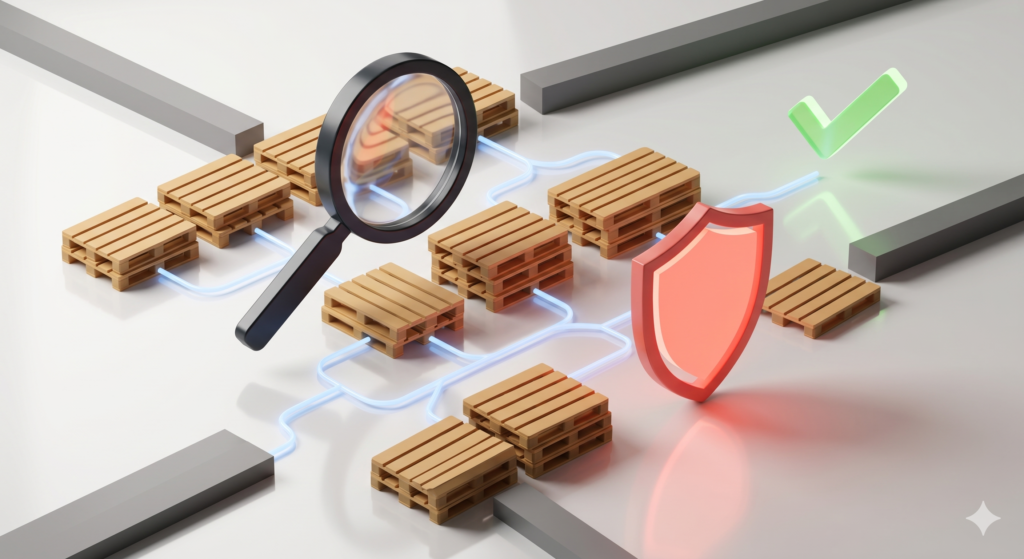
Reverse logistics and territorial grid to massively reduce empty kilometers
The secret to a profitable circular loop lies in geographical proximity. Traditionally, a truck must travel long distances to return empty carriers to their point of origin, generating transport costs often higher than the residual value of the carrier itself. Flat Cargo breaks this model by offering a distributed deposit system for your wooden pallets.
Flat Cargo's promise of cost reduction is based on a simple mathematical equation.
- Filling rate optimization By grouping collection needs from several manufacturers, we consolidate wooden pallet flows and optimize every return journey.
- CO2 emissions reduction This model reduces the carbon footprint per pallet transported by nearly 30%. This is no longer an estimate, but tangible data for your CSRD reports.
- The Pallet Cloud Your wooden pallet is credited to your account as soon as it is deposited in the hub. It becomes a digital asset immediately available, eliminating the need for long-distance physical transport for empty carriers.
Optimizing Return Flows via Short Local Loops
Operational efficiency in 2026 relies on the use of short local loops. Instead of repatriating your wooden pallets to your own sites, they are re-injected into the local circuit via our network. This system eliminates the dormant stock at your customers' premises and ensures that every kilometer traveled by your transport providers is a useful kilometer, not a traction expense for empty wood.
Ending empty transport and fleet buybacks.
Lack of visibility on carriers in circulation generates direct losses. Accepting this logistical inefficiency is a sunk investment.
The truck delivers and must return empty (or with retrieved pallets) over an equivalent distance. The cost per return kilometer is almost identical to the outbound.
The carrier unloads and drops off supports at a nearby hub. By reducing distance from 400 to 50 km, traction needs are drastically reduced.
Securing Return Management to Eradicate Asset Loss
The physical disappearance of load carriers is a fatality that companies no longer have to endure. The logistics "black hole", which often occurs at the time of unloading at the distributor, is eliminated by rigorous digitalization of exchanges. To secure your wooden pallet fleet, we replace theoretical declarations with transactional traceability.
Each movement of carriers between your factory, the end client, and our hub network is recorded in real-time. This method provides three immediate benefits.
- Anomaly identification The system instantly detects discrepancies between shipped volumes and hub returns, allowing for action before the trail is lost.
- Exact accounting vision You have a reliable inventory of your circular assets, essential for justifying your CSR performance during audits.
- End of disputes Certified digital proof holds every actor (carrier, receiver) accountable and puts an end to endless discussions about the number of wooden pallets actually returned.
Closed-loop logistics to ensure your industrial sovereignty
Adopting a closed-loop logistics system is no longer just an environmental commitment, it is a strategy of sovereignty. Unlike pooling where you pay for the use of carriers that do not belong to you, the Flat Cargo closed loop allows you to remain the owner of your assets.
This model offers decisive financial advantages in 2026.
- Massive economies of scale Once your wooden pallet has reached its break-even point after a few rotations, its cost of use becomes negligible compared to a perpetual daily rental.
- Protection against volatility By systematically recovering your carriers, you build a priority stockpile of reconditioned wood, isolating you from brutal price hikes on the new market.
- Quality mastery You control the cycle of wooden pallet repair, ensuring their perfect compatibility with your automated production lines.
Packaging Return Logistics: Transforming Your Flows into a Driver of Sustainable Profitability
Optimizing reverse logistics is the last great source of productivity in the modern supply chain. By combining a dense territorial grid and rigorous transactional traceability, Flat Cargo enables manufacturers to regain total control over their assets while meeting the 2026 decarbonization mandates.
The shift to circular management is not a leap into the unknown, but a logical transition towards precision logistics. By eliminating empty miles and securing every rotation of your wooden pallets, you transform an operational constraint into a major competitive advantage.
Free audit of your pallet return flows
Are you losing more than 10% of your fleet every year? Our experts analyze your return flows and calculate your potential savings through pooling and our hub network.
FAQ
Q. What is reverse pallet logistics?
Reverse pallet logistics refers to all processes for retrieving empty load carriers from the final delivery point to a reconditioning center or production site. The goal is to create an efficient return flow to reintroduce wooden pallets into the sales cycle instead of letting them accumulate at distributors.
Q. Empty kilometers: how to reduce them in your network?
The main lever is decentralization. Instead of forcing a truck to bring back empty carriers over long distances, the Flat Cargo system allows you to drop off wooden pallets at a partner hub located in the immediate vicinity of the unloading point. This pooling transforms unnecessary return journeys into ultra-short local loops.
Q. Wooden pallets: why do they disappear from traditional circuits?
Asset loss is generally due to a lack of transactional traceability at the time of load break. Without certified digital proof between the sender, carrier, and recipient, responsibility becomes diluted. Flat Cargo secures this flow by recording every exchange, thereby preventing carriers from leaving the legal circuit.
Q. Closed-loop logistics: what are the advantages compared to pooling?
Unlike pooling (rental) where you pay daily fees for carriers that do not belong to you, the closed-loop logistics system allows you to remain the owner of your assets. You control the quality of your wooden pallet fleet and achieve massive economies of scale as soon as your carriers exceed their break-even point after a few rotations.