
Pallet Return Systems to Reduce Logistics Costs and Prepare for PPWR Compliance
Managing shipments is already a daily challenge for supply chain managers. But seeing your pallets disappear permanently at end customers' sites is an anomaly that companies can no longer tolerate. With the arrival of the European PPWR regulation (Packaging and Packaging Waste Regulation) in 2026, the pressure is mounting. It is no longer just about absorbing the cost of purchasing new wood: you must now prove to the authorities that your handling supports are indeed being reused.
Open-loop pallet de-consignment provides an immediate operational response. It allows you to transform this logistics loss into a profitable circular system, without burdening the daily routine of your loading dock teams. Flat Cargo explains how to regain control of your assets, relieve your purchasing budget, and anticipate upcoming sanctions.
PROFITABILITY
CYCLE
LOGISTICS
CENTER
PURCHASES
De-consignment: Monetize your supports and clear your docks.
CONTACT EXPERTWhy the PPWR packaging directive is shaking up industrial logistics
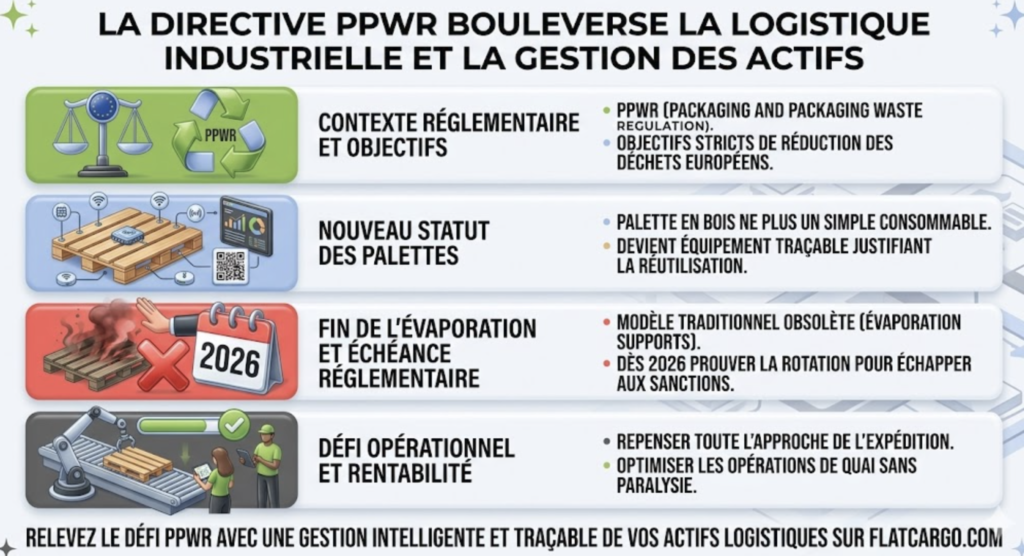
The European legislative framework is taking a decisive turn. The PPWR directive (Packaging and Packaging Waste Regulation) sets strict targets for reducing packaging waste. For a logistics manager, this means that the wooden pallet is no longer a simple consumable to be shipped and forgotten. It is becoming a traceable piece of equipment for which reuse must be justified.
The traditional model, which tolerates the evaporation of load supports at the final recipient, has become obsolete. From 2026, companies will have to prove the rotation of their assets to avoid regulatory sanctions. The entire shipping approach must be rethought, without paralyzing the operations of your loading dock teams.
The hidden costs of non-return and the impact on your procurement budget
Inaction regarding the continuous loss of your handling supports results in a true hemorrhage for your company. A pallet that does not return generates a triple logistics and budgetary penalty:
- The explosion of the procurement budget: You are forced to continuously repurchase new supports at the high market price to keep your shipping lines active.
- The risk of environmental taxes: A non-recovered pallet is often considered by regulations as final waste, exposing you to new processing taxes.
- The increase in the carbon footprint: Manufacturing new units to replace lost ones deteriorates the overall environmental footprint of your supply chain.
Ending direct losses.
In 2026, the PPWR will require proof of reuse for your supports. Seeing your pallets disappear is no longer just a financial cost, it's a major non-compliance risk.
Open-loop de-consignment transforms this logistics anomaly into an automated circular system for your loading dock teams.
STATUS: ANALYZING...
Optimizing pallet return management to control your expenses
The true cost of a pallet includes its purchase price, but above all the cost related to its non-return. Structuring an efficient pallet return management (or reverse logistics) system allows you to interrupt this destructive cycle of single-use purchasing. Instead of abandoning your equipment on your customers' docks, you organize their recovery.
This circular loop transforms a recurring cost center into a smart investment. De-consignment allows you to make your supports profitable over time, instantly relieving pressure on your purchasing budget.
Wood waste valorization to finance your future purchases
Even at the end of its lifecycle, when it can no longer be repaired for shipping, a pallet retains market value. A well-designed de-consignment infrastructure systematically integrates wood waste valorization.
Broken or non-standard units are no longer scrap that you have to pay to dispose of. They are bought back by our logistics network to be valorized. This mechanism acts as a direct credit that allows you to self-finance part of your future purchases of load supports.
Strategic advantages of the open loop compared to traditional rental companies
For decades, the market has been dominated by closed-loop pallet rental systems (Pooling). While these players offer a turnkey solution, they often lock your supply chain into rigid and increasingly expensive rental contracts.
The shift to an open-loop model relies on the use of standard supports (like the EPAL pallet). This standardization breaks the monopoly of rental and restores decision-making power to your logistics and purchasing teams.
| Logistics Criterion | Closed Loop (Traditional Rental) | Open Loop (Flat Cargo Solution) |
|---|---|---|
| Economic Model | Recurring costs (Accumulated daily rents) | Controlled costs (Payment strictly per rotation) |
| Fleet Flexibility | Total captivity (Exclusive proprietary fleet) | Independence (Interchangeable standard fleet) |
| Loss Management | Loss penalties often opaque and marked up | Transparency (Replacement based on real market index) |
Securing your PPWR compliance without technological dependency
The main argument of traditional rental companies is to provide proof of your pallets' rotation. However, obtaining this document no longer requires being chained to a closed network. Flat Cargo's infrastructure allows you to audit and track standard pallet flows. For every rotation validated by our hub network, a formal reuse certificate is issued. You thus guarantee your compliance with the PPWR standard for 2026, without paying the high price of rental.
Deploying de-consignment without disrupting your loading dock operations
Reducing your pallet purchasing budget and securing legal compliance does not require restructuring your teams' work. As a logistics partner, Flat Cargo connects your shipping flows to its local network.
We orchestrate the collection, sorting, repair, and re-injection of your supports. Your warehouse staff and forklift operators keep their current loading processes, while we handle the complexity of the return and the administrative tasks.
Evaluate the savings potential of your flows
Do not let the new regulations and the loss of your pallets penalize your profitability. Request a precise diagnosis of your shipments to quantify the savings generated by an open loop.
FAQ
Q. When does the PPWR directive apply to industrial packaging
The traceability obligations set by Europe are coming into effect gradually, but the first major deadline is set for 2026. This is when companies will need to justify the reuse of their packaging in their environmental reports, or face potential new taxes. Anticipating now helps avoid emergency adjustments.
Q. Does de-consignment work with all pallet types
It is operational immediately for all your flows using standard load supports (mainly the European or EPAL pallet). If you still use "single-use" (disposable) pallets or complex proprietary formats, the transition to the European standard is the first step we will help you take to make your returns profitable.
Q. What is the real gain compared to traditional rental
The optimization of your logistics costs generates an average observed saving of 12% to 18% from the first year of operation. This mechanical reduction in your budget is explained by the elimination of daily rents charged by rental companies, and by the end of heavy penalties inflicted for pallets not returned by your final customers.