
Pallet Dimensions and Ultimate Guide to Warehouse Optimization
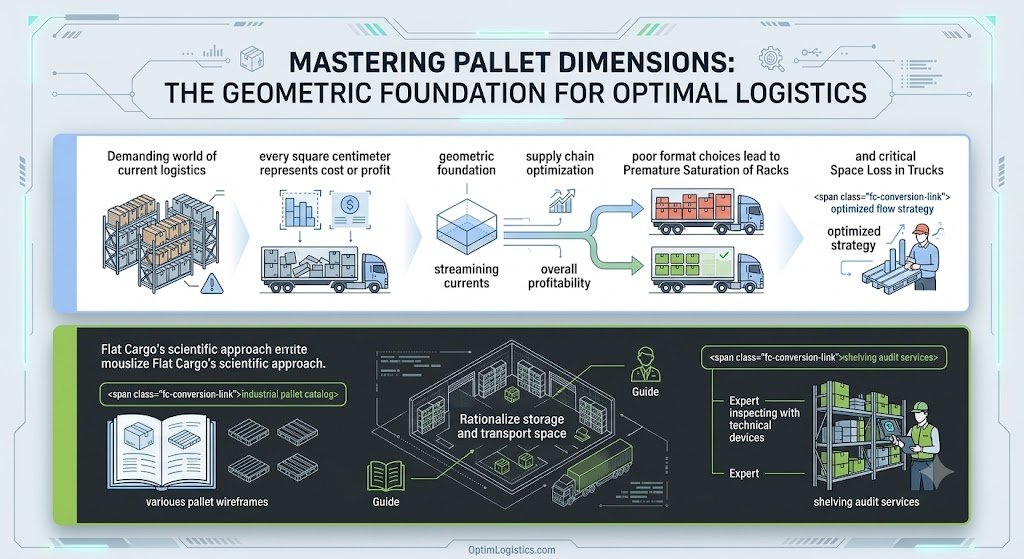
Pallet Dimensions: in the demanding world of current logistics, every square centimeter of your warehouse represents either a cost center or a direct profit lever. Mastering pallet dimensions is no longer a simple handling question; it is the geometric foundation for optimizing your supply chain. A poor choice of format can lead to premature saturation of your racks, a loss of critical space in your trucks, and a mechanical increase in your transport costs. By rigorously aligning the dimensions of your load supports with the ergonomics of your infrastructure, you instantly streamline your current flows and secure the overall profitability of your operations.
Flat Cargo offers you a scientific approach to rationalize your storage and transport space. By exploring our industrial pallet catalog, you gain access to all market standards. This comprehensive guide, supported by our shelving audit services, provides you with the keys to map your actual needs and transform your current shipments into a model of volumetric performance.
International standards for flow interoperability
The EUR pallet and global ISO formats for your current flows
- The European EUR EPAL standard Measuring 1200 x 800 mm, it is the cornerstone of current logistics on the continent. It is designed to fit efficiently into standard truck trailers, with up to 33 pallets per 13.6 m trailer. You can explore these models in our certified EPAL catalog.
- The ISO industrial format Defined by the ISO 6780 standard, the 1200 x 1000 mm format is widely used for heavy or bulky shipments. In North America, the 48 x 40 inch format (1219 x 1016 mm) is the usual reference.
- The Asian format Often set at 1100 x 1100 mm, this square support suits container filling in several Asian markets and can streamline your current transcontinental shipments.
Strategic selection criteria for your current shipments
Securing your supply technique
- Load capacity analysis It is important to calculate the dynamic and static load accurately. Keeping a safety margin below the nominal capacity, as specified by the manufacturer, helps limit structural fatigue of your supports.
- Equipment compatibility Your forklifts, pallet jacks, and automated conveyor systems must be calibrated to your pallet dimensions to limit handling accidents in your current flows.
- Nature of your goods Fragile products often call for solid deck pallets, while perishable goods can benefit from ventilated pallets for better air circulation.
Advanced techniques to maximize your warehouse storage volume
| Storage Solution | Space Impact | Benefits for Current Flows |
|---|---|---|
| Dynamic pallet racks | Maximum density | Natural FIFO management |
| Double-faced pallets | Stacking flexibility | Increased ground stability |
| Automated storage systems | Precision optimization | Reduction of human errors |
Innovation and automation of pallet fleets
Securing your assets with Flat Cargo
The future of current logistics relies on the symbiosis between robust hardware and precise data. At Flat Cargo, we do not just provide supports; we help you build an ecosystem where every pallet contributes to your efficiency. By requesting our global logistics audit, you prepare your infrastructure for tomorrow's standards while optimizing your gains today.