
Opening a Pallet Depot: 2026 Business Model and Profitability
Investing to open a pallet depot is becoming a strategic priority in the face of resource scarcity and new European regulatory constraints. In 2026, price volatility and the requirement for traceability prohibit an isolated, artisanal approach.
Flat Cargo provides the decentralized infrastructure necessary to transform a land asset into a profit center via a highly scalable Logistics Franchise.
Guarantee business flow automatically
Unlike an independent model, our franchisees benefit from Flat Cargo's decentralized infrastructure. Business comes to you without local prospecting effort.
Why industrial investment in 2026 is focusing on circular logistics
The handling market is undergoing a structural change. What was yesterday waste management is becoming in 2026 the management of critical financial assets. Two major factors dictate this acceleration.
- Resource scarcity Rising raw wood material costs mandate systematic reuse of load carriers to maintain profitability.
- PPWR regulatory pressure The European PPWR directive imposes strict reuse quotas starting in 2030, forcing manufacturers to rely on local hubs.
| Market Factor | 2026 Operational Impact | Franchisee Opportunity |
|---|---|---|
| PPWR Directive | Digital traceability requirement | Territorial exclusivity on flows |
| Transport Cost (FTL) | Explosion of carbon taxes | Profitability of remote stocks |
| EPAL Standard | Shortage of reconditioned pallets | Inbound flows guaranteed by the network |
By joining the Flat Cargo network, you are not just creating a storage platform but becoming an essential link in European logistics sovereignty.
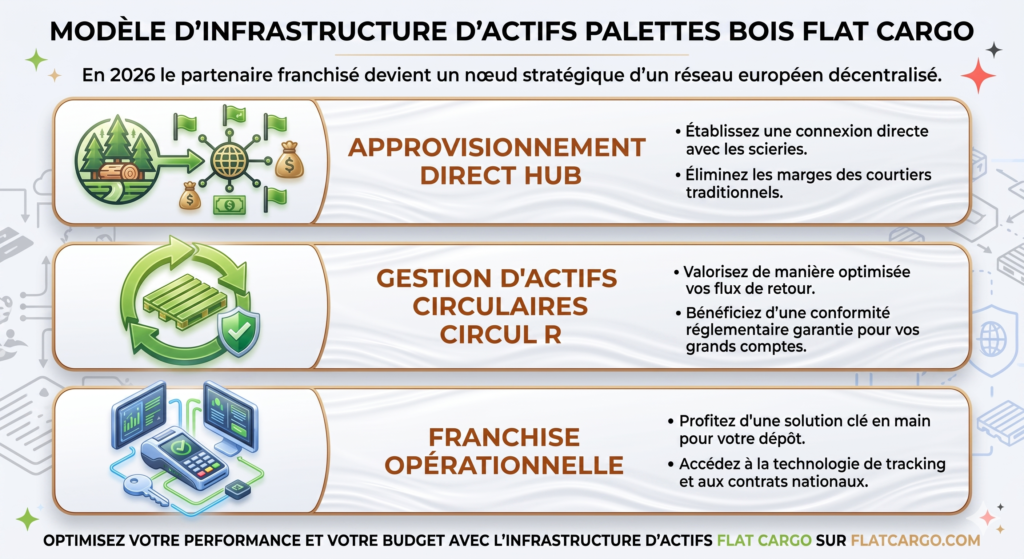
The Wooden Pallet Business Model: from handling to asset infrastructure
In 2026, opening a pallet depot is no longer limited to simple physical stock management. The Wooden Pallet Business Model of Flat Cargo relies on an integrated infrastructure approach. The franchisee partner is not an isolated reseller, but a strategic node in a decentralized European network respecting the rigorous standards of the FEFPEB.
This model is based on three value-generating pillars for your business.
- Direct Procurement (Hub) You benefit from a direct connection to sawmills to remove broker margins and secure your stock of standardized pallets.
- Circular Asset Management (Circul-R) You ensure the valuation of return flows, an essential pillar of circular logistics, to meet the regulatory compliance requirements of key accounts.
- Operational Franchise A turnkey solution including tracking technology and immediate access to national contracts to guarantee your workload plan.
Ready to validate the profitability of your future depot?
Access the Investor Masterclass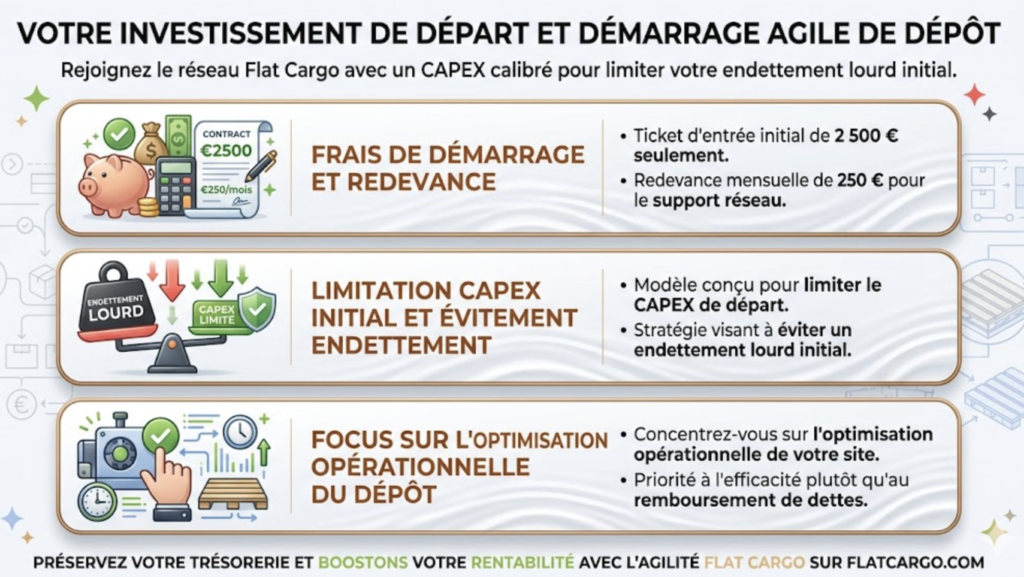
What is the initial investment to open a depot?
The investment to join the Flat Cargo network is carefully calibrated to limit initial CAPEX (capital expenditure).
This disruptive financial model allows you to focus on operational optimization and the growth of your hub, rather than bearing the burden of heavy debt related to purchasing trucks.
Logistics EBITDA Financial Analysis and Net Margin for Pallet Depot
The performance of a logistics profit center is measured by its capacity to optimize the holding cost per unit. Your Logistics EBITDA (an indicator whose financial definition you can check on Investopedia) is secured by the diversity of inbound flows, notably via buybacks or de-consignment, and outbound flows.
| Revenue Source | Margin Lever | Potential |
|---|---|---|
| Sales of EPAL Pallets | Volume and CEEB Indexed Price | High Transactional |
| De-consignment Service | Management Fees / Unit | Recurring (SaaS) |
| Wood Waste Valuation | Biomass Processing | Optimization of TCO |
Real Estate Optimization: Maximizing Warehouse Storage Profitability
The Net Margin for Pallet Depots is directly correlated to the optimization of the Revenue/sqm ratio. Flat Cargo mandates Open Loop management, guaranteeing rapid stock rotation and limiting capital immobilization.
For a standard 500 sqm warehouse, the goal is to reach break-even within 6 months thanks to business flow guaranteed by the central infrastructure. The latter directs flows from local manufacturers directly to your hub to ensure maximum Warehouse Storage Profitability.
FAQ
Q. What is the initial investment to open a pallet depot?
The investment to join the Flat Cargo network is calibrated to limit initial CAPEX. The entry fee is set at €2,500, complemented by a monthly fee of €250. This business model allows you to focus on operational optimization rather than heavy debt.
Q. What surface area is required for a profitable depot?
Warehouse storage profitability is optimal from 500 sqm. This surface allows for the simultaneous management of new pallet flows and the de-consignment areas necessary to serve local manufacturers through optimized warehouse management.
Q. How does Flat Cargo guarantee business flow?
Unlike an independent model, our franchisees benefit from Flat Cargo's decentralized infrastructure. Framework contracts signed at the national level are automatically redirected to the nearest local partner for physical execution, transforming each carrier into a strategic asset.
Q. Do I need logistics experience to succeed?
The "Business in a Box" model includes complete training on industrial processes and the use of our digital tracking tools. Your primary role is asset management and piloting local flows within our franchise network.