
Pallet Transport Innovations and Digital Workflow Transformation

Pallet Transport plays an important role in modern supply chain operations. Far from being a simple support for goods, the pallet influences how products are handled, stored, transported, and tracked throughout the logistics process. Selecting the right pallet transport solution can help companies improve load stability, simplify handling, and manage logistics costs more effectively.

For logistics decision-makers, efficient pallet transport involves more than moving empty or loaded pallets from one location to another. It requires the right combination of pallet specifications, transport planning, handling processes, and asset management. Flat Cargo helps companies optimize pallet-related operations while improving visibility and control across their supply chain.

Impact of IoT technologies on load carrier traceability

The Internet of Things (IoT) connects physical assets to digital systems through sensors, communication technologies, and data platforms. In pallet logistics, this can improve visibility over asset movements and provide useful information for managing reusable load carriers. For companies looking to improve returnable pallet tracking, connected technologies can complement existing identification and recovery processes.

Benefits of connected pallets for asset tracking

Depending on the technology used, connected pallets can provide information about location, movements, or handling events. RFID tags, Bluetooth devices, cellular trackers, and other low-power technologies can be selected according to the required range, infrastructure, and tracking frequency. For fleet managers, this visibility can help identify missing assets, improve inventory records, and coordinate pallet recovery more efficiently.

Using sensor data to monitor sensitive goods

Connected monitoring and operational control

Beyond location tracking, sensors can be used to monitor conditions such as temperature, humidity, vibration, or mechanical shocks when the application requires it. For pharmaceutical, food, and other temperature-sensitive products, this information can support quality control and help identify potentially problematic transport conditions. The Internet of Things provides the technological foundation for connecting these physical devices to digital systems and making their data available for analysis.
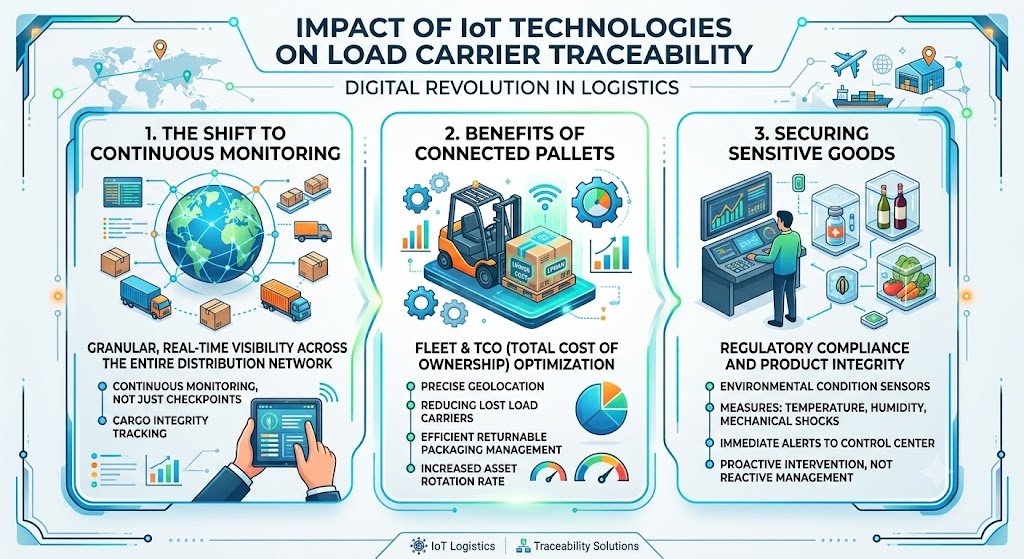
Une infographie numérique détaillée avec trois colonnes verticales distinctes, intitulée "IMPACT OF IoT TECHNOLOGIES ON LOAD CARRIER TRACEABILITY" avec le sous-titre "DIGITAL REVOLUTION IN LOGISTICS". La première colonne de gauche, étiquetée "1. THE SHIFT TO CONTINUOUS MONITORING", présente un globe avec des camions en mouvement, une main tenant une tablette et liste des avantages tels que "GRANULAR, REAL-TIME VISIBILITY ACROSS THE ENTIRE DISTRIBUTION NETWORK", "CONTINUOUS MONITORING, NOT JUST CHECKPOINTS", et "CARGO INTEGRITY TRACKING". La colonne centrale, "2. BENEFITS OF CONNECTED PALLETS", montre un chariot élévateur avec une palette intelligente et des engrenages, des graphiques et liste : "FLEET & TCO (TOTAL COST OF OWNERSHIP) OPTIMIZATION", "PRECISE GEOLOCATION", "REDUCING LOST LOAD CARRIERS", "EFFICIENT RETURNABLE PACKAGING MANAGEMENT", et "INCREASED ASSET ROTATION RATE". La colonne de droite, "3. SECURING SENSITIVE GOODS", affiche un opérateur devant une console de surveillance avec des conteneurs de vaccins, de vin et de légumes, et liste : "REGULATORY COMPLIANCE AND PRODUCT INTEGRITY", "ENVIRONMENTAL CONDITION SENSORS", "MEASURES: TEMPERATURE, HUMIDITY, MECHANICAL SHOCKS", "IMMEDIATE ALERTS TO CONTROL CENTER", et "PROACTIVE INTERVENTION, NOT REACTIVE MANAGEMENT". Le pied de page inférieur porte les logos de "IoT Logistics" et "Traceability Solutions".

Artificial intelligence and transport schema optimization

While IoT provides visibility, Artificial Intelligence (AI) serves as the decision-making brain of the modern supply chain. Integrating Machine Learning into transport management systems (TMS) allows for processing massive volumes of data to identify optimization schemas invisible to the human eye. In current logistics, AI no longer just analyzes the past; it becomes predictive, enabling resource allocation with surgical precision.

Reducing empty mileage through Machine Learning

One of the most financially impactful pallet transport innovations lies in dynamic route optimization. Machine Learning algorithms analyze real-time variables — traffic, weather conditions, delivery time slots — to instantly recalculate the most efficient routes. This agility makes it possible to maximize the vehicle load factor and drastically reduce empty mileage. For your current shipments, this technology translates into a direct reduction in transport costs per load unit and a significant reduction in CO2 emissions, thereby aligning economic performance with CSR goals.

Demand forecasting and proactive pallet fleet management

The management of carrier flows is often a complex logistical challenge, marked by seasonal imbalances. AI makes it possible to anticipate these variations by cross-referencing sales histories, market trends, and production cycles. By accurately forecasting carrier needs at each node of the network, companies can orchestrate inventory repositioning before shortages or surpluses occur. This proactive management guarantees the complete fluidity of your current flows, preventing critical handling bottlenecks and optimizing the tied-up capital within your pallet fleets.
AI application area Technological innovation Operational benefit
Flow planning Predictive demand algorithms Elimination of carrier stockouts
Transport execution Real-time route optimization Reduction in fuel costs and CO2
Asset maintenance Image analysis for pallet condition Preventive securing of the load unit

Transition toward sustainable materials and circular logistics

The evolution of load carriers is not limited to their electronic intelligence; it affects their very structural composition. Under pressure from environmental regulations and carbon neutrality goals, pallet transport innovations are moving toward eco-design and the circular economy. The pallet is no longer a potential waste product, but a renewable resource integrated into a logistics feedback loop.
The emergence of new composite materials and timber from sustainably managed forests makes it possible to produce lighter and sturdier carriers. Reducing the tare weight of the pallet has an immediate impact on the fuel consumption of your current shipments. At the same time, the "Pallet Pooling" model (rental management of shared fleets) is becoming the standard of current logistics. By delegating the management, repair, and recycling of carriers to experts, companies reduce their carbon footprint while optimizing their cash flow by eliminating the purchase of tied-up carrier fleets.

Warehouse automation and palletizing robotics

The final link in this transformation involves the interface between the carrier and the infrastructure. Material handling automation has become a necessity to address labor shortages and increase throughput. Pallet transport innovations now integrate complete compatibility with automated storage and retrieval systems (AS/RS).
Automated guided vehicles (AGVs) and autonomous mobile robots (AMRs) now navigate with millimeter precision, identifying pallets using high-performance computer vision systems. Robotic palletization, on the other hand, utilizes optimized stacking algorithms to maximize load stability and volume utilization. For your current flows, this robotization guarantees flawless preparation consistency and increased safety for employees, eliminating strenuous, low-value-added tasks. Warehouse 4.0 thus becomes a tangible reality, centered on the intelligent management of the load unit.
  • AGVs and AMRs: Streamlining internal transfers and reducing accidents.
  • Computer vision: Automated inventory and real-time quality control.
  • High-density storage: Optimization of real estate space through automated stacking.

FAQ on technological breakthroughs in the supply chain

Role of Blockchain in securing logistics exchanges

Among the most promising pallet transport innovations in 2026, Blockchain stands out as the ultimate trust protocol. By creating a decentralized and immutable ledger of every pallet movement, it eliminates disputes related to transfers of responsibility between different actors in the chain. Each "smart contract" automatically triggers billing or replacement processes as soon as a connected pallet crosses a checkpoint. For your current flows, this technology guarantees total data integrity and a massive reduction in administrative costs associated with manual tracking.

Profitability of technological investments for SMEs

Access to pallet transport innovations is no longer reserved solely for industry giants. The democratization of SaaS (Software as a Service) solutions and the falling cost of IoT sensors allow SMEs to begin their digital transition with a controlled initial investment. The ROI is quickly measured by the elimination of lost carriers, load optimization, and premium customer service. In current logistics, ignoring these advancements represents a risk of losing competitiveness to more agile and technologically better-equipped actors.

Conclusion on the future of intelligent load carrier management

Pallet transport innovations shape the outlines of an autonomous, sustainable, and highly efficient supply chain. From IoT-connected pallets to route optimization powered by AI, each technological block helps create an ecosystem where operational efficiency meets ecological imperatives. By adopting these solutions, you do more than modernize your carrier fleet; you secure your company's future in a globalized and demanding market. Flat Cargo supports you in this transition to make every pallet a growth driver for your current shipments.