
Industrial Crates & Pallet Collars: Modularity for Bulk Freight
Industrial Wooden Pallet Collars transform a standard pallet into a modular load-containment system designed to organize and protect goods during storage, handling, and transport. Their rigid wooden structure provides an adaptable solution for bulk products and loads that require additional containment.
Flat Cargo provides wooden pallet collars and packaging solutions designed for demanding industrial applications. Choose the appropriate configuration for your load requirements and secure your shipments with a practical, reusable packaging system.
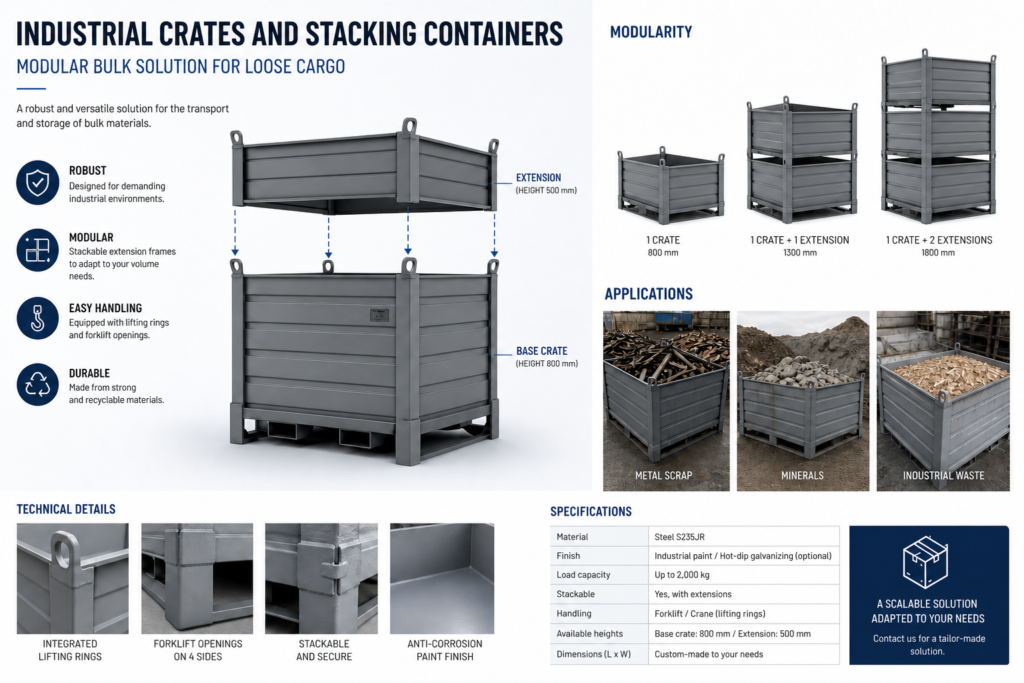
Logistics Volume Optimization Through Verticalization
Efficient space management is an important lever for controlling warehouse operating costs. Using industrial pallet collars can help create contained, stackable load units and make better use of available vertical space. This approach can increase storage flexibility while keeping goods organized and protected during handling. Explore Flat Cargo's pallet and packaging solutions to identify configurations adapted to your storage requirements.
Increasing Warehouse Storage Density
Maximizing storage capacity requires a balance between available floor space, stacking height, product characteristics, and handling equipment. Without an appropriate containment system, bulk products may be difficult to stack safely. Wooden pallet collars create a defined perimeter around the load, helping organize stacked goods and reduce the risk of products shifting or falling during handling.
| Storage Solution | Space Utilization | Load Security | Typical Consideration |
|---|---|---|---|
| Bare standard pallet | Limited by load configuration | Dependent on the load | Less suitable for loose or irregular goods |
| Pallet with collar | Improved through contained stacking | Enhanced load containment | Better suited to organized vertical storage |
The main operational benefits can include:
- Higher stacking flexibility when the load and warehouse equipment allow it.
- Perimeter protection for products that require additional containment.
- Better use of floor space by creating more structured storage units.
Reducing Transport Costs Through Better Load Utilization
Transport efficiency depends heavily on how effectively available vehicle capacity is used. When pallet loads contain excessive empty space or inconsistent heights, available volume may not be fully utilized. Industrial pallet collars can help create more structured and stable load units, making it easier to plan loading configurations and improve space utilization.
Wooden pallets and collars are also widely used in logistics, while international shipments involving wood packaging may be subject to specific phytosanitary requirements. The ISPM 15 standard provides the international framework for regulating wood packaging material used in international trade.
The potential logistics benefits include:
- More consistent loading heights across comparable shipments.
- Improved space utilization when pallet dimensions and load profiles are standardized.
- Greater load stability during handling and transport.
The right collar configuration depends on your products, pallet dimensions, stacking requirements, and handling process. Consult Flat Cargo's wooden pallet collar solutions to determine the appropriate configuration for your logistics flows.
Industrial Standards: Securing Your Cargo
In a logistics ecosystem where speed and precision are paramount, utilizing universal standards is not optional. The standardization of your material handling equipment is the only guarantee of uninterrupted operational fluidity.
The 1200x800 Pallet Collar: The Operational Standard
The 1200x800 format, better known as the Euro pallet (EPAL), forms the backbone of European logistics. Using pallet collars compatible with this format offers several strategic advantages:
- Total interchangeability: Your collars adapt seamlessly to your entire existing pallet pool.
- Automated compatibility: Standardized dimensions ensure smooth processing across your production lines and automated palletizing systems, reinforcing your logistics performance.
- Market availability: Replacing or adding units is simplified by the ubiquitous nature of this format across the market.
Robustness and Resistance: Industrial Constraints
Handling heavy bulk goods leaves no room for error. Industrial pallet collars must absorb the mechanical stresses associated with vertical stacking and transport vibrations. Hinge durability and wood density are the two determining variables for operator safety.
| Collar Type | Load Type | Stacking Capacity | Protection Level |
|---|---|---|---|
| Standard 20mm wood | Light / intermediate bulk | Up to 3 tiers | High |
| Reinforced 25mm wood | Heavy / industrial bulk | Up to 5 tiers | Maximum |
For the most demanding environments, wood can sometimes reach its structural limits. If your weight constraints exceed the load capacity of wood, we recommend transitioning to more rigid structures.
Contact us for your heavy-duty metal pallets.
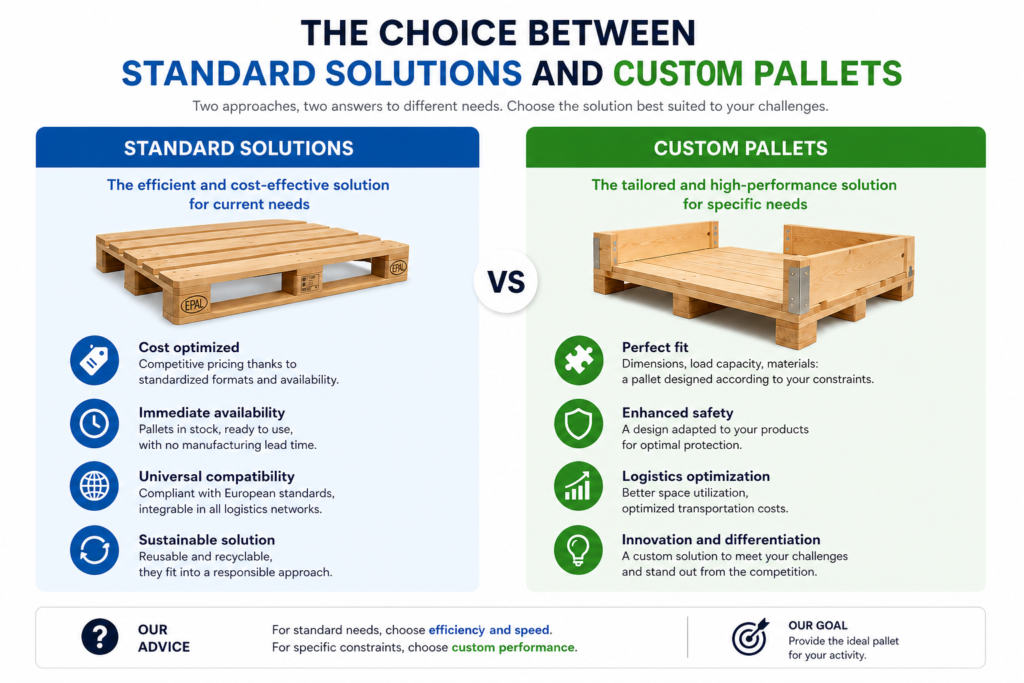
Choosing Between Standard Solutions and Custom Pallets
Cost rationalization requires strict discipline when selecting logistics assets. While the standard catalog covers 90% of material handling needs, custom solutions become a strategic lever as soon as the transported product presents specific dimensional or fragility constraints.
The Advantages of Foldable Pallet Collars in Reverse Logistics
Reverse logistics is often the hidden expense within the Supply Chain. Foldable pallet collars are critical tools for optimizing empty return flows. Their design allows for storage densification during non-use phases, mechanically reducing return transport costs.
- Space savings: 80% reduction in occupied volume when folded.
- Operational speed: Assembly and disassembly in under 10 seconds per operator.
- Durability: Reinforced hinges designed for intensive rotation without maintenance.
Investing in foldable pallet collars transforms a logistics cost (the return of empty pallets) into an optimized variable. Discover our catalog of wooden crates and pallet collars to evaluate the foldable models available in stock.
Case Studies for the Development of Customized Solutions
Custom design should not be confused with luxury, but rather with efficiency. When your products are not compatible with the 1200x800 EPAL format, consulting an engineering department becomes essential to avoid precarious dunnage or costly over-packaging.
| Decision Criteria | Standard Pallet Collar | Custom Packaging |
|---|---|---|
| Availability lead time | Immediate (Next-day) | Engineering and production time |
| Unit cost | Optimized by economies of scale | Premium |
| Product fit | Generic | Perfect (Zero clearance) |
Analyze your product typology before making a request:
- Standard bulk products require standard solutions: do not invest in custom designs unnecessarily.
- Oversized or out-of-gauge products require custom design: the cost of specific packaging is lower than the cost of freight damage.
For specific requirements not covered by our catalog, our technical team steps in during the design phase. Contact our engineering department for your custom pallets.
Compliance and Traceability for International Flows
International trade leaves no room for documentation errors. The regulatory compliance of your load carriers is an absolute prerequisite for maintaining the fluidity of your global Supply Chain. A non-compliant pallet or pallet collar presents a direct risk of production stoppages or customs seizures.
Applying the ISPM 15 Standard to Wooden Packaging to Secure Exports
The International Standard for Phytosanitary Measures (ISPM 15) is the global benchmark aimed at preventing the spread of pests through wooden packaging. Any packaging leaving the European zone must strictly comply with this requirement.
Using our treated pallet collars guarantees:
- Total compliance: Certified heat treatment traceability for every batch.
- Risk reduction: Elimination of delivery delays linked to phytosanitary customs holds.
- Global standardization: Immediate recognition by port and airport authorities.
Cost Management and Critical Tracking of Timber Indices
Lumber price volatility directly impacts your operational margins. An industrial buyer who absorbs prices without actively managing them is placed in a vulnerable position. Monitoring the CEEB and FCBA indices is the only way to verify whether your cost structure aligns with market reality.
Data-driven management allows you to anticipate two major phenomena of wooden pallet price inflation:
- Raw material inflation: Adjusting your procurement volumes before price peaks.
- Supply constraints: Securing your inventory when the index indicates an impending shortage.
We provide our members with total visibility into market trends to rationalize your procurement. Contact our experts in real-time to manage your sourcing budget with full transparency.
Conclusion: Modularity Driving Your Profitability
Industrial pallet collars should not be viewed as mere accessories, but as essential productivity levers. By securing your bulk loads, optimizing your storage density, and guaranteeing export compliance, they become a strategic asset in your Supply Chain.
Logistics efficiency relies on flow control: stop leaving your storage and transport capacities to chance.
FAQ
What are the standard dimensions of a pallet collar?The European industrial standard is the 1200x800 pallet collar (EPAL standard). These dimensions guarantee full compatibility with automated palletizing systems and existing logistics infrastructure across the European market.
Is ISPM 15 treatment mandatory for all pallet collars?Yes, whenever your shipments cross the borders of the European Union. ISPM 15 treatment (certified by an official heat treatment stamp) is an international regulatory requirement to prevent the spread of wood-borne pests. All our export-bound pallet collars are certified compliant.
How should I store my pallet collars when they are not in use?One of the major advantages of our foldable pallet collar models is their compacting capability. Once folded, they occupy approximately 20% of their initial volume, enabling vertical storage on pallet racks or floor block stacking, thereby freeing up valuable space in your warehouse.