
Pallet Fleet Management Optimization Strategies to Eliminate Hidden Industrial Supply Chain Costs
Pallet Fleet Management gives Site Managers a clearer view of how pallets are used, moved, and maintained across warehouse operations. Wooden pallets are not simply handling supports; when poorly managed, they can create additional sorting, handling, and replacement costs. A structured approach helps identify non-compliant pallets, reduce unnecessary handling, and improve the efficiency of warehouse teams.
The challenge is not simply to store pallets, but to manage their flow throughout the operation. This approach helps companies move away from reactive pallet handling toward a structured asset management strategy that supports warehouse performance, automated lines, and better cost control.
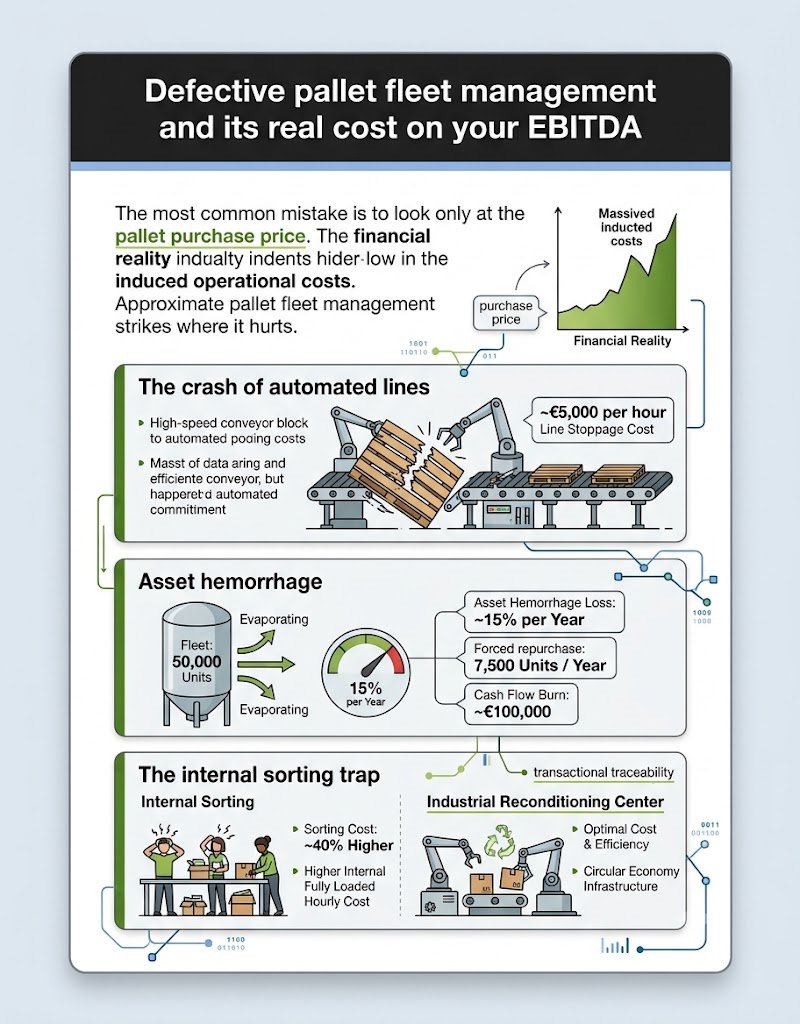
Defective pallet fleet management and its real cost on your EBITDA
The cost of a pallet fleet goes well beyond the initial purchase price. Damaged pallets, manual sorting, unexpected replacements, and handling issues can all add costs to warehouse operations. Effective pallet fleet management helps identify these hidden costs and improve control over the assets used every day.
- Impact on automated lines: Damaged or out-of-spec pallets can cause handling problems on conveyors and automated equipment. Identifying defective units before they enter these systems can help reduce interruptions and protect operational continuity.
- Asset loss and replacement: Without reliable traceability, pallets can leave the operational cycle without being recovered, inspected, or reassigned. Tracking movements and condition helps companies better understand replacement needs and control unnecessary purchases. This is particularly relevant when managing shared or returnable pallet pools, as described in pallet pooling.
- The internal sorting challenge: Sorting damaged and reusable pallets internally can consume valuable warehouse time. A specialized pallet reconditioning service can separate repairable, reusable, and non-compliant units, allowing warehouse teams to focus on their core operations.
Outsource sorting to free up your capacity.
Asking your forklift drivers to sort wooden pallets by quality grade is a strategic error. Every minute spent handling empty wood is a minute less spent shipping your finished products.
Delegating this management to the Flat Cargo infrastructure allows you to clear your docks and transform your warehouse into a true just-in-time flow zone, while extending the life of your supports.
Evacuation of passive storage. Immediate recovery of land space for your operations.
Proactive micro-repairs preventing breakage. Saving on new purchases.
Elimination of unstable stacks and splinters. Reduction of accidents and damage.
Outsource wooden pallet sorting to free up your operational capacity
In many warehouses, the receiving dock is cluttered with piles of disparate supports. Asking your forklift drivers to sort the wooden pallet by quality grade (1st choice, 2nd choice, broken) is a strategic error. Every minute spent handling empty wood is a minute less spent shipping your finished products.
Delegating this management to Flat Cargo allows you to transform your dock into a just-in-time flow zone.
- Immediate land release Passive storage of pallets awaiting sorting often immobilizes 10% of the dock area. By evacuating these flows to our regional hubs, you recover space for your high-value-added operations.
- Preventive maintenance and replacement The profitability of a wooden pallet depends on its longevity. Our approach allows for preventive repairs before structural failure, extending the life of the support by 25%. This is that much less new purchasing required for your annual budget.
- QHSE Guarantee An industrially maintained fleet drastically reduces the risks of accidents (splinters, unstable stacks) and product damage during transport.
Digitizing the wooden pallet fleet via the Flat Cargo infrastructure
Managing a fleet on an Excel spreadsheet in 2026 is a guarantee of having false data. Uncertainty about actual stocks pushes site managers to overstock for fear of shortages, thus immobilizing precious cash flow. The move to digital management with Flat Cargo changes the game radically.
Thanks to our centralized interface, you access what we call the Wood Asset Cloud.
- Critical threshold alerts You receive an automatic notification before the stock of compliant supports becomes a bottleneck for your production lines.
- Transactional reconciliation We compare your theoretical flows with the physical reality captured in our regional hubs. You know exactly where your wooden pallets are being lost and with which provider.
- Rotation history by grade This data allows you to adjust your future fleet investments with surgical precision, by eliminating support references that slow down your lines.
Transforming your material handling supports into a driver of sustainable profitability
Optimizing your material handling supports should no longer be an adjustment variable, but a pillar of your industrial strategy. In 2026, the ability to transform a constraint (wood) into exploitable data (flow) separates supply chain leaders from companies that suffer from their hidden costs.
By combining financial auditing, industrial maintenance, and predictive technology, Flat Cargo secures your flows while generating immediate economies of scale. It is time to treat your wooden pallet for what it really is: a strategic asset serving your EBITDA.
Goodbye spreadsheets. Welcome to the Wood Asset Cloud.
Managing a fleet on an Excel spreadsheet in 2026 is a guarantee of having false data. Uncertainty about actual stocks leads to overstocking for fear of shortages, immobilizing precious cash flow.
Our centralized interface radically changes the game for site managers:
Goodbye spreadsheets. Welcome to the Wood Asset Cloud.
Managing a fleet on an Excel spreadsheet in 2026 is a guarantee of having false data. Uncertainty about actual stocks leads to overstocking for fear of shortages, immobilizing precious cash flow.
Our centralized interface radically changes the game for site managers:
FAQ
Q. Pallet fleet management: Why outsource it rather than keep it in-house?
Outsourcing allows you to transform a complex fixed cost into an agile service. Internally, management mobilizes forklift driver time, dock space, and requires an expertise in repair that is often lacking. By delegating this flow to Flat Cargo, you benefit from professional maintenance and free up your resources to ship more goods.
Q. Wooden pallet inventory tracking: How does the real-time system work?
Our system replaces manual inventories with a dynamic inventory. Each movement to or from a Flat Cargo hub is recorded in your dashboard. This transactional traceability allows you to instantly know the status of your stocks (grades, repair needs, location) via our Wood Asset Cloud.
Q. Wooden packaging fleet audit: What are the concrete gains?
The audit reveals leaks in your circuit. We analyze the causes of breakage, dormant stocks, and flow inconsistencies. On average, this audit identifies potential savings of 10% to 20% on the annual budget, simply by optimizing rotations and eliminating non-standardized supports.
Q. Wooden pallet fleets: Is data-driven management suitable?
Absolutely. Even for a fleet of a few thousand supports, data helps avoid unnecessary repurchases and better plan for seasonal peaks. Knowing exactly when your wooden pallets need to be maintained protects your investment, whether you are an SME or a large industrial group.