
HACCP Food Grade Plastic Pallet TCO Impact and Cold Chain Compliance
Uncompromising sanitary safety
The HACCP Food Grade Plastic Pallet is a critical asset because, in the agri-food and pharmaceutical industries, sanitary safety represents an absolute obligation of result. A single cross-contamination incident can paralyze a production line, trigger product recalls, and destroy brand valuation. Keeping porous load supports within sterile environments or refrigerated flows constitutes an unacceptable operational risk for any Supply Chain Director.
Securing your operations with Flat Cargo
Flat Cargo secures your operations with a logistics infrastructure based on HACCP-certified plastic pallets. We support industrial management teams in replacing their obsolete fleets with standardized, smooth, and traceable assets through our design and packaging audit office. This strategic transition guarantees total biological neutrality while mathematically optimizing your total cost of ownership (TCO).
| Sanitary Criteria | Standard Wood Support | Flat Cargo Plastic Engineering |
|---|---|---|
| Surface porosity | High (Risk of bacterial nesting) | Zero (Non-porous material) |
| Cleaning protocol | Difficult (Drying constraints) | Optimized (Industrial wash compatible) |
| Sanitary Standard | Variable | HACCP & ISO compliant |
Secure your sanitary standards today
Identify vectors for optimization and biological risk reduction with our specialized engineering experts.
Request a packaging audit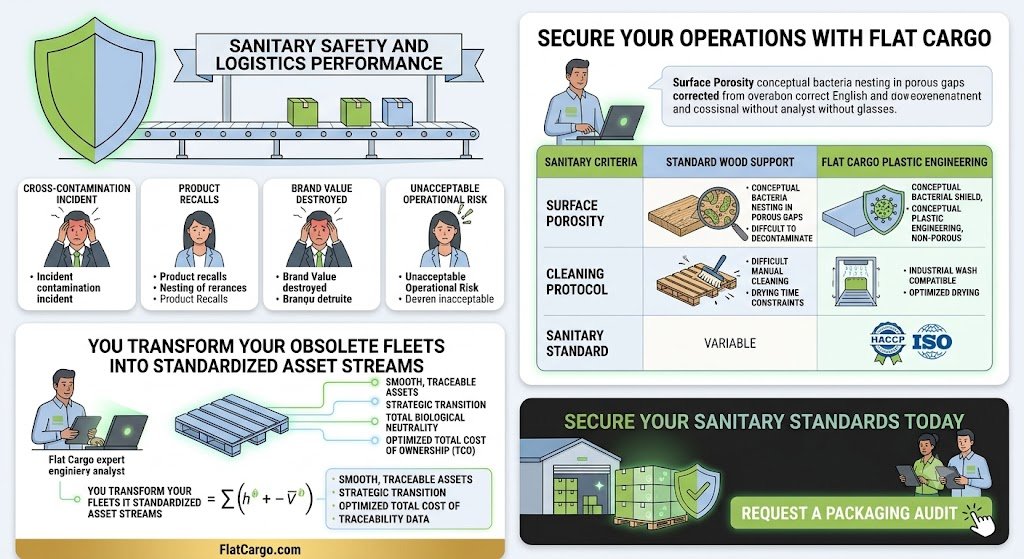
Legal Shield and Sanitary Traceability FDA and EU Requirements
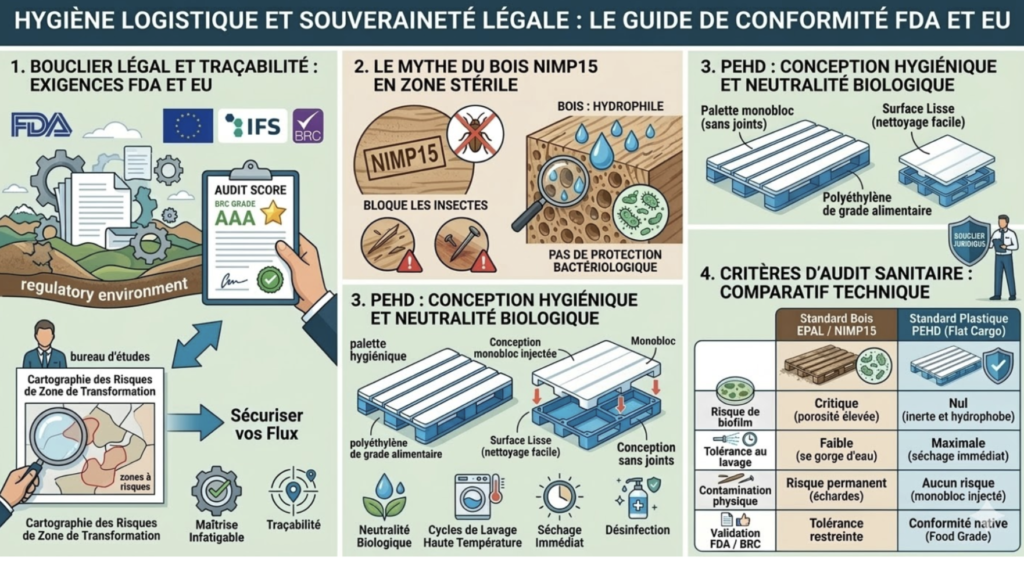
Regulatory pressure imposed by European authorities and the FDA requires an infallible mastery of every logistics link. Passing an IFS or BRC audit means physically eliminating any microbial vector in your processing areas. Our design office supports you through a compliance packaging audit to map your risk zones and secure your flows.
The Myth of ISPM15 Treated Wood in Sterile Zones
The ISPM15 standard blocks insect migration but offers no bacteriological protection. Wood remains hydrophilic. By absorbing moisture from clean rooms, it creates an ideal incubator for pathogens. Splinters and oxidized nails represent a permanent danger of physical contamination (FOD).
Hygienic Design and Biological Neutrality of HDPE
Our H1-type hygienic pallets made of food-grade polyethylene offer a smooth surface without dust traps. Their technical design acts as a legal shield during your unannounced sanitary inspections.
| Sanitary Audit Criteria | EPAL / ISPM15 Wood Standard | HDPE Plastic Standard (Flat Cargo) |
|---|---|---|
| Biofilm formation risk |
Critical
High natural wood porosity. |
None
Inert material and hydrophobic structure. |
| Industrial wash tolerance |
Low
Wood becomes waterlogged and alters tare. |
Maximum
Immediate drying and total disinfection. |
| Physical contamination (FOD) |
Permanent Risk
Presence of splinters and metal nails. |
No Risk
Monoblock injected structure, no fasteners. |
| FDA Validation / BRC Standard |
Restricted Tolerance
Tolerated only in transit gray zones. |
Absolute Compliance
Native compliance (Food Grade) for white zones. |
The TCO Economic Equation: Plastic vs Wood in Sterile Environments
For a financial management team, acquiring a pallet fleet should not be analyzed as an isolated expense (CAPEX), but through the prism of Total Cost of Ownership (TCO). The true profitability of a logistics asset is measured by its capacity to support multiple rotations while retaining residual value. To compare asset performance against market fluctuations, check our pallet price barometer.
CAPEX vs OPEX analysis and break-even point
The lifespan of a PEHD pallet evolving in a closed circuit easily reaches 10 years. In comparison, wood exposed to humid environments requires frequent repairs. The monoblock injected polymer structure, whose characteristics you can find in our logistics shop, allows for amortizing the asset over a tenfold increase in rotations.
Hidden cost matrix and HACCP performance
Maintaining porous assets in a cold chain creates an invisible financial hemorrhage. This table quantifies the impact of malfunctions linked to supports not compliant with HACCP protocols.
| Cost Factor | Financial Impact Wood ISPM15 | HDPE Plastic Performance |
|---|---|---|
| Industrial washing cost | Long drying time in oven mandatory | Immediate drying and rapid reuse |
| Machine breakdown (AS/RS) | Frequent (nails and broken boards) | None (indestructible structure) |
| Final customer quality rejection | Mold risk under film | Bacteriological integrity guarantee |
| Destruction fees (Waste) | Taxation on soiled wood | Material resale value (Recyclable) |
You have the opportunity to transform your logistics cost centers into a measurable competitive advantage today.
Logistics Engineering and Automated Compatibility
The deployment of robotic warehouses requires millimeter precision. A single sagging board on optical sensors causes ruinous emergency stops. Switching to load supports calibrated by our custom design office instantly eliminates the risk of mechanical blockage.
H1 Standardization and Constant Tare
The European H1 standard is the reference for intralogistics. Unlike wood, whose weight fluctuates by absorbing moisture, HDPE maintains a strictly constant mass. This stability is essential for calibrating automated weighing cells.
Thermal Resistance and Deep Freezing
Virgin high-density polyethylene maintains exceptional flexibility even at -40°C. Where wood crystallizes and fractures, our equipment guarantees total operational integrity in the most extreme deep-freezing environments.
| Automated Logistics Criteria | EPAL Wood Behavior | HDPE Performance |
|---|---|---|
| Tare Stability | Fluctuation (up to +30%) | Constant weight |
| Deflection Under Load | Risk of sagging (bending) | Non-deformable (steel reinforcements) |
| Cold Tolerance (-40°C) | Crystallization and rupture | Flexibility maintained |
Reverse Logistics and HACCP Asset Recovery
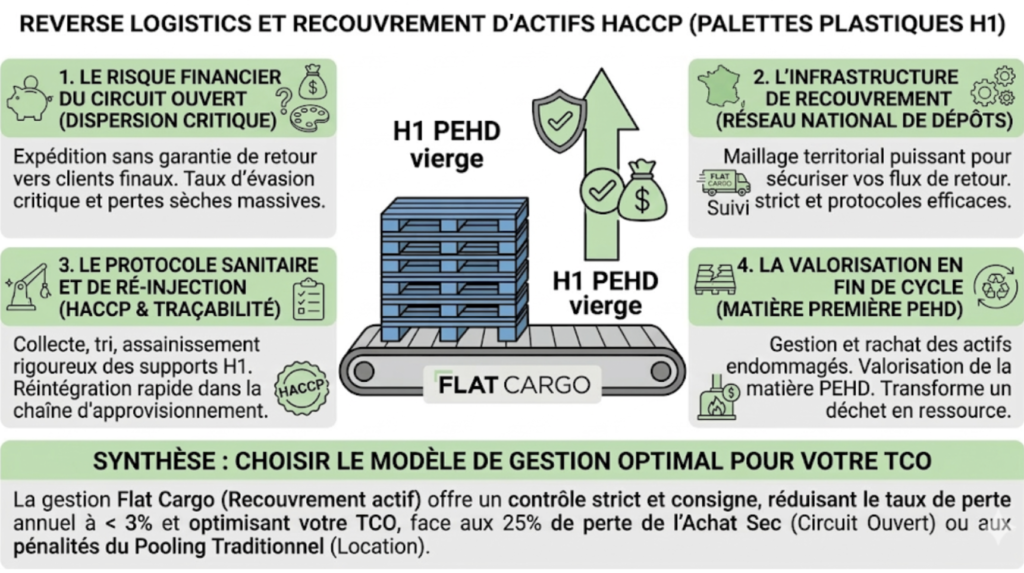
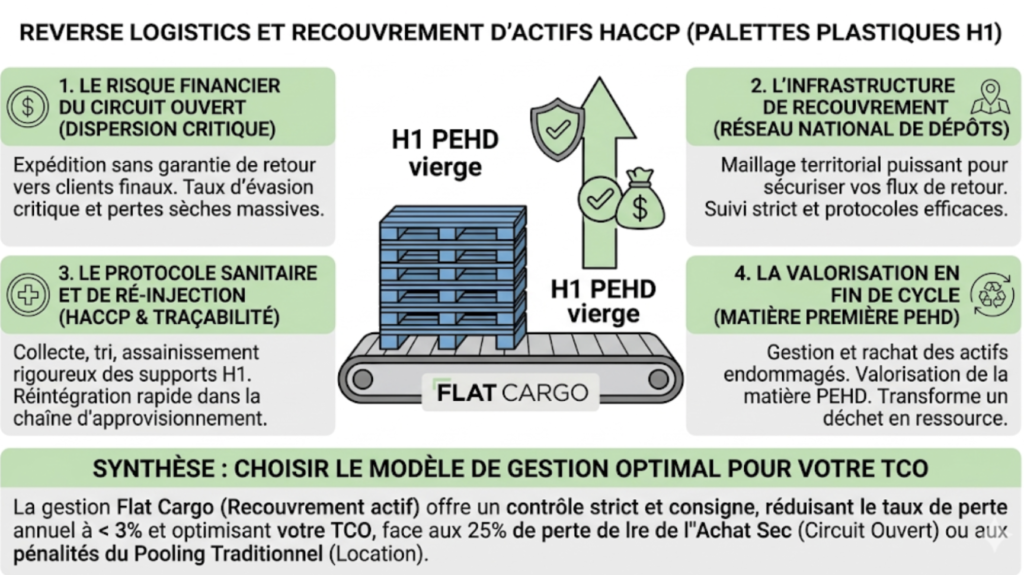
The barrier to massive plastic pallet integration lies not in their performance, but in the financial risk linked to their dispersion. Flat Cargo transforms this vulnerability into a strategic advantage through its Reverse Logistics and pallet consignment infrastructure.
The Financial Risk of Asset Leakage
Shipping to end customers without a return guarantee creates a critical leakage rate. Without a robust tracking system, your fleet value melts with every rotation. By leveraging our network map of partner depots, you benefit from a powerful territorial mesh to secure your return flows.
The Flat Cargo Solution: De-consignment and Buyback
Our approach is based on strict de-consignment protocols. Your supports are collected, sorted, and re-injected into your supply chain. In case of damaged assets, our service specialized in pallet management and buyback guarantees HDPE valuation, transforming waste into a financial resource.
Comparative Analysis of Management Models
| Strategic Model | Annual Loss Rate | Impact on WCR and TCO |
|---|---|---|
| Open Circuit Dry purchase without tracking |
Up to 25% Massive capital leakage | Unfavorable Constant purchase of new assets |
| Traditional Pooling Perpetual rental |
Return fees Loss penalties applied | Expensive Endless OPEX expense |
| Flat Cargo Management Active recovery |
Less than 3% Total fleet control | Optimized Amortization and cash preserved |
PPWR Directive 2026: Sustainability and Carbon Footprint
The agri-food industry faces a dual mandate: sanitary requirements and unprecedented environmental tax pressure. The European directive PPWR (Packaging and Packaging Waste Regulation) will penalize single-use industrial packaging starting in 2026. Switching to a sustainable plastic fleet is fully in line with your CSR strategy.
📉 Scope 3 Reduction
Life Cycle Analysis (LCA) demonstrates that HDPE resilience radically reverses the carbon curve over the long term. A pallet performing more than 250 rotations avoids the transport and chemical treatment of dozens of wood equivalents. This durability directly reduces the carbon footprint of your upstream and downstream logistics (Scope 3).
♻️ Circular Economy
An asset's end-of-life determines its balance sheet impact. Unlike soiled wood, our HACCP equipment is 100% recyclable. Flat Cargo promotes this model through its collection and repair services, ensuring that no value is lost.
| Environmental Indicator | Wood Fleet Impact | HDPE Fleet Performance |
|---|---|---|
| Waste generation | Massive Frequent mechanical breakage. |
Optimized Recyclable assets at end-of-life. |
| PPWR Compliance | Critical Risk Exposure to 2026 penalties. |
Total Compliance Qualified reusable packaging. |
Anticipate financial penalties and transform your compliance into a competitive advantage today.
Frequently Asked Questions about Packaging Audits
Our experts answer compliance and optimization questions encountered by industrial management teams when redesigning their packaging fleets.