
Euro Food Grade Pallet Procurement and Food Safety Optimization
Regulatory pressure and high-pressure cleaning in 2026
Technical analysis for your current flows
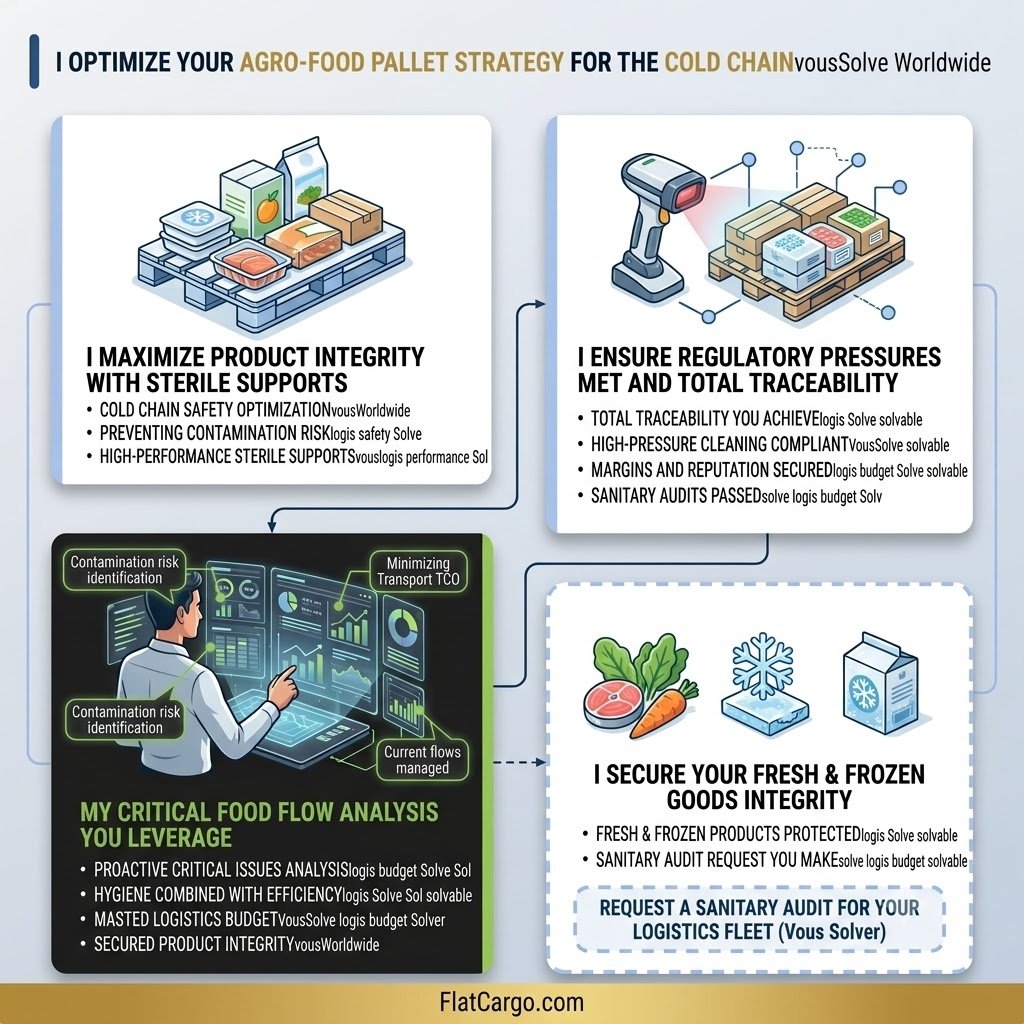
Flat Cargo analyzes critical issues in the food industry to guide you toward handling solutions that combine impeccable hygiene with operational efficiency. For your current flows, this proactive approach ensures the safety of your products while mastering your logistics budget.
Ensure the integrity of your fresh and frozen products.
Request a sanitary audit for your logistics fleet
Sanitary standards and essential certifications for the agri-food industry
Crucial importance of HACCP certification for your current flows
Role of European standards and FDA regulations on hygienic supports
Securing exports and packaging integrity
To cross borders in 2026, your pallets must respect European directives on materials in contact with food, as well as FDA standards for export. These regulations prohibit the use of toxic substances in the manufacturing of polymers. By prioritizing compliant hygienic Euro pallets, you ensure that your supports will not migrate any harmful particles into primary packaging. This regulatory compliance simplifies your customs processes and strengthens the global security of your current flows on an international scale, solidly protecting your logistics budget.
Ensure the integrity of your fresh and frozen products.
Discover HACCP and FDA certified solutions
Technological Innovations and AI in the Manufacturing of Your Supports
Benefits of Recycled HDPE Plastic Regarding Bacterial Constraints
Ecological Impact and Carbon Footprint Reduction for Current Flows
Circular Economy and Brand Value
Opting for recyclable plastic supports is part of a circular economy approach. In 2026, waste treatment costs have become a major price factor. The plastic pallet, once it reaches the end of its life after hundreds of rotations, is shredded and reinjected into new products. For your current flows, this closed-loop life cycle reduces your carbon footprint compared to single-use supports. This eco-responsible approach enhances your brand image while anticipating future environmental taxes, thereby securing your logistics budget.
Audit: Performance and Flat Cargo compliance
| Audit Criterion | Standard Wooden Support | Flat Cargo Hygienic Plastic |
|---|---|---|
| Contamination risk | Medium (Pores, splinters) | Verdict: None (Monoblock structure) |
| Cold resistance (-30°C) | Correct (but absorbs ice) | Verdict: Optimal (Does not weaken) |
| 5-year TCO | High (replacements) | Verdict: 40% increased profitability |
The Flat Cargo audit synthesizes key indicators to validate the profitability and safety of your food-grade supports in 2026 logistics. By eliminating sanitary risks and resisting extreme cold, these supports ensure the efficiency of your current shipments while sustainably mastering your logistics budget.
Selecting supports: Based on food product typology
Specific solutions: For fresh products and freezing zones
Handling techniques: Cleaning protocols in 2026
Standardization: Automation of asepsis
Maintaining asepsis is a daily battle. For your current flows, the cleaning protocol must be standardized. Washing with hot water (minimum 60°C), application of certified food-grade alkaline detergents, and high-pressure rinsing. In 2026, the major innovation lies in the use of automated washing tunnels that ensure uniform disinfection of every side of the pallet. Flat Cargo supports its clients in implementing these processes to ensure that every support reintroduced into your current shipments meets HACCP certification requirements, optimizing your logistics budget along the way.
FAQ on food-grade Euro pallet management and maintenance
How to prevent cross-contamination between different batches
The golden rule in 2026 is the strict separation of flows using color-coded pallets. Purchasing custom food-grade Euro pallets (for instance, blue for finished products, gray for raw materials) allows for visual identification of risk areas. This facilitates the work of operators and reduces handling errors in your current flows, thereby securing your pallet logistics.
Is recyclable plastic as resistant as virgin plastic
Thanks to new purification and molecular strengthening methods, recyclable plastic pallets deliver identical mechanical performance compared to virgin material. For your current shipments, they offer the exact same load capacity while meeting the sustainability imperatives of current logistics in 2026. This robustness maintains a competitive transport TCO while preserving your logistics budget.
Conclusion regarding performance and food safety
Purchasing food-grade Euro pallets is a direct investment in the quality of your value chain. In 2026, the convergence between HACCP sanitary requirements and ecological sustainability imperatives defines the leaders of the agri-food industry. By choosing Flat Cargo's hygienic, robust, and recyclable solutions, you secure your current flows against biological risks while optimizing your transport TCO.
Do not let a load support become the weak link in your current logistics. Choose excellence for your current shipments and guarantee your end customers' satisfaction in an increasingly demanding market, while mastering your logistics budget and your pallet logistics.
Securing your cold chain for 2026
Optimize your agri-food flows with our certified and hygienic Euro pallets.