
Understanding EPAL Pallet Price Trends in 2026 to Optimize Your Procurement
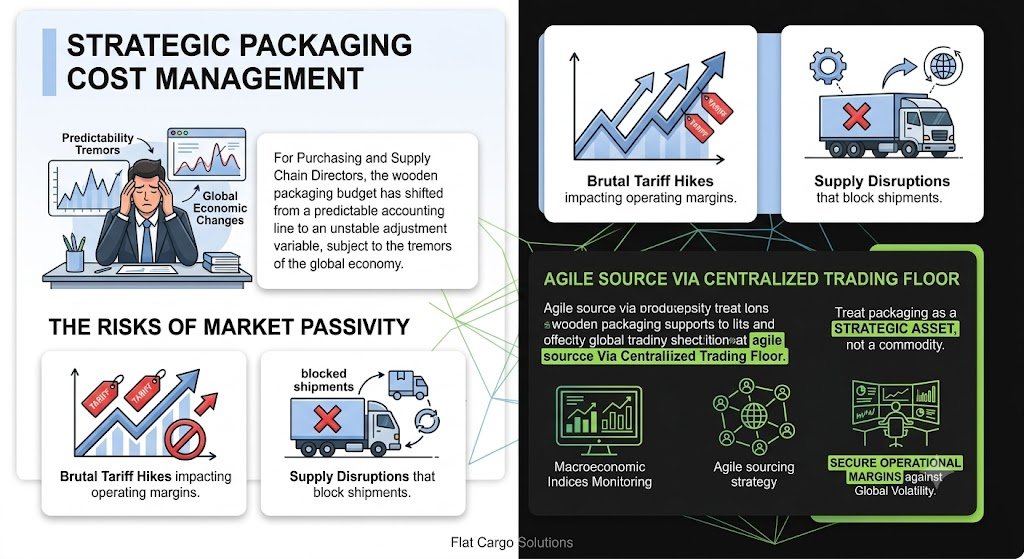
The risks of market passivity
Agile sourcing via a centralized trading floor
Mastering EPAL pallet pricing now rests on two pillars: active monitoring of macroeconomic indices and an agile sourcing strategy through a centralized Trading Floor. By treating packaging as a strategic asset rather than a commodity, you secure your operational margins against global volatility.
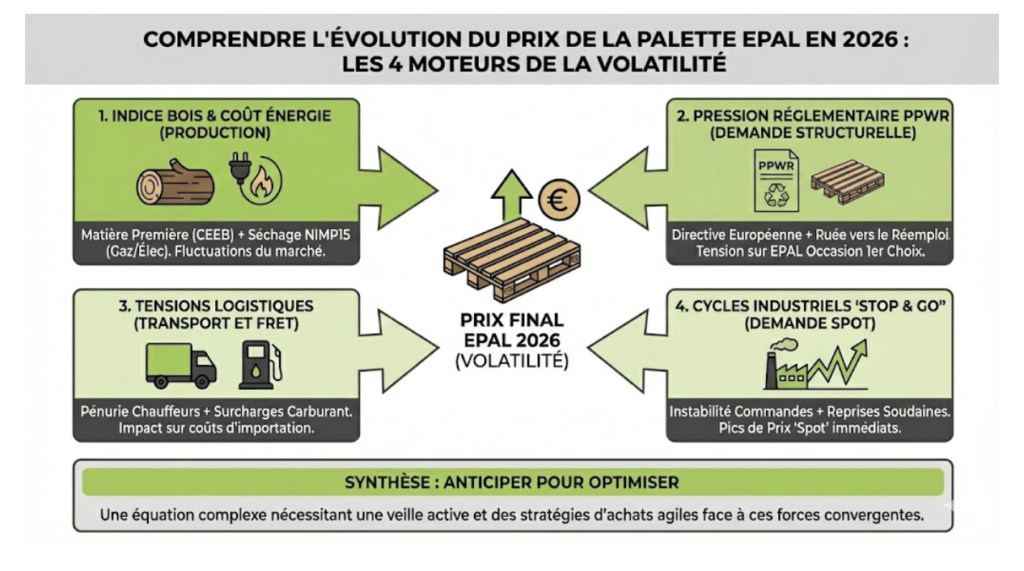
The 4 Drivers of Price Volatility
To anticipate changes in the "delivered to customer" cost, looking at the price of raw wood is no longer enough. The final price of a pallet is the result of a complex equation influenced by four major forces that act in concert.
The Wood Index and Energy Costs
Raw material historically represents the majority of the cost. However, the correlation between the CEEB index (packaging wood price) and the final price has become more complex. Energy costs directly impact the phytosanitary compliance (ISPM15 standard) required for industrial sawmills.
PPWR Regulatory Pressure
The gradual implementation of the European Packaging and Packaging Waste Regulation (PPWR) is creating a structural demand shock. This "rush to reuse" requires manufacturers to rely on an Industrial Trusted Third Party to secure stocks of high-quality used EPAL pallets and avoid compliance disruptions.
Logistics Tensions
The pallet is a bulky product: transport can represent up to 20% of its cost. Driver shortages and fuel price volatility favor local production and regional networks to reduce delivery distances and carbon footprint.
Stop & Go Industrial Cycles
Unstable order books cause "accordion" effects. A sudden market recovery can drain stocks, causing spikes in "Spot" prices for buyers not covered by a monthly price tracking barometer.
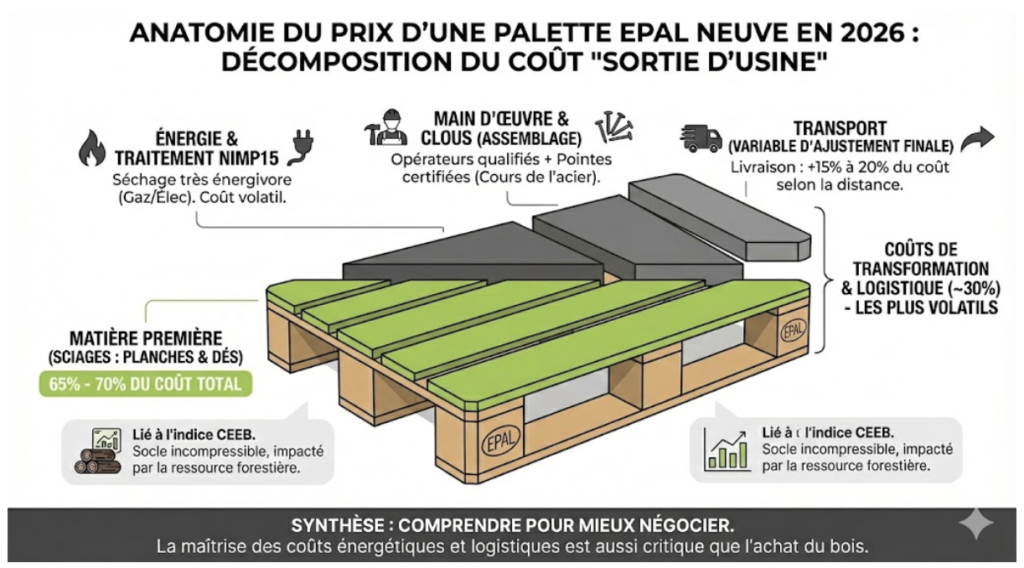
Understanding the anatomy of pricing and the cost breakdown of a new pallet
To negotiate better, you need to understand what you are buying. The price of a new Euro pallet is not just the price of wood in the forest. It is a standardized industrial product, whose cost structure has evolved considerably in recent years.
At Flat Cargo, we advocate for radical transparency. Here is how the "ex-works" price of a standard pallet is generally broken down:
The dominant share of raw materials (Sawn timber)
Wood (boards and blocks) remains the major component of total cost. This item is directly correlated to the CEEB index (Packaging wood price). Any tension on forest resources or competition with firewood (pellets) mechanically impacts this incompressible base.
The growing impact of manufacturing costs
- Energy and ISPM15 Treatment: Mandatory drying for export (heat treatment) is very energy-intensive. The energy bill for kilns now weighs heavily on the unit cost.
- Labor and Nails: Automated assembly requires skilled operators and consumables whose price follows the steel market.
- Transport: This is the final adjustment variable. A pallet delivered 500km away sees its cost increase by 15% to 20%. This is why the Flat Cargo Local Network is a massive cost-saving lever.
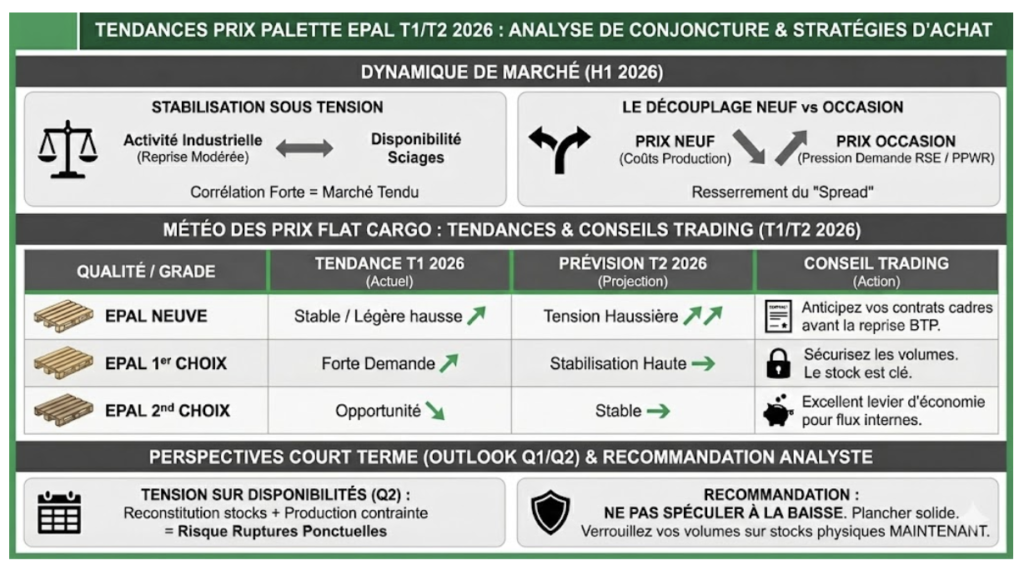
Q1/Q2 Price Trends (Market Situation Analysis)
Based on first-quarter indicators, the Euro pallet market is entering a phase of stabilization under pressure. Trends show a correlation between the recovery of industrial activity (including CP pallet demand) and the availability of sawn timber.
However, a new dynamic is taking hold: the partial "decoupling" between new and used prices. Analyzing this spread is the key to optimizing your industrial procurement.
Analyzing the New vs. Used Spread
We are observing a structural tightening of the "Spread". Strong demand for reuse keeps Grade A EPAL Pallet prices at high levels, even when new wood prices dip slightly. This trend confirms the value of constant monitoring via our monthly Price Barometer.
Here is the Flat Cargo forecast for the first half of the year:
| Quality / Grade | Q1 Trend (Current) | Q2 Forecast (Projection) | Trading Advice |
|---|---|---|---|
|
NEW EPAL (Ex-Works) |
Stable / Slight increase | Upward Pressure | Anticipate your framework agreements before the spring construction recovery. |
|
GRADE A EPAL (Premium Used) |
High Demand | High Stabilization → | Secure volumes. Stock is the lifeblood of operations. |
|
GRADE B EPAL (Standard / Storage) |
Opportunity | Stable → | Excellent cost-saving lever for internal logistics flows. |
Short-term Outlook (Q1/Q2)
For the second quarter, our model anticipates availability constraints. Replenishing safety stocks by major clients, combined with new pallet production constrained by energy costs, could create occasional shortages.
Our Analyst Recommendation
Do not speculate on a price drop. The current floor is solid. Take advantage of the current window of opportunity to lock in your volumes on existing physical stock.
Price vs. Quality Risk: Mastering EPAL "Grades"
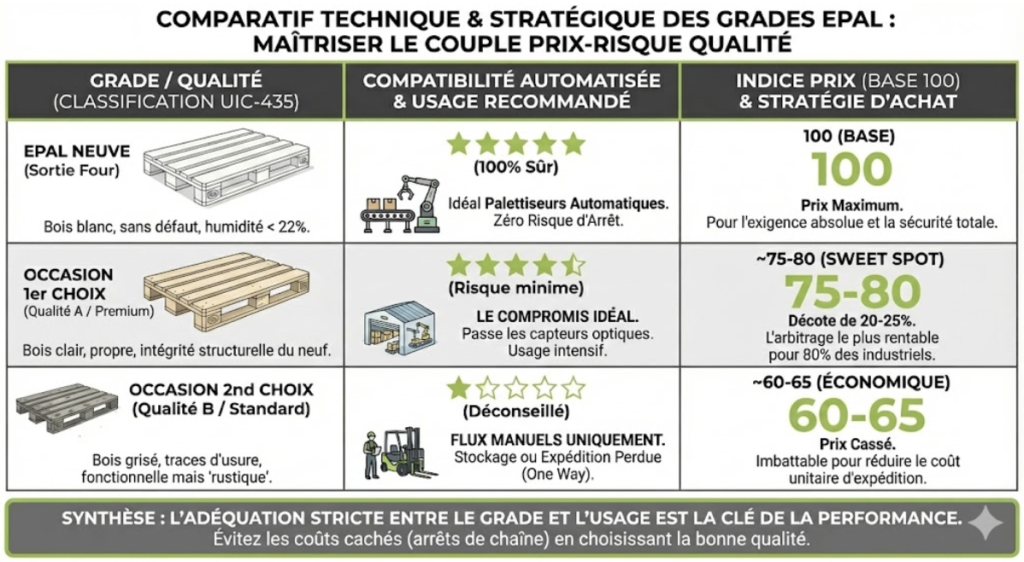
Budget optimization should never come at the expense of operational continuity. Buying cheaper is useless if the pallet causes a line stoppage or injures an operator. The secret to smart purchasing lies in the strict alignment between the pallet "Grade" and your logistics usage.
At Flat Cargo, we apply the strict UIC-435 classification to ensure that cost savings do not become hidden costs.
Visual: White wood, no defects, moisture < 22%.
Visual: Light wood, clean, no broken elements.
Visual: Grayish wood, signs of wear, functional.
Grade A Used: The Ideal Quality/Price Trade-off
This is the "Sweet Spot" for 80% of industrial companies. A Grade A Used (Premium) pallet is one that has completed very few rotations. It benefits from a 20-25% discount while guaranteeing the structural integrity required for automated palletizers.
Grade B Used: For Storage and One-Way Shipping
If your flows are manual, Grade B is unbeatable. Its visual appearance does not detract from its load capacity (1500 kg), but its lower price allows you to drastically compress the unit cost of one-way shipping.
Defining High-Performance Procurement Strategies to Secure Your Annual Budget
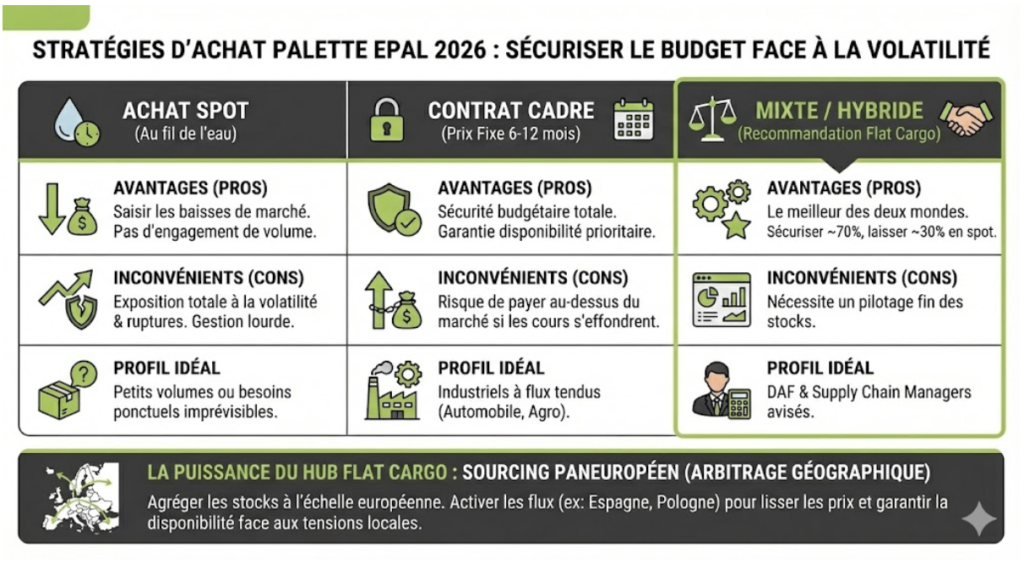
Faced with structural market volatility, buyers can no longer afford to be passive. Waiting for warehouse demand to place an order is the most expensive strategy. To regain control of your Total Cost of Ownership (TCO), it is imperative to activate two levers: contractual hedging (mixed sourcing) and geographic sourcing diversification.
Spot Buying vs. Framework Contracts (Hedging)
The eternal question: should you lock in a price for 12 months at the risk of paying above market rates if prices collapse, or buy as you go (Spot) at the risk of suffering a sudden price spike? The answer depends on your risk tolerance and your visibility on volumes.
- Capture immediate market dips.
- No volume commitment.
- Full exposure to volatility.
- Risk of supply disruption.
- The best of both worlds.
- Secure 70% via contract, leave 30% for spot.
- Requires precise inventory management.
- Total budgetary security (Hedging).
- Priority availability guarantee.
- Inertia against market downturns.
The Power of the Flat Cargo HUB: Pan-European Sourcing
Why limit your procurement to your local region? Price disparities between Eastern and Western Europe can reach 15%. The competitive advantage of the Flat Cargo HUB lies in its geographic arbitrage capability.
Thanks to our connected network, we aggregate available stocks on a European scale. If the French market is under pressure, we activate our flows from Spain or Poland to smooth out prices and guarantee availability. You are no longer buying from a captive local sawmill; you are buying from a liquid market.
Subsidizing Your Purchases: The Impact of "Fleet Buyback" on Your Average Price
In a traditional negotiation, you seek to lower the supplier's selling price. With the Flat Cargo approach, we propose lowering your net acquisition cost. How? By activating a "communicating vessel" financial mechanism between your waste and your purchases.
The concept is simple: every used pallet sitting on your site has a residual value. By reintroducing it into the circuit via our buyback offer, you generate a credit that mechanically subsidizes your new pallet purchases.
The "Netting" Mechanism: Selling to Buy Better
Stop looking at the "Face Price" of new pallets, and start looking at your "Net Cost Price". Here is a simulation for an order of 1,000 pallets, illustrating how the repurchase of your existing fleet offsets the rise in new pallet prices.
| Financial Flow | Classic Approach (Direct Purchase) |
Flat Cargo Approach (Purchase + Buyback) |
|---|---|---|
| Purchase 1,000 New Pallets (at 14.00€ / unit) | - 14,000 € | - 14,000 € |
| Dormant Stock Management (500 used pallets removed) | - 750 € (Waste/Skip Cost) | + 2,000 € (Fleet Buyback Gain*) |
| ACTUAL CASH OUTFLOW | - 14,750 € | - 12,000 € |
| UNIT COST PRICE | 14.75 € / pallet | 12.00 € / pallet |
Transforming your pallet waste into an acquisition budget
This gain of €2.75 per pallet (nearly 20% savings!) doesn't come from aggressive negotiations with the supplier, but from intelligent asset management. By signing a Buyback & Valorization contract with Flat Cargo, you transform a cost center (waste management) into a subsidy line for your Procurement Department.
Calculate the buyback value of your current fleet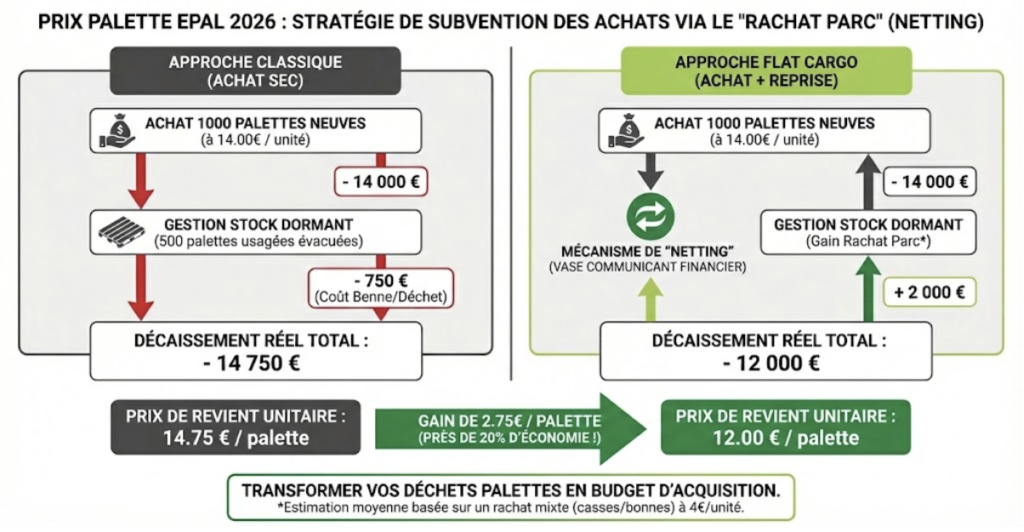
Conclusion: Information is Your First Margin
Today, the performance of a Purchasing or Supply Chain Director is no longer measured solely by their negotiation capacity, but by their ability to anticipate. In a market dominated by energy and regulatory volatility, those who simply "take" the daily price have already lost.
Flat Cargo offers you the tool to regain control: a clear view of cost components, a mixed sourcing strategy (New/Used), and direct access to pan-European stock. Do not let shortages or inflation dictate your P&L anymore.
Access Real-Time Market Prices
Stop navigating blind. Our Trading Floor aggregates stocks from 500 depots to provide you with the "Fair Price" and guaranteed availability.
- 📦 Full Truck Load (FTL) or Part Load
- 🔄 New, Grade A, or Grade B Pallets
- 🚛 Guaranteed Next-Day Delivery