
Complete guide to the EPAL European pallet
The EPAL European pallet: Standardizing global logistics
The EPAL European pallet is no longer a simple logistics accessory. It has established itself as the true unit of measurement for global efficiency. Whether you operate in the chemical industry, the agri-food sector, or construction, this standardized support constitutes the undisputed backbone of your supply chain. It guarantees that your goods cross borders and integrate into automated centers without the slightest friction.
Surgical knowledge to secure your current shipments
Logistics optimization today requires surgical knowledge of this medium, which has become a major strategic asset in the circular economy. Current logistics demands perfect mastery of manufacturing and repair standards. By relying on our range of EPAL certified pallets, you instantly secure your current shipments against the risks of warehouse refusal or customs blockages.
Streamlining all your current flows with Flat Cargo
The European standard serving your profitability
The integration of a homogeneous EPAL fleet transforms the management of your loading docks. Flat Cargo supports you in auditing and optimizing the use of these supports within your organization. This standardization is the most direct lever to streamline your current flows, reduce your handling costs, and affirm your commitment to sustainable and high-performance logistics.
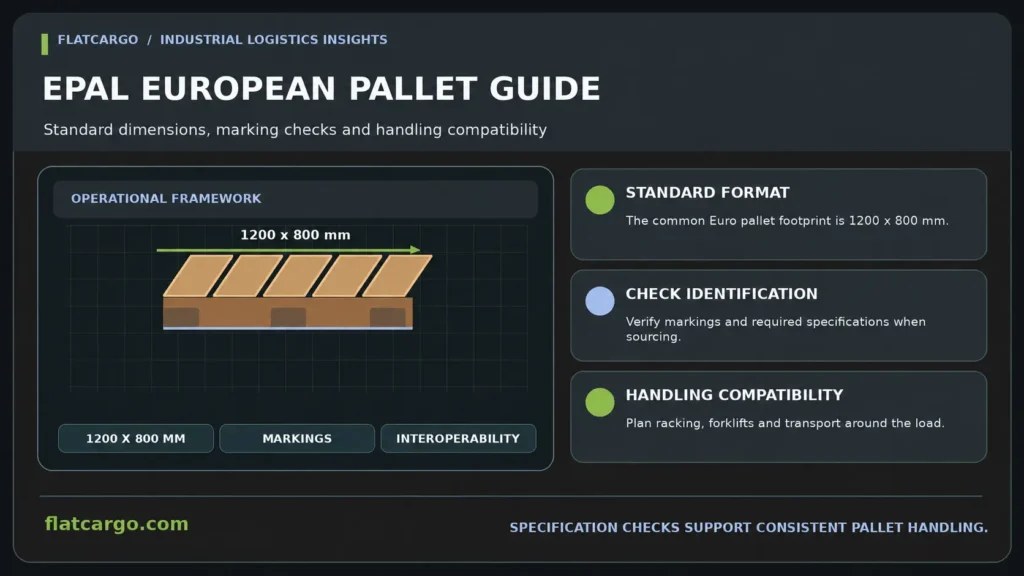
Anatomy and official standards of the EUR EPAL pallet
The European pallet is a four-way entry platform governed by extremely strict manufacturing (UIC 435-2) and repair (UIC 435-4) standards. This rigorous framework allows you to benefit from total interchangeability on the global market. Mastering this anatomy ensures the reliability of your current logistics.
Identification and certification for your current shipments
To ensure the safety of your current shipments, rapid visual identification is imperative on each support. Your teams must check these control points during receipt:
- EPAL logo Present on the left and right corner blocks, guaranteeing authenticity.
- EUR logo Symbolizing the historical interoperability of your current flows.
- Identification plate Indicating the precise manufacturer code and country of origin.
- Repair nail For renovated pallets, certifying a refurbishment compliant with official specifications.
Technical specifications and comparison of the EPAL range
Choosing the wrong support can lead to damage or costly rack storage refusals. Here is the reference table to guide your operational decisions and secure your current flows.
| Model | Dimensions (mm) | Weight | Dynamic Load |
|---|---|---|---|
| EPAL Standard | 800 × 1200 × 144 | ~ 25 kg | 1500 kg |
| EPAL 2 (Heavy) | 1200 × 1000 × 162 | ~ 35 kg | 1250 kg |
| Half pallet EPAL 6 | 800 × 600 × 144 | ~ 9.5 kg | 500 kg |
Strategic note for the storage of your current flows
It is crucial to differentiate between load capacities. While the static load on the ground can reach 4000 kg, the capacity in racks (shelving) is strictly limited to 1000 kg. Respecting this constraint is essential to ensure the safety of your teams and the integrity of your current logistics.