
Packaging Engineering for Custom Wooden Pallet Design and Production
Custom Wooden Pallet Solutions for Industrial Transport and Storage
A custom wooden pallet provides manufacturers, industrial distributors and logistics operators with a load carrier specifically engineered to accommodate products that cannot be safely or efficiently transported on standard pallet formats. Unlike conventional EUR/EPAL pallets, custom-made wooden pallets can be manufactured with tailored dimensions, reinforced deck boards, adapted stringers and optimized support points to meet precise handling and transportation requirements. These solutions are particularly relevant for heavy machinery, automotive components, aerospace equipment, industrial spare parts and oversized goods. When specifying a custom pallet, procurement teams should evaluate product weight, load distribution, static and dynamic load capacities, forklift accessibility, warehouse storage conditions and compatibility with transport vehicles. For international shipments, solid wood packaging must also meet applicable ISPM 15 phytosanitary requirements. Working with a specialized B2B supplier such as Flat Cargo enables businesses to coordinate technical specifications, material selection and production requirements while improving load stability and transport space utilization. A well-designed custom wooden pallet can help reduce packaging waste, limit handling-related damage and optimize the total cost of ownership (TCO) across recurring industrial logistics operations.
Structural engineering and mastery of mechanical constraints
Addressing geometric challenges in high-end sectors
| Evaluation criteria | Standard Support (EPAL) | Flat Cargo Custom Engineering |
|---|---|---|
| Load adaptation | Generic (standard) | Optimized (custom) |
| Risk of damage | Moderate (depends on product) | Minimal (targeted design) |
| Transport profitability | Standard (space waste) | Maximal (LDM optimization) |
Need a custom packaging solution?
Our experts analyze your mechanical constraints to design the ideal support for your high-value goods.
SUBMIT YOUR SPECIFICATIONS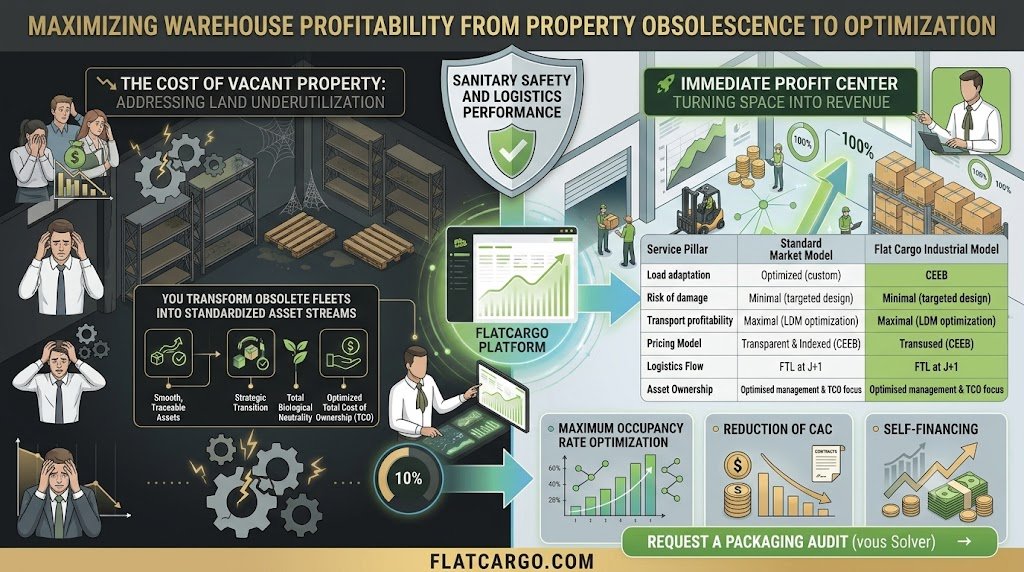
Design office structural resistance optimization for specific loads
The transition from mass logistics to precision logistics requires a total mastery of materials physics. Unlike standard supports, designing wood packaging for critical loads requires a predictive analysis of constraints. Our design office intervenes to model pallet behavior against compression, bending, and shearing forces, ensuring that each unit remains a secure asset throughout the supply chain.
CAD modeling and simulation
The use of Computer-Aided Design (CAD) software allows our engineers to simulate extreme use scenarios before the prototyping phase. This process identifies critical points of potential failure. By integrating a rigorous custom resistance calculation, we optimize deck thickness to reduce tare weight without compromising the structural rigidity required by your specifications.
Strategic wood species selection
The performance of an industrial pallet relies on the meticulous choice of wood species. Each project undergoes a trade-off: softwoods (Pine, Fir) are preferred for their flexibility and lightness, whereas hardwoods (Oak, Beech) are indispensable for exceptional loads or intensive cycles in aggressive logistics environments.
| Technical Parameter | Market Standard | Flat Cargo Engineering |
|---|---|---|
| Dimensional precision | +/- 5 mm | +/- 2 mm (AFNOR tolerances) |
| Bending calculation | Empirical | Finite element modeling |
| Moisture content (MC) | Variable | Controlled (KD - Kiln Dried upon request) |
An ill-suited support generates hidden costs such as product damage or automatic sorter stops. Prior to any production, we recommend requesting a comprehensive technical audit to validate the match between your infrastructure and your assets before any order on our Trading Floor.
REQUEST A TECHNICAL AUDIT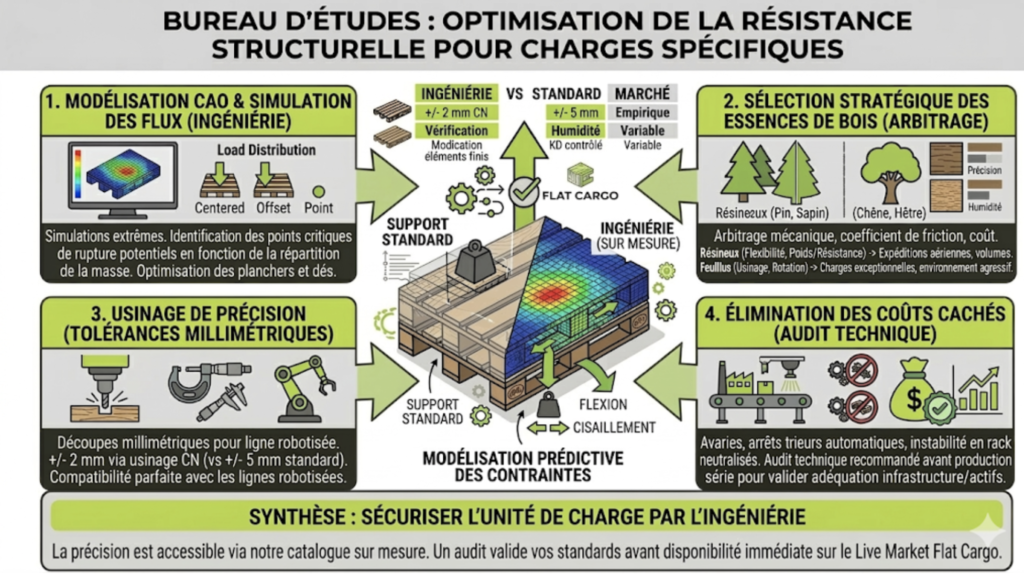
Export compliance and ISPM15 heat treatment (International safety)
For an industrial exporter, load supports must never become a logistical bottleneck. Cross-border shipment of specific equipment requires strict compliance with the ISPM15 standard. Wood treated in a non-compliant manner can lead to the immediate quarantine of the load unit, generating critical demurrage costs for your contractual commitments.
Mastery of the HT (Heat Treatment) cycle
The heat treatment process is managed with surgical precision: the core of the wood must reach a constant temperature of 56°C for 30 minutes. Custom export pallets require a heating time calibrated according to component thickness to guarantee total eradication of wood-boring organisms. Each production batch is subject to a certificate of conformity accessible via our quality audit service.
Customs security
The sender's liability is engaged as soon as the goods leave the factory. Within complex projects, Flat Cargo integrates ISPM15 compliance from the design phase at the engineering office. For flows to high-sensitivity destinations (Australia, USA, China), it is recommended to consult our network map of authorized centers for rapid compliance.
| Logistical Risk | Financial Impact | Security Protocol |
|---|---|---|
| ISPM15 marking defect | Rejection / Batch destruction | Indelible heat branding (4 sides) |
| Use of unbarked wood | Heavy customs fines | Machining with DB (Debarked) certified wood |
| Excessive humidity (Mold) | Degradation of goods | Technical cell drying (Kiln Drying) |
Anticipating these constraints is at the heart of our engineering approach. A custom pallet is designed to be a sanitary barrier as much as a mechanical support. To avoid any phytosanitary risk, the design of hygiene and export plastic supports is also an alternative that can be modeled by our experts.
Industrialization and series production: Securing your production lines
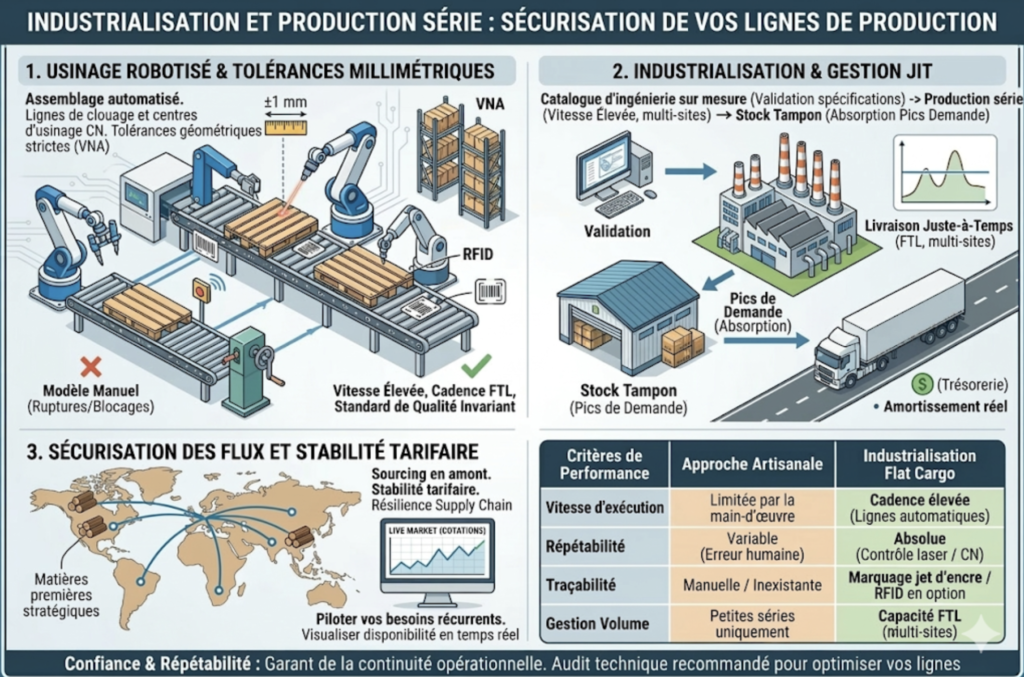
In an integrated Supply Chain model, a supply shortage of load supports is an unacceptable risk. The industrialization of pallet manufacturing requires reconciling design flexibility with mass production power. For a principal, a partner's capacity to deliver large volumes (in full truckloads - FTL) is the guarantee of operational continuity.
🤖 Robotic machining and precision
The production process relies on automated nailing lines and CNC machining centers. This technology imposes strict geometric tolerances, essential for smooth passage on automatic conveyors or high-density storage systems (VNA). By validating your specifications with our technical design office, you ensure consistent machining quality.
📦 Lean flows and Buffer stock
Supply management should not weigh on your working capital. Flat Cargo deploys buffer stock strategies and Just-in-Time (JIT) deliveries to absorb demand spikes. This resilience guarantees price stability. Budget management is facilitated by consulting our market price barometer and quotes.
| Performance Criteria | Craft Approach | Flat Cargo Industrialization |
|---|---|---|
| Execution speed | Limited by labor | High output (Automatic lines) |
| Repeatability | Variable (Human error) | Absolute (Laser / CNC control) |
| Traceability | Manual or non-existent | Inkjet marking / RFID optional |
| Volume Management | Small batches only | FTL capacity (Multi-site) |
Industrial performance is built on trust. Delegating the management of your specific supports to an expert capable of aligning their production with your schedules allows you to free up internal resources. It is recommended to request a technical audit to evaluate the productivity gains linked to the standardization of your formats.
Circular economy of specific assets: Value creation and captive fleet management
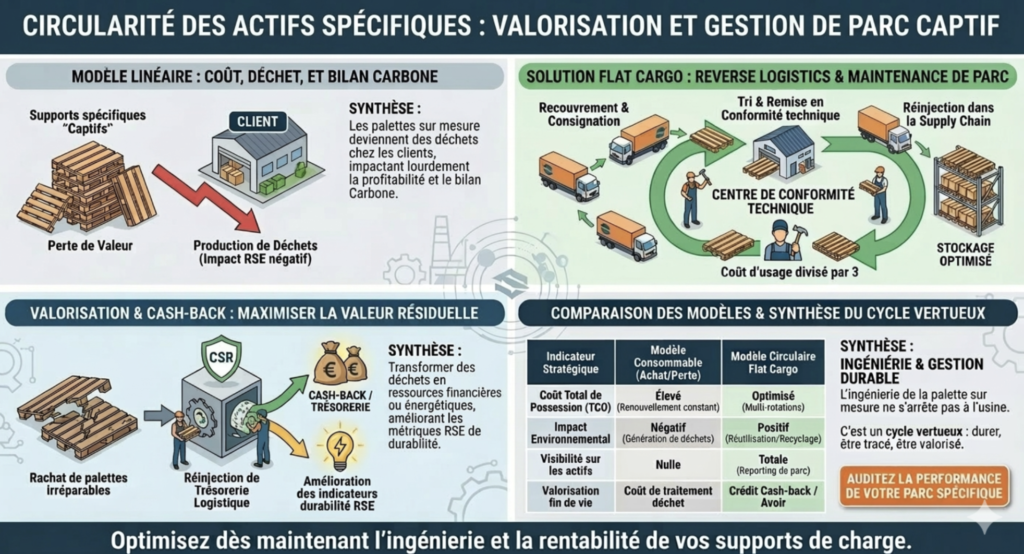
Acquiring a custom support fleet constitutes a set of strategic assets. Unlike standard pallets circulating in open pooling, specific supports create captive fleets. Without a dedicated management strategy, these high-value-added assets risk being decommissioned prematurely, impacting both profitability and carbon footprint.
🔄 Reverse Logistics and Maintenance
The longevity of a custom support relies on its ability to perform multiple rotations. Flat Cargo deploys reverse logistics solutions to organize the repatriation of your supports. Via our recovery and consignment service, we ensure sorting and technical restoration, thus reducing the need for manufacturing new units.
💰 Value Creation and Cash-back
The end-of-life of a custom wood support retains intrinsic value. Our pallet buyback and value creation program transforms irreparable assets into financial resources. This "Cash-back" mechanism reinjects liquidity into your logistics budgets while meeting European environmental regulation requirements.
| Strategic Indicator | Consumable Model (Buy/Lose) | Flat Cargo Circular Model |
|---|---|---|
| Total Cost of Ownership (TCO) | High (Constant renewal) | Optimized (Multi-rotation) |
| Environmental Impact | Waste generation | Reuse and Recycling |
| Asset visibility | None | Total (Fleet reporting) |
| End-of-life value | Waste treatment cost | Cash-back credit / Voucher |
Custom pallet engineering is part of a virtuous cycle where every support is designed to last, be tracked, and be valued. Our experts assist you in auditing the current performance of your fleets and identifying your potential savings.
DISCOVER OUR DESIGN OFFICE OFFERTechnical FAQ & Engineering Office
Industrial management teams regularly ask us about the technical specifications and design protocols of our custom equipment. Here are the answers to your main Supply Chain challenges.