
Custom Pallet Solutions and Supply Chain Optimization Strategies

Custom Pallet Solutions provide an effective way to adapt load supports to products with specific dimensions, weights, or handling requirements. Rather than relying on a standard format for every application, companies can use tailored pallet designs to improve load stability, space utilization, and handling efficiency across their supply chain.

Adapting the support to the product for more efficient logistics

By adapting the pallet to the product rather than forcing the product onto a standard support, you can make better use of warehouse and transport space. A bespoke design can reduce unnecessary dunnage and empty areas while providing the structural support required for the load. To explore these possibilities, discover our range of personalized wood designs.

Technical expertise for your operational performance

Making customization a practical logistics advantage

Flat Cargo supports companies in designing pallet solutions adapted to their products, handling constraints, and transport requirements. By requesting our packaging engineering audit, you can assess your existing supports and identify opportunities to improve load protection, space utilization, and logistics efficiency.

Strategic benefits of your custom supports

Designing a dedicated support allows you to respond precisely to requirements that standard formats may not fully address. Whether you need to handle unusual load dimensions, protect fragile products, or meet the constraints of automated handling, Custom Pallet Solutions can be adapted to the technical and operational requirements of your supply chain.

Identifying your requirements for more reliable shipments

Every industrial sector has its own requirements. For shipments serving industries such as aerospace, pharmaceuticals, or heavy equipment, the pallet should be considered as part of the product protection system. An effective design takes into account load distribution, dynamic handling, storage conditions, and compatibility with automated equipment. This level of precision can improve load stability and help reduce the risk of damage during transport.

Choosing materials according to your logistics requirements

Material selection influences the pallet's weight, strength, hygiene requirements, repairability, and total cost of ownership. The right choice depends on the load, handling environment, frequency of reuse, and transport conditions rather than on a single material characteristic.
Material Key characteristics Typical applications
Wood Repairable, versatile, widely available, and suitable for a broad range of loads General logistics, storage, and heavy loads
Plastic Easy to clean, resistant to moisture, and suitable for applications requiring consistent dimensions Food, pharmaceutical, and closed-loop logistics
Metal High strength, stiffness, and durability for demanding industrial environments Heavy industry and controlled returnable loops

Optimizing your TCO with Flat Cargo

The right material and custom pallet design should be selected according to your product, handling equipment, storage conditions, and transport requirements. At Flat Cargo, our engineers can analyze these constraints and identify a suitable configuration. A packaging performance audit can also help identify opportunities to reduce unnecessary packaging costs and improve logistics efficiency.
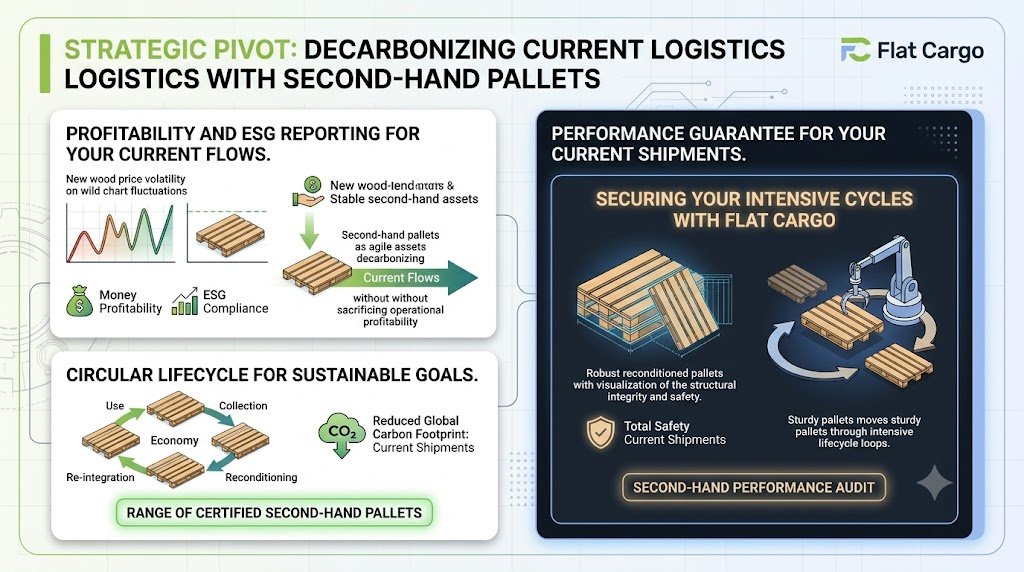
An infographic, branded by Flat Cargo, titled 'STRATEGIC PIVOT: DECARBONIZING CURRENT LOGISTICS WITH SECOND-HAND PALLETS.' The infographic is split into three main panels. The top-left panel focuses on 'PROFITABILITY AND ESG REPORTING FOR YOUR CURRENT FLOWS,' showing a line graph contrasting volatile new wood prices with stable second-hand asset costs, leading to an arrow showing second-hand pallets reducing carbon in 'Current Flows' without sacrificing operational profit. Icons for 'Money Profitability' and 'ESG Compliance.' The bottom-left panel details a 'CIRCULAR LIFECYCLE FOR SUSTAINABLE GOALS,' with a circular flow of 'Use, Collection, Reconditioning, Re-integration' leading to 'Reduced Global Carbon Footprint' for shipments. A button says 'RANGE OF CERTIFIED SECOND-HAND PALLETS.' The entire right panel guarantees 'PERFORMANCE GUARANTEE FOR YOUR CURRENT SHIPMENTS,' securing intensive cycles with robust reconditioned pallets featuring 'visualization of the structural integrity and safety.' It shows a robotic arm moving sturdier pallets through intensive lifecycle loops, with a shield icon for 'Total Safety Current Shipments' and a button for 'SECOND-HAND PERFORMANCE AUDIT.'

Technological innovation and traceability for modern logistics

Custom pallets can integrate tracking technologies that improve visibility across storage, handling, and transport operations. By combining a tailored physical design with digital identification, companies can gain better control over pallet movements, product handling, and asset circulation.

Integration of RFID tracking and IoT

Technology can be integrated directly into the pallet structure when traceability requirements justify it. RFID identification can help automate asset identification and inventory processes, while suitable IoT sensors can monitor selected conditions such as temperature, humidity, shock, or tilt. Flat Cargo can assess these requirements when designing custom pallet solutions and help determine whether an advanced traceability solution is appropriate for your logistics operation.

Financial strategies between acquisition and maintenance

The decision between purchasing new supports and repairing or reconditioning existing ones should consider the pallet's condition, expected service life, repair requirements, and total cost of ownership. Evaluating these factors helps companies make better-informed decisions about their logistics assets.

The ROI of reconditioning and repair

Extending the life of your strategic assets

Maintaining custom pallets can extend their useful service life and reduce the need for premature replacement. Depending on the pallet design, damage level, and repair requirements, reconditioning may offer a practical alternative to manufacturing a new support. Flat Cargo can assess the condition of your pallet fleet and identify suitable repair or replacement options. A logistics ROI audit can help compare these alternatives based on operational requirements and total ownership costs.

FAQ on optimizing custom pallet fleets

How does custom design reduce your carbon footprint?

By optimizing the dimensions of your supports to match your products exactly, you radically eliminate the transport of air. For your current flows, this means increased load density per truck, fewer trips required, and a direct reduction in your CO2 emissions per unit transported.

Is custom design compatible with your standard racks?

Absolutely. During the design phase, our engineers scrupulously integrate the constraints of your existing infrastructure. Your custom pallets are drawn to be handled effortlessly by your current forklifts and stored safely in your racks, without any modification necessary to your facilities within current logistics.

Conclusion on the transition to high-precision logistics

Mastering your load supports is primarily about mastering your operational profitability. Custom pallets stand out as the cornerstone of an agile, sustainable, and perfectly connected supply chain.

By investing in solutions adapted to your current flows, you secure your goods and optimize your transport costs sustainably. Flat Cargo supports you in transforming your technical constraints into real competitive advantages through cutting-edge engineering applied to all of your current shipments.