
CP8 Pallets and Securing Critical Industrial Loads
CP8 Pallets are the benchmark support for industrial operations handling heavy loads and specific bulk containers such as octabins. In modern logistics, where the security of chemicals and raw materials is an absolute priority, this standardized format guarantees flawless load stability. Its unique design, featuring a central opening for easy bottom discharge, makes it an indispensable tool for dry bulk material flows.
Flat Cargo analyzes the performance drivers of the CP8 pallet to transform the reliability of your current shipments, while meeting the strict durability demands of 2026.
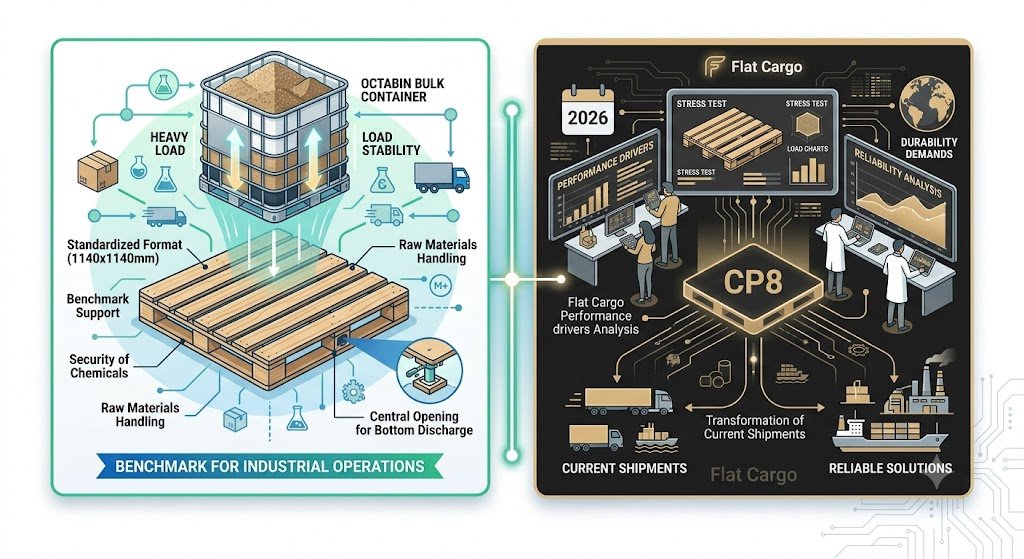
Technical specifications of the 1140 x 1140 mm format
Reinforced design for octabin transport
Payload capacity for industrial flows
Mechanical resistance and safety
Made from high-density timber, the CP8 pallet has a dynamic load capacity exceeding 1500 kg. This mechanical strength is essential for transporting powders, granules, or heavy metal components. In 2026, carrier reliability is the primary defense against handling accidents. By integrating CP8 pallets into your current shipments, you drastically reduce line disruptions caused by failing carriers, thereby optimizing your overall logistics cost price.
Operational advantages in current chemical logistics
Stacking optimization in warehouses and shipping containers
Damage risk reduction during current shipments
| Logistics Challenge | CP8 Pallet Solution | Operational Gain |
|---|---|---|
| Dead space in shipping containers | Adapted 1140 x 1140 mm dimensions | Maximized fill rate |
| Big bag puncturing | Flat and solid contact surface | Zero material damage |
| Stacking instability | Perimeter bottom frame | Increased operator safety |
Operational advantages in current chemical logistics
Stacking optimization in warehouses and shipping containers
Damage risk reduction during current shipments
| Logistics Challenge | CP8 Pallet Solution | Operational Gain |
|---|---|---|
| Dead space in shipping containers | Adapted 1140 x 1140 mm dimensions | Maximized fill rate |
| Big bag puncturing | Flat and solid contact surface | Zero material damage |
| Stacking instability | Perimeter bottom frame | Increased operator safety |
FAQ on the use and maintenance of the CP8 pallet
What is the fundamental difference between a CP8 and a classic Euro pallet?
The difference lies in the target use. While the Euro pallet (1200 x 800 mm) is versatile for general distribution, the CP8 pallet (1140 x 1140 mm) was developed with specific engineering for the chemical industry. Its main feature is its central opening, which allows bottom discharge of Big Bags (FIBCs) and octabins, while offering reinforced perimeter load-bearing to prevent these heavy loads from sagging.
How to optimize safety when handling octabins on CP8 pallets?
Safety relies on two main pillars, load centering and carrier integrity. Ensure that the octabin rests perfectly on the outer frame of the pallet to distribute pressure. In your current flows, it is crucial to regularly inspect your CP8 pallets. If the central support boards show signs of wear, preventive repair will prevent container failure during lifting.
Conclusion on securing industrial bulk loads
The CP8 pallet is not just an alternative format, it is the technical safeguard of your most sensitive operations. By offering perfect synergy between robustness, shipping container compatibility, and ingenious design for octabins, it stands out as the most rational investment for the chemical industry.
In a context where damage-related costs are skyrocketing, choosing CP8 standardization means securing your current shipments from end to end. Flat Cargo puts its industrial expertise at your service to audit, supply, and maintain your chemical pallet fleet, in full compliance with the environmental and customs requirements of 2026.
Secure your industrial bulk flows today
Access our certified chemical pallet catalog and optimize your supply chain reliability.