
Strategies for Choosing Transport Pallet and Flow Optimization
Choosing the right transport pallet is no longer a simple procurement formality; it is a fundamental logistics engineering decision. In a high-pressure supply chain, the unit load is the common denominator connecting your factory, your carriers, and your end customers. Selecting an inadequate support creates a structural vulnerability throughout your operations, leading to excess freight costs, load shifts, and commercial disputes.
To transform this constraint into a competitive advantage, it is essential to move from a unit-price-based approach to a comprehensive life-cycle analysis. Flat Cargo guides you through a rigorous assessment of your requirements to align your material handling supports with the profitability and safety demands of modern logistics.
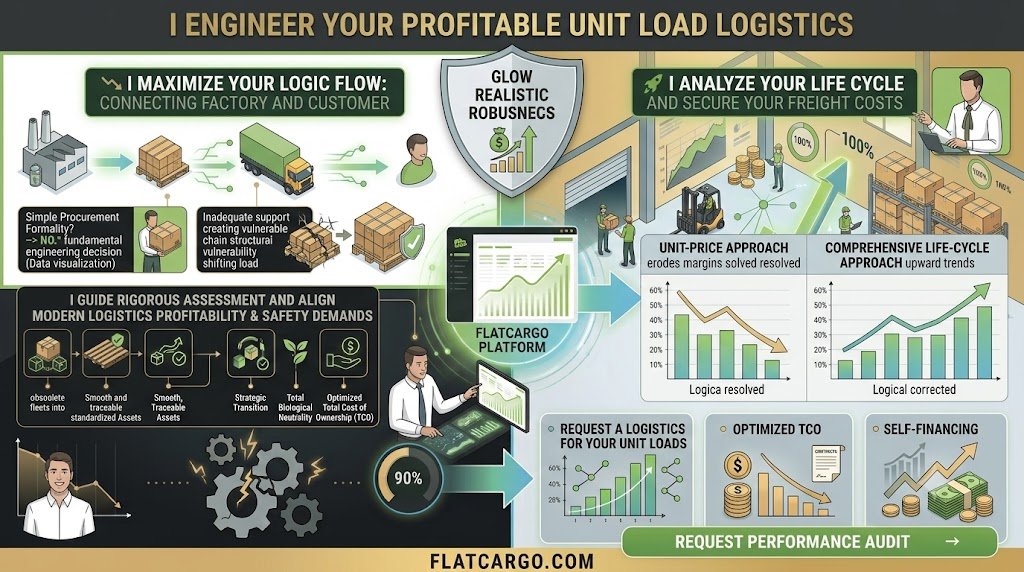
Evaluating logistics constraints and selecting material handling supports
Mastering dynamic and static loads according to stacking requirements
| Load Type | Operational Definition | Risk of undersizing |
|---|---|---|
| Static | Floor storage or stationary stacking | Stack collapse and product crushing |
| Dynamic | Transport (truck, train) or forklift handling | Support breakage during acceleration phases |
| Rack | Pallet racking (resting on two beams) | Excessive deflection or sudden drop of the unit load |
ISPM15 export compliance and international sanitary requirements
Comparative material analysis and impact on total cost of ownership
Wooden pallets for a balance between robustness and repairability
Plastic solutions for hygiene and long-term amortization
Metal structures for heavy industry extreme loads
| Support material | Initial investment (CAPEX) | Average estimated lifespan | Preferred application sector |
|---|---|---|---|
| Wood (Standard / EPAL) | Low to Moderate | Short to Medium (repairable) | Mass retail, Open flows |
| Plastic (HDPE / PP) | Moderate to High | Long (over 10 years) | Pharma, Food processing, Closed flows |
| Metal (Steel / Aluminum) | Very High | Extreme (over 20 years) | Heavy industry, Automotive, Foundries |
Improving trailer fill rate and pallet stacking in road freight
Volumetric optimization through adherence to dimensional standards
Reducing return flows through nestable designs
The lever of extreme compactness
This ingenious geometry allows for stacking up to three times as many empty supports in the same footprint. By optimizing the fill rate in this manner, you drastically reduce the number of rotations required for material repatriation, effectively dividing the freight costs of your return shipments by three in the context of modern logistics.
Testing protocol and operational validation of your equipment
Compatibility with automated handling infrastructures
Simulating transport stresses and impact resistance
| Field testing phase | Elements to control | Profitability objective (ROI) |
|---|---|---|
| Intralogistics audit | Conveyor throughput and gripper handling | Zero machine downtime |
| Stacking trial | Rack stability and deck deflection | Optimizing storage surface area |
| Road pilot testing | Impact and vibration resistance | Eliminating disputes and customer damage claims |
FAQ on selecting and managing logistics equipment
International standards and format interoperability
The most universal size for international transport is the standard Euro format (800x1200 mm). This dimension is the gold standard of global logistics. It guarantees total interoperability with maritime containers, semi-trailers, and standardized warehouse racking systems. Using this format helps maximize fill rates and prevents cargo breaks during transfers between different carriers in modern logistics.
Environmental impact and end of life for supports
The choice of material directly influences your supply chain's carbon footprint. While HDPE plastic is petrochemical-based, its end-of-life recyclability and exceptional longevity offset its initial ecological cost. Conversely, wood is a bio-sourced and biodegradable material, but its massive usage encourages deforestation if not sourced from certified channels. The most eco-responsible strategy consists of prioritizing continuous repair and the integration of recycled materials to minimize industrial waste.
Conclusion on your supply chain equipment strategy
Transport pallet selection dictates the pace, safety, and profitability of your shipments. Whether made of repairable wood, hygienic plastic, or ultra-resistant metal, each support meets precise technical specifications. By evaluating your stacking constraints, customs obligations, and the architecture of your return flows, you transform a simple loading platform into a real competitive asset. Flat Cargo puts its engineering expertise at your disposal to audit your processes and deploy handling solutions perfectly aligned with the economic and environmental requirements of your current shipments.
Secure your logistics flows with high-engineering supports
Benefit from custom guidance to reduce your transport costs and optimize your fill rate.