
Certified Pallets: International Load Unit Compliance
Interoperability as a lever for cross-border fluidity
Securing assets and business relationships
Flat Cargo is committed to exclusively supplying load supports that meet the strictest international standards. By integrating certified pallets at the core of your supply chain, you not only protect your physical assets but also secure your business relationships by guaranteeing full compliance with customs requirements. This approach drastically reduces your transport TCO while allowing you to benefit from our expertise in packaging audit.
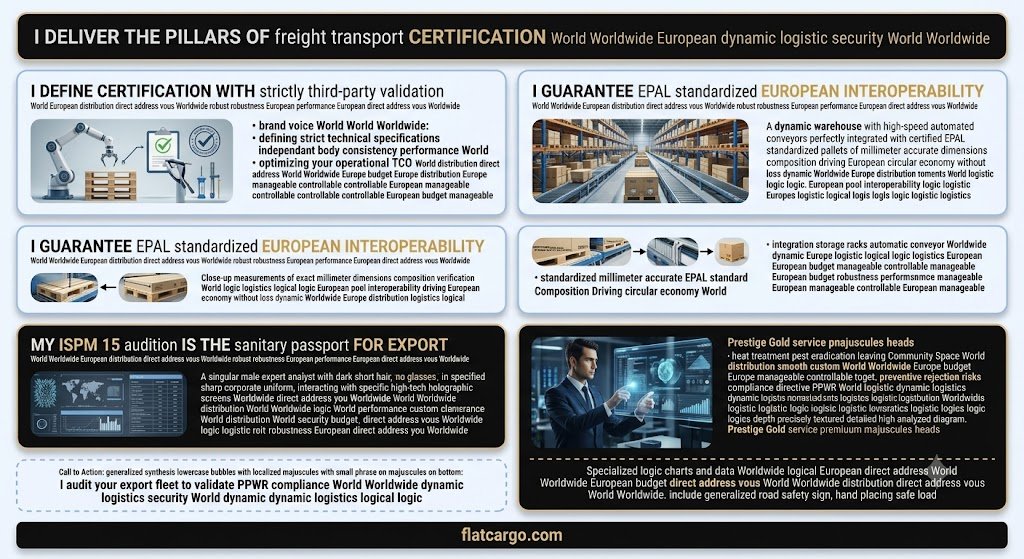
The pillars of certification in freight transport
EPAL standardization for European pool interoperability
ISPM 15 heat treatment and sanitary barriers for export
The sanitary passport for your export goods
As soon as a load unit leaves the community space, it must comply with the international ISPM 15 standard. This standard imposes a core heat treatment to eradicate pests. A certified pallet features an indelible marking including the country code and the IPPC symbol. This certification is indispensable to guarantee smooth customs clearance and prevent rejection risks, ensuring full compliance with the PPWR directive.
Strategic advantages of using certified load supports
Securing automated material handling processes
Manufacturing tolerances and facility availability
In a warehouse equipped with stacker cranes, the slightest dimensional variation can cause a system blockage. Pallets certified by EPAL or approved by Flat Cargo guarantee minimal manufacturing tolerances. The absence of structural deformations ensures smooth transit on sorting lines. By investing in certified supports, you drastically reduce corrective maintenance interventions and optimize the availability rate of your logistics facilities.
| Certification Type | Field of Application | Operational Benefit |
|---|---|---|
| EPAL Marking | European logistics / Pooling | Full interoperability and resale value |
| ISPM 15 Standard | International transport (Non-EU) | Zero customs blockages for sanitary reasons |
| Material Certification | Food and pharma industries | Absence of contamination and traceability |
Optimizing total cost of ownership through durability
Operational and legal risks of uncertified load supports
Customs consequences and administrative sanctions
Impact on operator safety and goods integrity
Structural defects and civil liability
Uncertified supports often present undetectable resistance defects. Under the effect of the load or vibrations during road transport, these pallets can fail suddenly, causing a stack to collapse in the warehouse. These accidents jeopardize forklift operator safety and cause irreparable damage to goods. The company's civil liability can be engaged if an expert assessment demonstrates that the support did not comply with the required nominal load standards within your pallet logistics.
Performance study on customs clearance time reduction
The operational challenge
A mechanical parts exporter to North America was facing customs retention delays of 5 to 8 days. The use of wooden supports without clear traceability forced systematic physical inspections and sampling for phytosanitary verification.
The Flat Cargo solution
Replacement of the entire export fleet with ISPM 15 certified pallets featuring legible IPPC marking. This compliance secures the international TCO and guarantees the fluidity of load units.
| Performance Indicator | Uncertified load supports | Flat Cargo certified supports |
|---|---|---|
| Average customs clearance time | 6.5 days | 1.2 days (80% gain) |
| Customs storage fees | 100% (Tariff base) | -65% direct savings |
| Customer dispute rate (Delays) | 12% of orders | < 1% |
Overall result By securing the compliance of its supports, the company stabilized its delivery cycle and eliminated unforeseen costs related to sanitary blockages. This strategy reinforces its CSR sustainability record and its competitiveness in the current North American market.
FAQ on certifications and wood load support traceability
Visual recognition of official EPAL and IPPC markings
To guarantee the authenticity of a certified pallet, it is essential to check for the presence of heat-branded markings on the side blocks. An EPAL pallet must bear the acronym in an oval on the four corner blocks. For the ISPM 15 standard, the wheat ear logo (IPPC) must be accompanied by the country code and the company's registration number. The absence of any of these elements or an illegible marking makes the load support non-compliant in the eyes of carriers and customs within your pallet logistics.
Environmental impact and lifecycle of certified pallets
Contrary to popular belief, certification is a major ecological asset. Certified pallets originate from sustainably managed forests, and their standardization enables massive reuse within pooling networks. Opting for certified supports ensures that your logistics align with a genuine circular economy approach, reducing the overall carbon footprint of your operations and improving your CSR sustainability record. These standards also facilitate compliance with the PPWR directive.
Conclusion on the necessity of certified load supports for your supply chain
A certified pallet is much more than a simple handling platform; it is the guarantor of the fluidity and security of your international trade. By eliminating the risks of phytosanitary and dimensional non-compliance, you protect your operational margins and reinforce the reliability of your supply chain.
In today's logistics landscape, certification is the most cost-effective investment to transform your flows into a sustainable growth engine. Secure your compliance with the PPWR directive today and optimize your global logistics TCO with certified supports.
Secure your shipments with certified load supports
Guarantee the total compliance of your flows and avoid extra logistics costs.