Becoming an Independent Logistics Provider: A Turnkey Business Model

Operational Opportunity
INVESTOR PROFILE

The industrial logistics sector suffers from a glaring shortage of local operational nodes. You have vacant warehouse space but fear the commercial risk associated with new client acquisition.

Launching a traditional transport business requires massive investments, particularly in fleets and fuel, exposing you to a value-destructive price war. Without guaranteed business volume, your square footage generates a straight financial loss month after month.

The solution lies in integrating into a decentralized European infrastructure. By joining our network as a Trusted Industrial Partner, you gain access to a turnkey business model that ensures continuous inbound volume and immediate profitability for your storage space.

Business Inbound GUARANTEED Commercial risk neutralized
Target warehouse occupancy rate 100%

Supply chain volume injected directly via national key accounts within the Circul-R and Hub ecosystem.

FLAT CARGO HUB SYSTEM :: TELEMETRY.
[OPERATIONAL ANALYSIS IN PROGRESS]
Join the Network
STG_01: SPACE AUDIT
Technical Validation
FTL access & warehouse space capacity
STG_02: TECH INTEGRATION
Data Flow Connection
Real-time inventory management
STG_03: EPAL STANDARDS
Initial Training
Pallet return & quality processes
STG_04: VOLUME INJECTION
Automated Inbound
Exclusivity zone activation
< 15 DAYS
Global Hub Deployment
[Target Objective: Full Integration]
Sector Profitability Study
INVESTOR PROFILE

Logistics Franchise - A Profitable Business Idea in the Industrial Sector

Why Launching a Traditional Transport Company Has Become Risky

The traditional road freight model is under intense pressure today. For an investor, the initial capital expenditure (CAPEX) is disproportionate to the expected profitability.
  • Massive acquisition costs: Purchasing or leasing a heavy vehicle fleet ties up your cash flow and limits your borrowing capacity.
  • Volatile operating expenses (OPEX): Constant fluctuations in fuel prices, maintenance, and insurance destroy any mid-term financial predictability.
  • Management complexity: Managing driving personnel and exposure to road liabilities significantly weigh down operational profitability.
In this context, the price war imposed on traditional freight exchanges squeezes subcontractors' margins to the point of financial asphyxiation.

Setting Up a Truck-Free Logistics Business - A Strategic Pivot

Value no longer lies in the movement of goods, but in controlling the storage and distribution points. Operating a local logistics hub allows you to eliminate fleet management risks and focus on a high-value-added model: monetizing your square footage.
Here is the comparative financial equation:
Financial Indicator Conventional Road Transport Flat Cargo Logistics Franchise
Initial CAPEX High (Vehicle Fleet) Controlled (Warehouse Build-out)
Operational Risk Critical (Accidents, Breakdowns) Low (Secure Indoor Supply Flows)
Client Acquisition Continuous prospecting Guaranteed business inbound (Exclusivity)
Target EBITDA 2% to 4% 12% to 15%
Average Target EBITDA +15%
Predictable profit generation Max
This strategic pivot transforms dormant infrastructure into a highly predictable profit center, backed by industrial master service agreements.
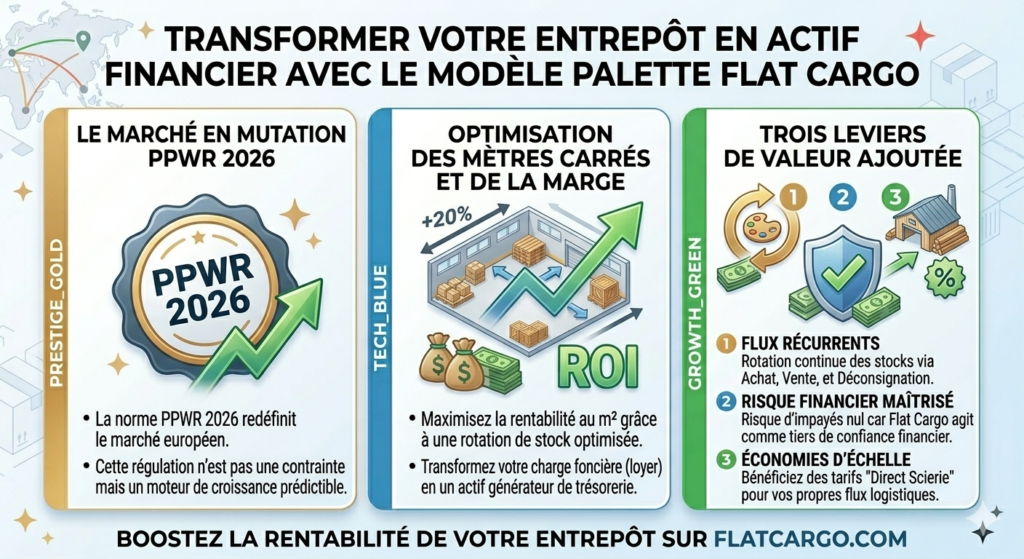
Infographie stratégique pour Flat Cargo expliquant comment assurer la rentabilité de votre entrepôt de stockage de palettes bois face à la norme PPWR 2026. Le visuel montre comment transformer une charge foncière en actif générateur de trésorerie grâce à l'optimisation des mètres carrés et de la marge nette. Elle détaille trois leviers de valeur : des flux récurrents avec une rotation continue (Achat/Vente/Déconsignation), un risque d'impayés nul grâce au rôle de tiers de confiance financier de Flat Cargo, et des économies d'échelle avec un accès aux tarifs Direct Scierie pour booster la performance de votre supply chain sur flatcargo.com.
Financial Projection
BUSINESS PLAN

Wooden Pallet Business Model - Securing Warehouse Profitability

The European wooden pallet market is undergoing a major structural transformation with the implementation of the PPWR 2026 regulation. For a Flat Cargo partner, this regulation is not a constraint, but a driver of predictable growth.

Square Footage Optimization and Net Margin Protection

Unlike passive warehousing, operating a Flat Cargo hub maximizes profitability per square foot through optimized inventory turnover. Our infrastructure turns a real estate liability (warehouse rent) into a cash-generating asset.
  • Recurring revenue streams: continuous inventory turnover (Purchase/Sale/Pallet Return).
  • Zero bad debt risk: Flat Cargo acts as a trusted financial clearinghouse.
  • Economies of scale: access to "Direct-from-Sawmill" pricing for your own supply flows.

Guaranteed Inbound Volume - The Lever for Your EBITDA

The primary cause of failure for independent logistics providers is the inability to fill the warehouse from month one. Flat Cargo solves this structural issue by immediately injecting volumes from our national master service agreements (manufacturing, chemicals, agrifood).

Impact on your income statement (typical simulation):
Revenue Stream / Cost Item Standalone Independent Flat Cargo Partner
Business Inbound (Volume) Uncertain (Active Prospecting) Guaranteed (Master Agreements)
Average Net Margin Variable (Price War) Protected (Indexed Pricing)
Infrastructure Fee €0 Fixed Subscription (SaaS + Brand)
Annual EBITDA (Est.) Low / Unstable Optimized & Scalable
To secure your investment, we limit the number of locations per region. It is imperative to verify the eligibility of your exclusivity zone before initiating any administrative procedures.
SCALABILITY LAYER :: MULTI_HUB_OS
From local hub to territorial grid
Open a Hub
[ACTIVE_TERRITORIAL_MAPPING]
OPEX Dilution / Hub Fixed cost optimization
-25%
Business Volume Integrated multi-hub network
OPTIMIZED
Deployment Model Controlled saturation threshold
REPLICATION
Digital Command Center
SAAS TECHNOLOGY

Infrastructure Technology - Digital Steering of Your Net Margin

Operating a Flat Cargo hub goes far beyond physical material handling. You become the manager of a data node within a decentralized European logistics infrastructure.

SaaS Interface and Real-Time Supply Flow Synchronization

Every partner gains access to our proprietary platform, enabling full visibility over inventory and transport orders. This digitalization eliminates input errors and optimizes the turnover rate of your real estate assets.
Error Reduction 99%
Data synchronization reliability Max

Automated Reporting and EBITDA Optimization

The Flat Cargo technological tool automates time-consuming administrative tasks. By reducing your administrative personnel requirements (OPEX), you directly safeguard your operational profitability and ensure stable dividend returns.
OPEX ↓

The reduction in fixed costs driven by software automation mechanically transfers into net profit on your income statement.

Deployment Timeline
ACCELERATED ONBOARDING

Steps to Become an Independent Logistics Provider with the Flat Cargo Infrastructure

Joining the Flat Cargo network requires no business development skills. Our "Business in a Box" model is designed for immediate execution.

A Rapid and Standardized Operational Deployment

Thanks to our industrial protocols, opening your logistics hub follows a rigorous timeline, guaranteeing you are up and running in less than 15 days:
1

Space audit: Technical validation of your warehouse (FTL access, storage capacity).

2

Technological integration: Connection of your platform to Flat Cargo data streams for real-time inventory management.

3

Initial training: Know-how transfer regarding EPAL quality standards and pallet return processes.

4

Volume injection: Activation of automated business inbound within your exclusivity zone.

Go-To-Market 15 Days
Validation and supply flow injection 100%
Verify My Warehouse Eligibility (2-Min Test)

Model requiring minimum storage space and an equity contribution.

Projection & Development
SCALE & EXIT

Scalability strategy: from local hub to territorial grid

The Flat Cargo model is designed for builders looking to replicate local success on a regional or national scale.

Model Replication Across Multiple Exclusivity Zones

As soon as your first hub reaches its saturation threshold, our structure supports you in opening secondary hubs. This scalability allows you to dilute your core fixed costs and multiply your overall business volume.
OPEX Dilution / Hub -25%
Business volume multiplier (Multi-Hub Network) Optimized

Asset Equity Valuation of Your Logistics Profit Center

As an affiliated independent logistics provider, you build a tangible and valuable asset. The standardization of our processes facilitates the transfer or resale of your infrastructure in the medium term, ensuring a potential capital gain on your initial investment.
Capitalizing Your Network Affiliation with the Flat Cargo franchise mechanically increases the valuation multiple upon the sale of your operating company.
ASSET Liquid & Valuable
Executive Summary
DECISION STAGE

Conclusion - Maximize the Profitability of Your Real Estate Assets

The independent logistics provider model under the Flat Cargo franchise is the structural response to circular logistics challenges. You safeguard your EBITDA while becoming a key player in European logistics sovereignty.
Financial Protection PROTECTED EBITDA
DISCOVER THE FRANCHISE AND VERIFY MY ELIGIBILITY
Business Model Validation
INVESTOR FAQ

FAQ

CAPEX

What is the budget required to open a Flat Cargo logistics franchise?

The entry ticket is set at €2,500. This amount covers technological integration, training in operational protocols, and access to our European network. No heavy investments, such as acquiring a road vehicle fleet, are required. Your initial CAPEX is thus strictly controlled.
RISK

Do I need to prospect to find industrial clients?

No. The model relies on guaranteed business inbound. Flat Cargo signs master service agreements with manufacturers and key accounts, then directly injects these operational volumes into your logistics hub. You focus on operational execution; we secure your revenue.
OPEX

What is the average profitability of a partner storage warehouse?

The target EBITDA for a partner hub ranges between 12% and 15%, depending on your operating footprint and asset turnover (EPAL pallets). Volume consolidation and pallet returns allow you to quickly offset your fixed real estate costs (OPEX) and safeguard your Net Margin.
Barrier to entry €2,500
Business Volume Guarantee SECURED

Immediate execution via a Trusted Industrial Partner agreement.