
How Wooden Crates Protect Cargo During Sea Freight
Wooden crates for sea freight play a critical role in protecting industrial cargo throughout international maritime transportation. Unlike packaging intended primarily for domestic distribution, sea freight packaging must account for prolonged transit times, variable environmental conditions and repeated handling at ports and logistics terminals.
Industrial machinery, sensitive equipment and high-value components can be exposed to vibration, condensation, mechanical shocks and changes in temperature. Choosing properly engineered wooden shipping crates helps reduce these risks while improving cargo stability and handling efficiency.
Packaging decisions should therefore consider the entire journey, from manufacturing and warehouse preparation to container loading and final delivery. Businesses can integrate these requirements into a broader strategy for selecting wooden transport crates for international logistics to improve consistency between packaging specifications and freight operations.
Why Port Handling and Marine Conditions Threaten Industrial Cargo
Maritime shipments involve several operational risks that should be addressed during packaging design. Crates may experience repeated lifting, handling and movement during loading, unloading and transshipment.
Inside freight containers, temperature fluctuations can contribute to condensation. When combined with prolonged exposure to humid conditions, inadequate packaging may increase the risk of corrosion, material degradation and damage to moisture-sensitive products.
Appropriate structural reinforcement, internal securing and moisture protection should be selected according to the cargo's characteristics and the intended shipping route.
Balancing Shipment Protection with Container Space Efficiency
At Flat Cargo, effective export packaging engineering means balancing mechanical protection with freight efficiency. Custom crate dimensions can help reduce unused space, improve container loading arrangements and limit unnecessary packaging weight. These decisions should be supported by an assessment of cargo dimensions, handling requirements and total logistics costs.
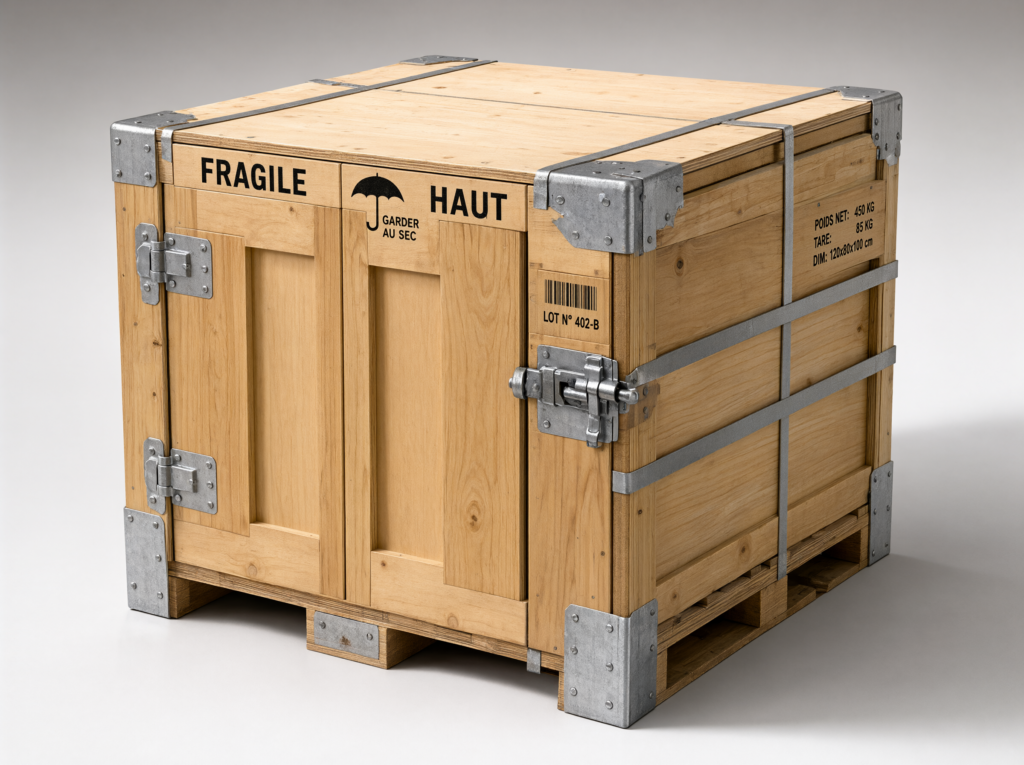
How Custom Wooden Crates for Sea Freight Improve Loading Efficiency
Exporting industrial machinery, aerospace components or high-value equipment requires packaging designed around the cargo rather than relying on standard dimensions. Custom wooden crates for sea freight provide the flexibility to accommodate irregular shapes, concentrated loads and demanding handling requirements.
Effective packaging engineering combines structural protection with efficient use of transport space. The objective is to minimise unnecessary packaging volume while maintaining the mechanical strength needed for international shipping.
Optimising Wooden Crate Dimensions for Maritime Containers
Container loading efficiency is an important consideration when designing wooden export crates. Industrial shippers must account for the internal dimensions of 20-foot and 40-foot containers, including door clearances and practical loading constraints.
A crate that is unnecessarily wide, tall or long may limit the number of units that can be loaded into a container. Conversely, reducing packaging dimensions without sufficient structural analysis can expose cargo to damage.
Container loading optimisation begins with accurate measurements of the goods, including protruding components and required internal clearance.
Crate designers should then assess handling access, load distribution and the proposed loading arrangement. Three-dimensional modelling can help evaluate whether different crate configurations offer better use of the available container space.
How Wooden Packaging Costs Affect International Freight Budgets
The cost of sea freight packaging extends beyond the price of timber, panels and assembly. Total expenditure may also include protective materials, handling, securing equipment, storage and transport-related charges.
Custom wooden crates may require a higher initial investment than standard packaging, but a design adapted to the shipment can help reduce avoidable empty space and improve cargo protection.
Match external crate dimensions to cargo requirements and container loading constraints.
Specify reinforcement, internal supports and securing systems for the actual load.
Evaluate packaging expenditure alongside handling, container utilisation and damage risks.
Procurement teams can also consider how custom wooden pallet engineering supports load distribution and handling compatibility when designing industrial export packaging.
Designing Reinforced Crates for Maritime Handling and Vessel Movement
During maritime transportation, cargo may experience vibration, acceleration and movement associated with vessel operations. Port loading and unloading introduce additional handling forces that must be considered during crate design.
Structural Reinforcement and Safe Lifting Arrangements
Heavy-duty wooden crates may require reinforced bases, internal bracing, suitable load-bearing connections and dedicated lifting arrangements.
Where crane handling is anticipated, lifting points should be specifically engineered and rated for the intended operation. Forklift entry points and restraint arrangements must also be compatible with the cargo and handling procedures.
Appropriate structural design, combined with a verified cargo-securing plan, helps reduce movement and damage during international transport.
How to Protect Wooden Sea Freight Crates from Moisture
International maritime transportation exposes industrial cargo to changing temperatures, humidity and potential condensation inside freight containers. For businesses using wooden crates for sea freight, controlling these conditions is essential to reduce the risk of corrosion, packaging deterioration and damage to sensitive equipment.
A suitable export packaging strategy combines structural protection, moisture management and compliance with applicable phytosanitary requirements. These measures should be adapted to the materials being transported, the duration of the shipment and the destination country.
How Moisture Barriers and VCI Films Help Prevent Corrosion
Container condensation can develop when humid air encounters cooler surfaces during temperature changes. Metal components and machinery are particularly vulnerable when moisture accumulates inside inadequate packaging.
VCI corrosion protection, using volatile corrosion inhibitor materials, can help limit oxidation on compatible metal surfaces. VCI films, papers or emitters release corrosion-inhibiting substances within a suitable enclosed packaging environment.
Suitable barrier films and sealed protective enclosures can help restrict moisture entering the packaging space. Their effectiveness depends on the material specification, sealing quality and transport conditions.
Appropriately sized desiccants can help manage residual moisture, while compatible VCI materials provide additional corrosion protection for metal parts. Product selection should follow the supplier's technical guidance.
Packaging preparation matters. Metal components should be clean and dry before protective wrapping. VCI materials must be compatible with the metals, coatings and other substances present.
The selected barrier system should also account for shipment duration, temperature variations and the possibility of moisture exposure. Neither VCI materials nor desiccants should be treated as a guarantee against corrosion in all conditions.
What Does ISPM 15 Require for Export Wooden Crates?
ISPM 15, also known as the International Standard for Phytosanitary Measures No. 15, establishes requirements intended to reduce the risk of spreading pests through solid wood packaging used in international trade.
Where the standard applies, wooden crates and associated packaging components must meet the approved treatment, debarking and marking requirements. The internationally recognised IPPC mark identifies the relevant country, authorised producer or treatment provider and treatment code.
Exporters should verify destination requirements before shipping. A valid ISPM 15 mark supports phytosanitary compliance but does not replace other customs, cargo or import documentation.
Businesses sourcing export packaging can also review ISPM 15 pallet requirements for international shipments when planning the use of solid wood pallets, crates and supporting materials.
Important Distinction for Plywood Export Crates
Packaging made entirely from certain processed wood materials, such as plywood or oriented strand board manufactured using glue, heat or pressure, is generally exempt from ISPM 15 requirements.
However, a plywood crate containing solid wood frames, runners or reinforcement may still include components subject to the standard. The complete packaging construction should therefore be assessed before export.
Checking treatment records, the legibility of the IPPC mark where required, and the rules of the destination country helps reduce avoidable compliance problems.
How to Audit Wooden Crate Performance for Maritime Exports
Evaluating sea freight packaging requires more than checking whether a wooden crate can support the weight of its cargo. Industrial exporters must also assess moisture protection, container loading efficiency, regulatory compliance and the total cost of shipping operations.
An effective packaging audit compares standard shipping solutions with custom wooden export crates designed around specific cargo and transport requirements. The objective is to identify avoidable risks and select packaging that delivers suitable protection without unnecessary expenditure.
Which Risks Should a Sea Freight Packaging Audit Measure?
| Performance Indicator | Non-Optimised Standard Crate | Engineered Wooden Export Crate |
|---|---|---|
| Corrosion Protection | Basic wrapping may provide insufficient protection against condensation and moisture exposure. | Suitable moisture barriers, desiccants and compatible VCI protection can be specified according to cargo requirements. |
| Container Space Utilisation | Standard dimensions may leave unusable space or complicate loading arrangements. | Custom dimensions and loading simulations can help improve container space utilisation. |
| Export Compliance | Solid wood components without the required treatment or marking may create phytosanitary compliance problems. | Applicable ISPM 15 requirements can be checked during design, procurement and shipment preparation. |
| Cargo Handling Safety | Generic bases and securing arrangements may not suit irregular or concentrated loads. | Structural reinforcement, lifting provisions and cargo restraints can be engineered for specific handling conditions. |
| Total Shipping Costs | Lower initial packaging expenditure may be offset by inefficient loading, handling difficulties or cargo damage. | Higher design and manufacturing costs may be justified when measurable freight or damage-related savings are achieved. |
This comparison is qualitative. Actual performance and cost benefits depend on the goods, packaging design, loading conditions and shipping route.
How Can Better Crate Design Control Sea Freight Costs?
Shipping packaging costs should be assessed within the wider transport budget rather than treated as an isolated purchasing expense. Crate dimensions, tare weight, loading efficiency and handling requirements can all influence the total cost of a shipment.
A useful total cost of ownership (TCO) assessment includes packaging manufacture, protective materials, loading operations, storage, transportation and potential damage-related expenses.
For reusable packaging, the analysis should also account for maintenance, return transport and expected service life.
Procurement teams can complement this assessment by examining the relationship between wooden pallet costs and logistics profitability when calculating wider freight expenditure.
Flat Cargo Strategic Packaging Assessment
At Flat Cargo, evaluating industrial export packaging involves matching structural design, cargo protection and loading requirements with the commercial objectives of each shipment.
Comparing standard and custom packaging solutions can help identify opportunities to reduce avoidable handling risks, improve container loading efficiency and support more informed purchasing decisions.
The most suitable option is determined by verified operational requirements, not by the lowest initial packaging price alone.
How Smart Crate Design Improves Sea Freight Cargo Visibility
Modern sea freight packaging can combine precision manufacturing, computer-aided design and connected monitoring technologies. For businesses exporting machinery and high-value industrial components, these capabilities can support more consistent packaging quality, better load protection and improved shipment visibility.
However, the suitability of these technologies depends on cargo characteristics, operational requirements and available logistics infrastructure. Digital tools should complement, rather than replace, sound packaging engineering.
How Precision Manufacturing Improves Wooden Crate Consistency
Consistent manufacturing is important when producing custom wooden crates for industrial exports. Accurate cutting, component positioning and fastening can help maintain predictable dimensions across repeated packaging orders.
Where suitable manufacturing equipment is available, automated cutting and assembly processes can reduce certain production variations. Quality control remains essential to verify wood condition, fastener placement, structural connections and finished dimensions.
This consistency is particularly valuable when crates must work with standardised handling systems, pallet bases and container loading arrangements.
How CAD Packaging Design Supports Safer Maritime Transport
Computer-aided design (CAD) allows packaging engineers to model crate dimensions, internal supports and structural configurations before production. It can also help evaluate how cargo geometry affects container loading efficiency.
For irregular or concentrated loads, CAD models can support the positioning of reinforcements, lifting provisions and internal restraint systems.
When combined with appropriate engineering calculations, digital design tools can help identify potential stress points and compare alternative packaging configurations.
Simulation results should be checked against material properties, actual handling conditions and any applicable testing requirements before a crate design is approved.
Industrial exporters can also explore the principles of custom wooden pallet engineering and manufacturing when coordinating crate bases, handling access and load distribution requirements.
Which IoT Sensors Can Monitor Cargo During Sea Freight?
IoT freight tracking can provide additional information about the conditions experienced by sensitive industrial goods. Depending on the device, monitoring systems may record temperature, relative humidity, movement and mechanical shocks.
Sensors can record changes in relative humidity, helping operators assess moisture exposure during container transportation.
Accelerometers can record handling impacts and acceleration events that may require further cargo inspection.
Compatible tracking devices can provide location updates when positioning signals and communication networks are available.
Device selection should account for battery autonomy, sensor accuracy, data retention, connectivity and the requirements of the transport operator.
Can GPS Tracking Improve Visibility Across International Shipping Routes?
Tracking technologies can support shipment management by providing location and event records throughout parts of the international transport journey. For high-value freight, this information can help logistics teams investigate delays or unexpected handling events.
Understanding the Limits of Connected Cargo Monitoring
GPS and cellular tracking systems do not necessarily deliver continuous live updates during ocean crossings. Signal availability and communication performance depend on the device, container location and network infrastructure.
Some monitoring systems store measurements during periods without connectivity and transmit them when communication becomes available. Alerts should therefore be configured according to the practical capabilities of the selected technology.
For sensitive shipments, monitoring records can complement transport documentation and post-delivery inspections. They do not eliminate the need for appropriate physical cargo protection.
How Packaging Technology Influences Long-Term Shipping Costs
Connected monitoring systems and precision packaging design can involve additional investment. Their financial value depends on shipment frequency, cargo sensitivity and the operational risks they help address.
A realistic packaging lifecycle cost assessment should include design, manufacturing, monitoring equipment, maintenance, transport and replacement expenditure.
Any expected reduction in damage or handling costs should be validated using operational evidence rather than assumed savings percentages.
How to Secure Industrial Cargo on International Sea Routes
Selecting appropriate wooden crates for sea freight is an important part of protecting industrial cargo during international transportation. From container loading and port handling to temperature variations and moisture exposure, maritime shipments require packaging designed around real operational constraints.
Effective sea freight packaging combines structural reinforcement, suitable moisture barriers, cargo-securing methods and compliance with applicable export requirements. Custom wooden crate design can help improve space utilisation while maintaining the protection required for sensitive or high-value goods.
Digital design and connected monitoring technologies may provide additional advantages where justified by shipment requirements. However, reliable packaging performance still depends on appropriate engineering, verified specifications and correct handling procedures.
Flat Cargo supports industrial procurement and logistics teams in evaluating packaging solutions for international freight, helping them balance cargo protection, operational efficiency and total cost of ownership.
Need wooden export crates adapted to your industrial equipment and international shipping requirements? Contact Flat Cargo to discuss packaging specifications, moisture protection and maritime logistics constraints.
Request an Export Packaging AssessmentFAQ
Which Materials Best Protect Cargo Against Sea Freight Moisture?
Wooden export crates provide structural protection, but moisture-sensitive cargo often requires additional internal packaging. Suitable moisture barrier films, sealed protective enclosures and correctly sized desiccants can help manage humidity during maritime transportation. The protection system should be selected according to the cargo, shipping duration and environmental conditions.
Do Wooden Export Crates Need ISPM 15 Treatment?
Solid wood packaging used in international trade may be subject to ISPM 15, depending on the destination and applicable regulations. Where required, compliant wood packaging must meet the relevant treatment and IPPC marking requirements. Certain processed wood materials, including qualifying plywood, are generally exempt, but any solid wood components must be assessed separately.
How Can VCI Packaging Reduce Corrosion During Ocean Shipping?
VCI corrosion protection uses compatible corrosion-inhibiting materials to help protect metal components inside suitable packaging. VCI films or papers may be combined with moisture barriers and desiccants where appropriate. Their effectiveness depends on correct application, material compatibility, enclosure conditions and shipment duration.
How Can Custom Wooden Crates Reduce Sea Freight Costs?
Custom wooden crates can help improve container space utilisation, reduce unnecessary packaging dimensions and provide better protection for irregular industrial cargo. Buyers should compare design and manufacturing costs against handling expenses, transport charges and potential cargo damage. Any projected savings should be supported by shipment-specific calculations.
What Is the Environmental Impact of Wooden Export Crates?
The environmental impact of wooden export crates depends on timber sourcing, manufacturing, transport, service life and end-of-life treatment. Responsibly sourced materials, repairable designs and reusable packaging systems may help reduce resource use. Recycling or recovery options depend on the crate's condition, material composition and locally available facilities.