
Warehouse Plastic Pallets for Storage and Automation
Warehouse plastic pallets are used to move, store and handle goods across industrial facilities and distribution centres. Selecting the right pallet requires more than comparing materials: its design must be compatible with the warehouse's racking system, conveyors, handling equipment and load characteristics.
Plastic pallet specifications vary considerably between models. Some are designed for efficient empty storage, while others are engineered for repeated handling or use on unsupported rack beams. Load ratings, dimensional tolerances and operating temperatures should therefore be assessed before making a purchasing decision.
Flat Cargo helps businesses source plastic pallets through its European logistics network. By matching pallet specifications with actual storage and handling conditions, procurement teams can compare available options and evaluate their operational costs.
How Warehouse Plastic Pallets Support Different Storage Systems
Different warehouse operations place different demands on pallet design. A pallet used for floor storage may not be appropriate for unsupported racking, while a lightweight nesting model may not suit an automated conveyor line.
Before selecting a warehouse plastic pallet, procurement teams should identify the required dimensions, handling equipment, load weight, load distribution, storage configuration and temperature conditions.
The supplier should then confirm which pallet models are suitable for those requirements.
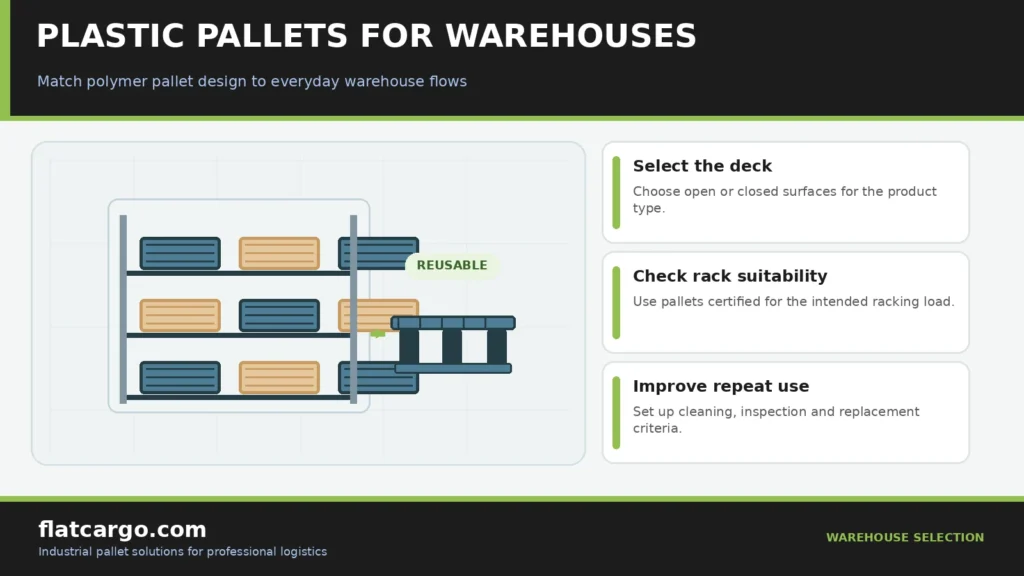
Compare Nestable, Stackable and Rackable Pallets Before Buying
Different pallet configurations suit different storage and handling tasks. These features can overlap; a pallet may combine more than one of them.
| Configuration or feature | Typical application | Main selection consideration |
|---|---|---|
| Nestable | Space-efficient storage and empty returns | Confirm compatibility with the handling and storage system |
| Stackable | Floor stacking and repeated internal movement | Verify stacking capacity and load distribution |
| Rackable plastic pallets | Storage on rack beams or partially unsupported surfaces | Check rated rack load, beam spacing and support orientation |
| Hygienic or closed-deck design | Operations requiring frequent cleaning | Verify material suitability, surface design and cleaning procedures |
The correct choice depends on how the pallet will be supported and handled. Learn more about nestable plastic pallets before comparing models.
Check Static, Dynamic and Racking Load Ratings Carefully
Plastic pallet load capacity must be assessed under the relevant operating conditions. Static, dynamic and racking ratings are not interchangeable.
Static load refers to a pallet supported on a stationary surface under specified conditions.
Dynamic load relates to the pallet's capacity during handling or movement under defined test conditions.
Racking load applies when the loaded pallet is supported by rack beams or another specified configuration.
For high-bay storage, assess the actual rack span, loading pattern, support direction and permissible deflection. Reinforcement may be required for some designs, but its presence alone does not establish compatibility. Request the technical data sheet for the exact pallet model.
Choose Deck and Runner Designs for Warehouse Equipment
Deck and runner geometry affects pallet handling, cleaning, storage and compatibility with warehouse equipment.
Open-deck designs may provide ventilation or reduce material weight, depending on their construction. Closed-deck models may be easier to clean in operations with particular hygiene requirements. For hygiene-focused applications, review plastic pallet designs for hygienic operations alongside the cleaning process used on site.
Runner arrangements also influence forklift entry, conveyor contact and rack support. The number of runners alone does not determine whether a pallet can be used in an automated warehouse.
For conveyor systems, verify dimensional tolerances, underside geometry, contact surfaces and compatibility with sensors and pallet handling equipment.
Plastic pallets can help avoid hazards associated with exposed nails or wood splinters, but safe handling still depends on load stability and operational procedures.
Assess Pallet Costs Using Real Operational and Maintenance Data
A reliable purchasing comparison should consider the total cost of ownership rather than assuming that one pallet material is always cheaper.
| Evaluation factor | Wooden pallets | Plastic pallets |
|---|---|---|
| Initial acquisition | Depends on type and grade | Depends on design and technical specification |
| Maintenance | Inspection and repair requirements vary | Inspection and replacement requirements vary |
| Automated handling | Requires model-specific compatibility checks | Requires model-specific compatibility checks |
| Cleaning | Depends on surface condition and process | Depends on material and design |
| Cost per rotation | Depends on utilisation and recovery costs | Depends on utilisation and recovery costs |
Estimated Cost per Rotation = (Acquisition + Handling + Inspection + Repair + Recovery Costs − Residual Value) / Completed Rotations
This formula can help procurement teams compare realistic operating scenarios. Financial benefits should be calculated from company-specific data rather than fixed assumptions about service life or maintenance costs.
For more cost factors, see our guide to plastic pallet logistics costs.
Verify ISO 8611 Test Results for Each Pallet Model
ISO 8611-1:2025 sets test methods for new flat pallets under specified loading and support conditions. A reference to the standard should not be treated as a universal guarantee against pallet failure or as proof that a model suits every warehouse system.
When comparing warehouse plastic pallets, ask which tests were performed, which product configuration was assessed and which load ratings apply. Request model-specific test documentation or manufacturer data for the intended use.
For automated handling and racking, confirm compatibility with the equipment supplier using the actual pallet model and operating conditions.
Use RFID Pallet Tracking with a Compatible Warehouse System
RFID can help businesses identify pallets and record movements when compatible tags, readers and software are installed.
A tagged pallet does not automatically transmit its position continuously. The level of visibility depends on the tracking technology, reader coverage, data integration and operating environment.
For warehouses equipped with a warehouse management system (WMS), suitable tracking infrastructure may improve inventory records and support returnable pallet management. Confirm whether RFID tagging is available for the selected pallet model and whether existing systems can process the resulting data.
Choosing a Used Pallet Supplier Across Europe
A suitable supplier should provide clear information about pallet dimensions, available quantities, condition grading, technical specifications and delivery arrangements.
For recurring industrial requirements, buyers should also evaluate regional stock availability, lead times, quality control procedures and the supplier's ability to provide consistent batches.
Flat Cargo's European partner network can help businesses assess regional sourcing options and select pallets according to their operational needs.
Used Pallet Availability and Purchasing Planning
Used pallet availability can change with industrial activity, return flows, supplier inventories and regional demand.
Buyers planning recurring orders should request updated quotations and confirm stock before committing to a delivery schedule. Where supply continuity is important, an agreed purchasing plan may help coordinate deliveries and reduce exposure to short-notice procurement.
Compare Plastic Pallets for Your Warehouse Requirements
Review your storage configuration, handling equipment, load specifications and purchasing volumes before selecting a model.
Flat Cargo can help you identify suitable options through its European pallet sourcing network.
Frequently Asked Questions
Are all plastic pallets suitable for warehouse racking?
No. Only pallets designed and rated for the relevant racking conditions should be considered. Check the support span, load distribution and specifications for the exact model.
Can plastic pallets be used in automated warehouses?
Yes, certain models are designed for automated handling. Verify compatibility against conveyor dimensions, pallet geometry, load ratings and equipment requirements.
How much weight can a plastic pallet hold?
There is no single load capacity for all plastic pallets. Capacity depends on the model, load distribution and support conditions. Compare the manufacturer's static, dynamic and racking ratings, and confirm the rack span and handling system requirements.
Does ISO 8611 guarantee that a pallet will never fail?
No. ISO 8611 provides methods for evaluating pallet performance under defined conditions. Suitability depends on the selected model and its operating environment.
Can RFID track plastic pallets in real time?
RFID can record pallet identification and movements where suitable reader infrastructure is installed. Continuous location visibility requires a compatible tracking architecture and cannot be assumed from the presence of an RFID tag alone.