
Wooden Pallet Business Model: Net Margin Optimization 2026
The wooden pallet business model is going through a major industrial consolidation phase. While the demand for load carriers is skyrocketing due to European regulatory pressure, operating an independent warehouse remains a risky financial exercise. Unexploited square meters represent an immediate cash drain (OPEX) for professionals in the sector.
Flat Cargo's technological infrastructure provides a structural response to this vulnerability. By shifting from a traditional craft model to a standardized logistics franchise, we secure our partners' capacity investments. This security is built on exclusive, data-driven operational fundamentals:
- Guaranteed recurring revenue generation through contractually secured business leads from national supply chains.
- Definitive elimination of commercial risk related to local sales prospecting or broker volatility.
- Centralized management of warehouse storage profitability through our proprietary software ecosystem.
Want to secure your assets and profitability?
Discover our Investor MasterclassAsset-Light vs Traditional Model
What is the initial investment required to open a logistics hub?
Starting up requires significantly less capital compared to the traditional logistics industry.
Exponential demand for circular logistics in 2026
The transport packaging market is undergoing an unprecedented structural shift. Industrial decision-makers are no longer looking for mere timber suppliers. They demand partners capable of managing the full life cycle of their logistics assets on a European scale.
The PPWR directive as a market accelerator
The enforcement of the European PPWR directive forces manufacturers to rethink their operational models. It imposes strict reuse quotas and rigorous traceability for transport packaging. This legal constraint compels companies to move away from one-off purchases in favor of deposit-refund systems and reverse logistics solutions.
- Application of financial penalties for non-compliant industrial players.
- Legal obligation to provide audited certificates of reuse.
- Need for an ultra-local territorial network to minimize the carbon footprint of Scope 3 related collections.
Operational limitations of traditional players
Faced with this regulatory pressure, the historical market has proven unable to meet demand. Brokers lack the physical infrastructure to handle collections. Pooling giants impose costly closed-loop systems. As for independent logistics providers, they hit a technological glass ceiling that restricts their expansion.
| Performance Criteria | Independent Logistics Model | Flat Cargo Network Infrastructure |
|---|---|---|
| Customer Acquisition | Time-consuming and uncertain local sales prospecting | Guaranteed national business leads secured by contract |
| Regulatory Compliance | Manual processes with a high risk of audit failure | Integrated traceability and automatic certificate generation |
| Pricing Strategy | Opaqueness and exposure to margin-killing price wars | Strict indexing aligned with official market indicators |
| EBITDA Generation | Low margins and heavy exposure to unpaid invoices | Secured profitability driven by billing and invoicing mandates |
Cost structure and warehouse storage profitability
The main barrier to traditional logistics expansion lies in capital intensity. The Flat Cargo model reverses this paradigm by turning an unavoidable operating expense (the rent of an empty warehouse) into a highly profitable capacity investment. The goal is to generate a positive EBITDA right from the first quarter of operations.
CAPEX modeling for a truck-free logistics business startup
The barrier to entry is drastically reduced. Flat Cargo's network infrastructure removes the need to acquire an in-house transport fleet. Initial capital (CAPEX) is exclusively allocated to bringing the storage space up to standards and integrating our technology stack.
- Entry fee to the franchisee network, limiting the financial risk of startup bootstrapping.
- Zero investment in heavy vehicles thanks to outsourcing via our internal freight exchange.
- Standard handling equipment (counterbalanced forklift truck) is sufficient to initiate cross-docking operations.
OPEX management and target EBITDA calculation
Profitability relies on optimizing cross-docking and maximizing volumes. Here is the structural financial projection for a standard area of 500 square meters operated under a Flat Cargo mandate.
| Financial Item | Traditional Operations | Flat Cargo Network Model |
|---|---|---|
| Rent and Property Charges | Heavy OPEX (Dead loss if unexploited) | Expense covered by guaranteed business volume |
| Technology and Software Fees | Multiple and disparate SaaS subscriptions | Single monthly fee (All-in-one infrastructure) |
| Net Operating Margin | 3% to 5% (Severe competitive pressure) | 12% to 15% (Streamlined flows and indexation) |
Interactive Revenue Simulator
Estimate your potential monthly turnover based on your unexploited warehouse surface area.
Exploitable surface area (in sqm): [Numerical input]
Calculate my profitability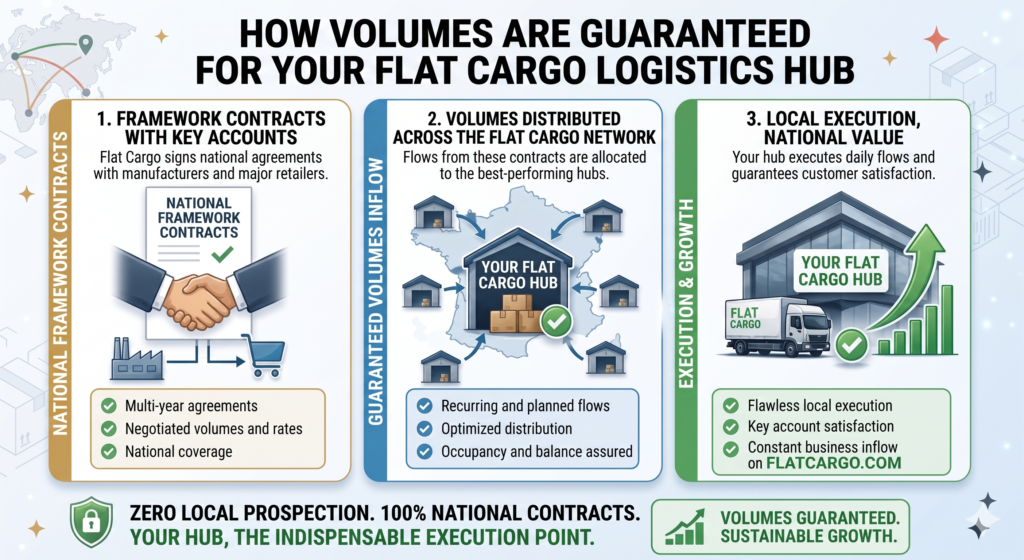
Leveraging a logistics franchise to mitigate risk
Operating a logistics hub involves incompressible fixed costs. Profitability therefore depends exclusively on the ability to maintain a maximum occupancy rate and secure debt collection. It is on this dual axis that the Flat Cargo logistics franchise outperforms the traditional model.
Vulnerabilities of the traditional independent model
Independent logistics providers operate in a highly precarious environment. Without the backing of a national infrastructure, they bear the full brunt of corporate risk, from customer acquisition to financial collection.
The technological advantage and billing mandate
The Flat Cargo ecosystem acts as a protective financial shield for its partners. By joining the network, investors delegate the entirety of commercial risk to the parent company, allowing them to focus on physical execution excellence.
- Integrated Billing Mandate: You fulfill the service, while the Flat Cargo platform centralizes invoicing and guarantees the payout of your net margins.
- Eradication of Bad Debt Risk: Industrial clients' creditworthiness is fully audited and covered upfront by our financial infrastructure.
- Process Standardization: Proprietary operating software automates flow traceability and delivery note generation without manual administrative intervention.
Join a secure and high-performing network for your logistics business.
Become a Flat Cargo FranchiseeLeveraging a logistics franchise to mitigate risk
Operating a logistics hub involves incompressible fixed costs. Profitability therefore depends exclusively on the ability to maintain a maximum occupancy rate and secure debt collection. It is on this dual axis that the Flat Cargo logistics franchise outperforms the traditional model.
Vulnerabilities of the traditional independent model
Independent logistics providers operate in a highly precarious environment. Without the backing of a national infrastructure, they bear the full brunt of corporate risk, from customer acquisition to financial collection.
The technological advantage and billing mandate
The Flat Cargo ecosystem acts as a protective financial shield for its partners. By joining the network, investors delegate the entirety of commercial risk to the parent company, allowing them to focus on physical execution excellence.
- Integrated Billing Mandate: You fulfill the service, while the Flat Cargo platform centralizes invoicing and guarantees the payout of your net margins.
- Eradication of Bad Debt Risk: Industrial clients' creditworthiness is fully audited and covered upfront by our financial infrastructure.
- Process Standardization: Proprietary operating software automates flow traceability and delivery note generation without manual administrative intervention.
Join a secure and high-performing network for your logistics business.
Become a Flat Cargo FranchiseeGuaranteed business leads and revenue acceleration
The primary point of failure when launching an independent logistics company is the inability to generate immediate revenue streams. The Flat Cargo model relies on a closed-loop architecture that eliminates this critical cash flow latency period. Business volume generation is not a possibility—it is the central operational engine of the franchise.
Infrastructure synergies with Pallet Hub and Circul-R
The volumes allocated to our local partners stem from master service agreements signed at the European level. Our national sales teams secure industrial supply chains and reverse logistics operations. When a client deploys our pallet deposit-refund solution to optimize their TCO, our franchised regional nodes execute the physical handling and capture the associated revenue.
- Capturing massive national supply chain flows and routing them with surgical precision to nearby hubs.
- Pooling major corporate client portfolios that are inherently inaccessible to an isolated operator.
- Generating hybrid revenue streams by combining equipment transactions with recurring service fulfillment.
Securing cash flow from the very first quarter
This systematic injection of business volume drastically compresses the time required to see a return on investment. As soon as the hub's operations are validated, the storage facility is connected to Flat Cargo's algorithmic routing to process its first pre-qualified orders.
- Reaching the break-even point faster by completely eliminating local customer acquisition costs (CAC).
- Gaining financial predictability for highly controlled, data-driven scaling of warehouse capacity.
- Immediate validation of incoming cash flows through the centralized factoring of the parent infrastructure.
Would you like to join our network and benefit from this guaranteed business volume?
Join the Investor MasterclassAction plan to deploy your regional hub
Deploying a Flat Cargo infrastructure does not require the typical engineering lead times of a traditional franchise. Since the technology architecture is centralized (Plug & Play), bringing your logistics node into production occurs within a strict 30-day cycle. The objective is to secure your first revenue invoice in the month following execution.
Eligibility study and allocation of exclusive zones
The first phase validates the financial and geospatial relevance of your facility to ensure successful absorption of allocated volumes.
Onboarding process and operational liftoff
The second phase focuses on knowledge transfer and connecting your operations to the national business generation network.
Transform your warehouse into a European logistics node
The allocation of exclusive zones is strictly regulated to safeguard our partners' profitability. Submit your operating facility details to our qualification system to validate your market potential.
Check my geographic territory eligibilityFrequently asked questions about the wooden pallet business model
What is the initial investment required to open a logistics hub?Starting up requires significantly less capital compared to the traditional logistics industry. The initial entry fee and technology setup is fixed at €2,500. Beyond this, basic handling equipment (forklift) can be financed via leasing to smooth out CAPEX, as no investment in a truck fleet is required.
How are business leads and contract volumes concretely guaranteed?Flat Cargo does not rely on local sales prospecting. The volumes routed to your hub stem from national master service agreements for supply and deposit-refund systems signed with major industrial players and key retail accounts. Your hub operates as an essential physical fulfillment node for these contracts.
What is the minimum warehouse surface area required?To secure optimal profitability (EBITDA) and accommodate the rapid turnover (cross-docking) required by our clients, a minimum exploitable surface area of 500 sqm is required. The facility layout must successfully allow maneuvering and loading for Full Truckloads (FTL). Contact us to validate your facility.