
Pallet Load Capacity and Linear Floor Space Optimization
Pallet Load Capacity is one of the most critical performance indicators for optimizing transport efficiency and ensuring the profitability of current logistics. For a transport director or a supply chain manager, empty space in a trailer represents an immediate net loss. Mastering the number of transportable load units is not just a matter of geometry; it is a strategic lever to reduce the unit transport cost and minimize the carbon footprint of every shipment.
Flow optimization relies on a detailed understanding of how carrier dimensions interact with the useful volume of the trailer. Flat Cargo offers a technical analysis of loading configurations to transform your road freight operations into a model of operational efficiency.
Calculation of useful space and dimensions of standard load units
Theoretical capacity of a semi-trailer in Euro pallets
Impact of load unit dimensions on the transport plan
| Pallet Format | Dimensions (mm) | Units on floor (13.6m Semi) | LDM consumed / unit |
|---|---|---|---|
| Euro Pallet (EPAL) | 800 x 1200 | 33 units | 0.4 m |
| Industrial Pallet | 1000 x 1200 | 26 units | 0.5 m |
| Half-pallet | 600 x 800 | 66 units | 0.2 m |
Technical specifications based on trailer payload volume
Configuration of trucks with tail lifts and refrigerated vehicles
Flexibility of curtainside trucks and low loader trailers for oversized cargo
| Vehicle type | Capacity (Euro pallets) | Strategic advantage |
|---|---|---|
| Tautliner semi-trailer | 33 units | Versatility and fast side loading |
| Refrigerated truck | 30 to 33 units | Thermal protection and sanitary compliance |
| Rigid truck with tail lift | 16 to 22 units | Self-sufficient unloading in urban areas |
| Low loader trailer | 18 to 20 units | Transport of tall and oversized loads |
Strategies to maximize load factor and reduce freight costs
Utilizing overhead clearance through pallet stacking
Securing non-stackable goods
For fragile or non-stackable goods, using double-deck trailers represents a strategic alternative. This system creates an adjustable second storage level, protecting the integrity of the lower products while maximizing the volume transported per trip in your current shipments.
Flow consolidation and load planning optimization
Loading floor linear meter calculation methodology for your shipments
Calculating LDM for standard and non-standard load units
$$\text{LDM of a unit} = \frac{\text{Length (m)} \times \text{Width (m)}}{2.4\text{ m (standard reference width)}}$$
By multiplying this result by the total number of non-stackable units, you get the total required floor length. This precision allows you to choose between a less-than-truckload (LTL) shipment or booking a full truckload (FTL) for your current flows.
Trade-off between volumetric footprint and weight limits
Pallet Load Capacity and Its Impact on Transport Planning
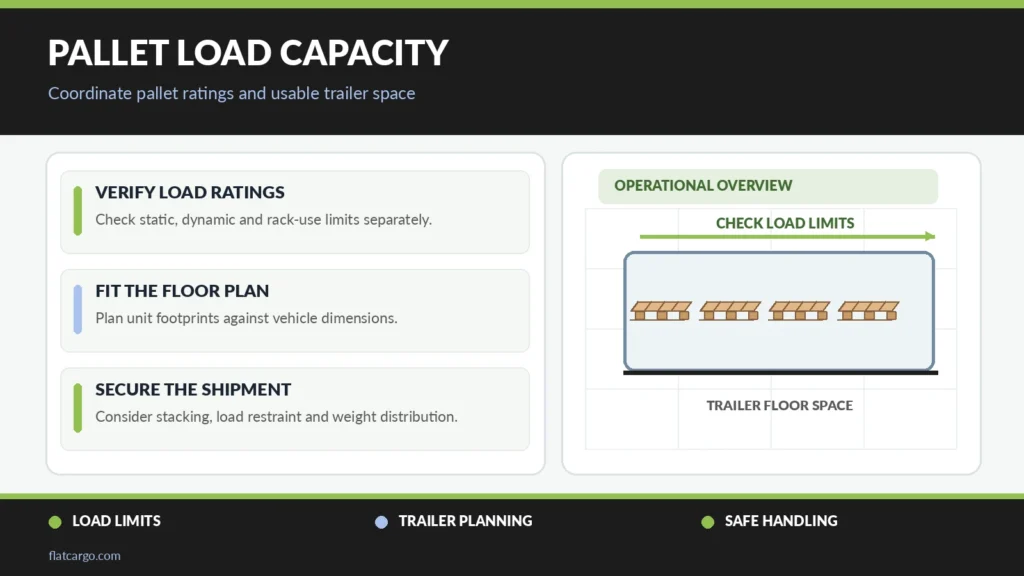
Understanding pallet load capacity is essential for manufacturers, warehouse operators and logistics companies seeking to optimize trailer utilization without compromising cargo safety. The maximum weight a pallet can safely support depends on its material, structural design, dimensions, condition and load distribution. Industrial buyers must distinguish between static load capacity, which applies when a pallet rests on a stable surface, dynamic load capacity, which concerns forklift and pallet truck handling, and racking load capacity, which applies when a pallet is supported by warehouse rack beams. These ratings are not interchangeable and should always be verified against the manufacturer's technical specifications. When planning palletized freight transport, logistics teams must also consider the combined weight of the pallet and its goods, vehicle payload limits, axle load distribution and appropriate cargo-securing methods. A pallet may occupy only 0.4 loading meters (LDM) while carrying a load that significantly influences the remaining payload capacity of the truck. By aligning pallet weight limits with floor space calculations, businesses can improve FTL and LTL loading efficiency, reduce the risk of overloaded shipments and better control transportation costs. Flat Cargo supports professional buyers in selecting suitable load carriers for industrial handling, storage and recurring road freight operations.
| Load unit format | Dimensions (mm) | LDM value (per unit) |
|---|---|---|
| Euro Pallet (EPAL) | 800 x 1200 | 0.4 LDM |
| Industrial Pallet | 1000 x 1200 | 0.5 LDM |
| Half-pallet | 600 x 800 | 0.2 LDM |
FAQ on space management and loading capacity
Pallet loading capacity in sea containers
Multimodal transport imposes different standards than road freight. For a 20-foot container (Dry), pallet loading capacity is limited to 11 Euro units on the floor. In a 40-foot container, the useful space allows aligning up to 23 to 24 Euro pallets depending on the chosen stowing method. Unlike road trailers, the internal width of standard sea containers is slightly narrower (2.35 m), which prevents placing two 1200 mm pallets side-by-side lengthwise. This technical constraint must be anticipated to avoid any unexpected issues during your current flows.
Impact of pallet height on the load factor
The number of transportable pallets is not just a matter of surface area. The height of each load unit determines whether stacking is possible. A standard trailer offers a useful height of 2.7 meters. If your pallets measure less than 1.35 meters, you can potentially double your loading capacity by stacking them. In current logistics, standardizing pallet height is the most effective lever to optimize cubic meter costs and make your current shipments profitable.
Conclusion on performance and volumetric optimization
Mastering **pallet loading capacity** is a fundamental skill to transform transport from a cost center into a performance driver. By using the **loading floor linear meter (LDM)** as a benchmark and adapting your loading plans to the trailer's payload volume, you secure your margins and gain operational agility. **Flat Cargo** supports supply chain players in **engineering their flows** to guarantee an optimal load factor and complete safety for your goods. Together, let's redefine the efficiency standards of your **current shipments**.
Optimize your loading plans and reduce your freight costs
Contact our experts to calculate your ideal LDM and maximize the use of your trailers.