
Half Plastic Pallets: Logistics Performance 2026
Direct shelf placement and elimination of handling disruptions
Efficiency and sustainability of the urban supply chain
Decarbonization and local profitability
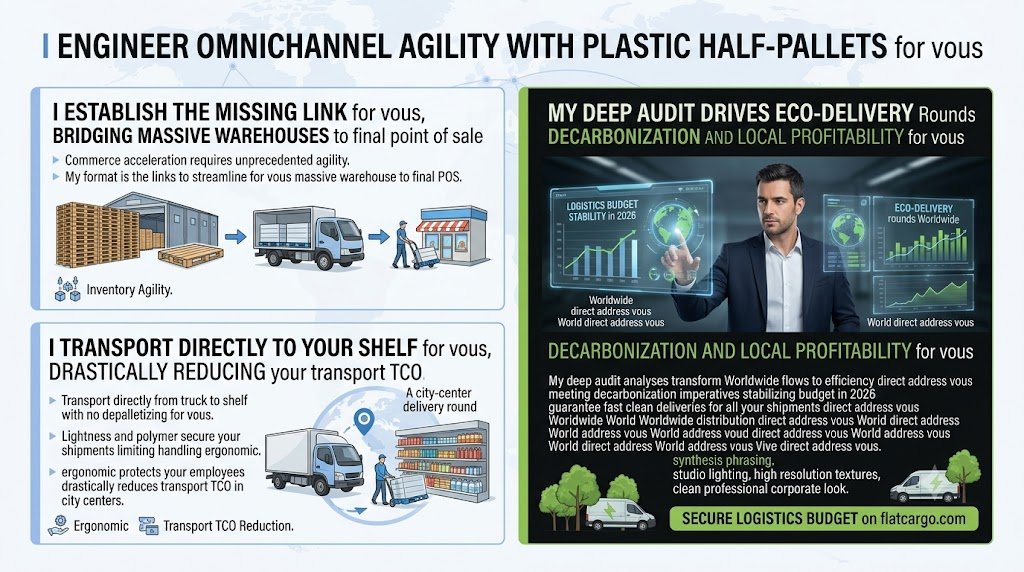
Flat Cargo analyzes how this compact support transforms your current flows into a model of efficiency. By meeting the decarbonization imperatives of the modern supply chain, you stabilize your logistics budget in 2026 while guaranteeing fast and clean deliveries for all your current shipments.
Mechanical advantages and durability of polymer load supports
Increased robustness against last-mile constraints
Hygiene and sanitary compliance for current flows
HACCP safety and brand image protection
The non-porosity of plastic is a critical advantage for the food and pharmaceutical sectors. For your current shipments, the total absence of mold is a guarantee of quality. In 2026, high-pressure cleaning is instantaneous, allowing immediate return to circulation. This characteristic ensures total compliance with HACCP standards, protecting your current flows and securing your logistics budget.
Strategic role of the half-pallet in urban e-commerce
Modularity and storage space optimization
Technological customization and RFID tracking
Unit traceability and rental fleet security
Innovation does not stop at the material. In 2026, Flat Cargo integrates RFID chips and QR codes directly into the plastic mass. For your current shipments, this offers essential traceability for e-commerce. This digitalization of current logistics makes it possible to know the location of each unit in real time, optimizing your inventory management and protecting your logistics budget against material losses.
Flat Cargo profitability audit and environmental impact
| Logistics Indicator | Wooden Half-Pallet | Flat Cargo Plastic Half-Pallet |
|---|---|---|
| Lifecycle (Rotations) | 5 to 10 (High fragility) | More than 100 (High resilience) |
| Tare weight (Handling) | 8 to 10 kg (Variable with moisture) | 3 to 6 kg (Constant and lightweight) |
| Global carbon footprint | High (Frequent replacement) | Optimized (100% recyclable) |
The following strategic audit compares the efficiency of the plastic half-pallet against traditional wooden solutions for the 2026 horizon. By cutting the weight of your load supports in half while multiplying their lifespan, you sustainably stabilize your logistics budget. This investment transforms your pallet logistics into an ecological advantage and significantly lowers the transport TCO of your current flows.
FAQ on using plastic half-pallets
What is the static and dynamic load capacity?
Despite their lightweight design, our half-pallets are engineered for heavy industry. For your current flows, they support up to 2,000 kg under static load and 750 kg under dynamic load. In 2026, this structural power is sufficient to transport liquids, canned goods, or dense electronic equipment without any deformation during your current shipments, thereby protecting your logistics budget.
Are the pallets compatible with automation?
Absolutely. The dimensional precision of plastic is perfect for conveyors and automated storage and retrieval systems (ASRS). For your current flows, this eliminates line stoppages due to wood debris or out-of-tolerance dimensions. In 2026, this geometric stability is the essential foundation for the total automation of your urban warehouses, optimizing your pallet logistics daily.
Conclusion on transitioning to agile logistics
Adopting the plastic half-pallet is a concrete response to the urbanization and sustainability challenges of 2026. By combining exceptional robustness with digital customization capabilities, this load support transcends its primary function to become a true tool for competitiveness. With Flat Cargo, optimize your truck space, guarantee flawless hygiene, and sustainably reduce the carbon footprint of your current flows.
No longer suffer the constraints of current logistics. Switch to the half-pallet format to offer your current shipments the agility required by the globalized market, while structurally optimizing your transport TCO.
Propel your urban logistics for 2026
Reduce your costs and secure your flows with our high-performance plastic half-pallets.