Pallet Depot Franchise Costs and Startup Requirements
Opening a pallet depot can be an option for entrepreneurs, warehouse operators and logistics businesses looking to develop a regional pallet trading and recovery activity.
A pallet depot franchise or network partnership may provide access to purchasing arrangements, operational tools, training and potential business opportunities. However, the financial viability of each location depends on local demand, warehouse costs, staffing, stock management and the commercial conditions agreed with the network.
Flat Cargo offers a European pallet hub partnership model for businesses looking to operate a local collection, sourcing and distribution facility.
This guide explains the operational model, published network fees, additional startup costs and key questions to assess before investing.
How a Pallet Depot Partnership Operates in Practice
A pallet depot typically receives, stores, sorts and dispatches pallets for industrial customers, distributors and logistics operators.
Activities may include purchasing new pallets, recovering used units, inspecting pallet condition, organising appropriate repairs through authorised operators and coordinating deliveries.
Joining a business network can provide shared purchasing resources, management software, commercial assistance and operational guidance.
- Partners remain responsible for managing local operations in accordance with the agreement and applicable requirements.
- Confirm the scope of support, lead allocation and commercial obligations before signing.
For a broader overview, see our logistics franchise guide. If you are assessing the launch process, also see our pallet depot opening guide.
What Does It Cost to Join Flat Cargo?
Flat Cargo's publicly listed European pallet hub partnership conditions identify three network charges.
| Network charge | Published amount | How it is applied |
|---|---|---|
| Joining fee | €2,500 | Initial network access fee |
| Brand licence fee | €249 excluding VAT | Monthly charge |
| Operating fee | 3% of sales excluding VAT | Turnover-based charge |
Source: Flat Cargo partnership programme
These are published network conditions, checked in November 2026. They are indicative for this article and must be confirmed against the current programme documentation and proposed contract.
The €2,500 joining fee should not be confused with the full investment required to establish or operate a pallet depot. The final budget depends on the applicant's existing facilities, equipment, financing arrangements and local operating costs.
Calculate Startup Investment Beyond the Network Joining Fee
Before opening a depot, applicants should evaluate all relevant setup and working capital requirements.
| Investment category | What to assess |
|---|---|
| Network entry | Joining fee and contractual setup charges |
| Premises | Rent, deposits, utilities and site preparation |
| Equipment | Forklifts, handling tools and maintenance |
| Opening inventory | Initial pallet purchases and safety stock |
| Staffing | Recruitment, training and payroll |
| Compliance | Insurance, safety arrangements and applicable authorisations |
| Transport | Own vehicles or subcontracted freight |
| Working capital | Cash required between stock purchases, operations and customer payments |
Applicants who already operate suitable industrial premises may have a different investment profile from those needing to lease and equip a new site. Every budget should distinguish one-time expenditure, recurring costs and cash tied up in inventory.
Estimate Warehouse Revenue and Operating Profit Using Real Assumptions
A pallet depot business model should be assessed through realistic sales, costs and cash-flow assumptions. A forecast can include revenue from pallet sales, collection services and other activities actually covered by the proposed agreement.
Direct operating expenses may include pallet purchasing, sorting, repairs, transport and handling. Fixed costs typically include premises, staffing, insurance, software and other ongoing charges.
Gross Profit = Revenue − Direct Costs
Operating Profit = Revenue − Direct Costs − Operating Expenses
Break-even Revenue = Fixed Operating Costs / Contribution Margin Ratio
The contribution margin ratio should account for variable costs, including turnover-based network charges. For investment decisions, prepare conservative, expected and optimistic scenarios using realistic customer demand, unit margins and monthly operating expenses.
Do not build a forecast around preset sales, operating margin or investment recovery timelines. Actual profitability depends on the operating conditions of the business.
Understand Network Support and Local Operating Responsibilities Clearly
A logistics partnership may provide useful resources, but responsibilities should be clearly allocated.
| Activity | Potential network support | Local operator considerations |
|---|---|---|
| Purchasing | Supplier access and purchasing arrangements | Stock financing and purchasing decisions |
| Software | Inventory, invoicing and CRM tools | Accurate data entry and operational use |
| Training | Technical and commercial guidance | Staff training and daily compliance |
| Commercial development | Access to network opportunities | Local customer requirements and service quality |
| Transport | Access to transport coordination options | Freight arrangements and delivery execution |
| Pallet recovery | Operational guidance | Collection, sorting and storage capacity |
Applicants should verify the services included in each fee and identify any activities that require separate investment or third-party contracts.
For companies exploring models without their own truck fleet, consult our guide to starting a logistics business without trucks.
Confirm Territorial Rights and Business Referral Terms Before Signing
A defined operating territory can help clarify responsibilities. The rights attached to an area are determined by the written agreement.
Prospective partners should verify the geographic scope, contractual duration, renewal conditions, existing network operations and any restrictions on customer acquisition.
They should also ask how business opportunities are allocated, whether minimum activity levels apply and how the agreement treats sales volumes below plan.
Network participation or access to a purchasing platform alone does not establish customer orders or profitable operation. Territory availability should be confirmed directly with Flat Cargo during the application process.
Review Franchise Documentation and Legal Obligations Carefully
The legal structure of a logistics network arrangement depends on the actual agreement, the parties' obligations and the relevant jurisdiction.
In France, where the conditions of Article L330-3 of the Commercial Code apply, the network operator must provide the required pre-contractual information and draft agreement at least 20 days before the relevant contract signature or qualifying advance payment.
The documents should allow the candidate to evaluate the network, market conditions, contractual restrictions and investment commitments.
Official reference: French Commercial Code — Article L330-3
Candidates should seek appropriate legal and financial advice before committing to an investment.
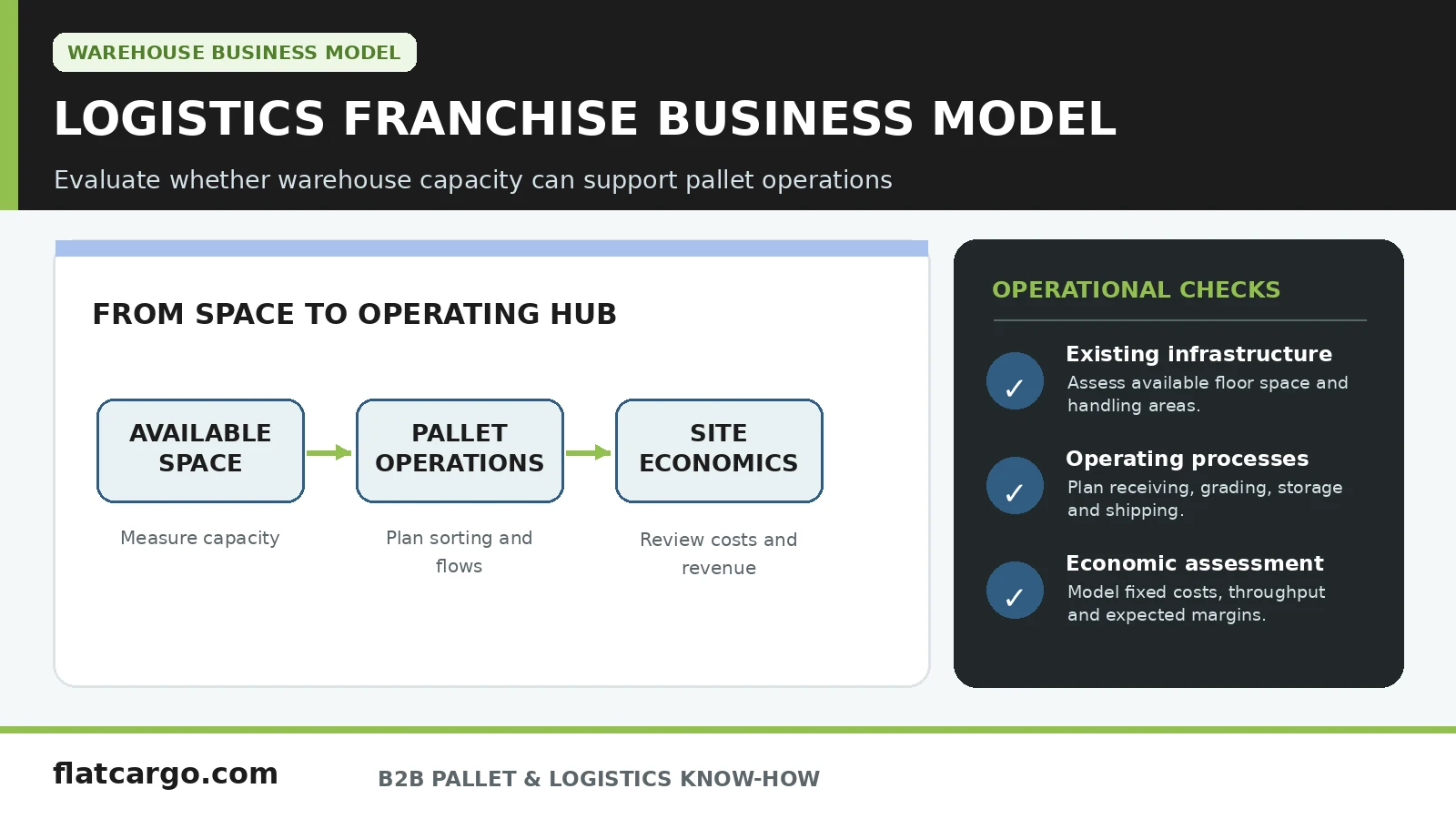
Evaluate Your Location and Business Plan Before Applying
The suitability of a pallet depot depends on practical site conditions and local market demand.
Review vehicle access, usable storage space, loading areas, material handling equipment, security arrangements and potential supplier or customer locations.
A suitable site should also allow efficient separation of incoming, inspected, rejected and ready-to-dispatch pallets.
For applicants using existing industrial premises, the financial assessment should identify the additional revenue that could realistically be generated and the additional costs required to achieve it.
The objective is to establish whether the proposed operation is commercially viable for the specific location, rather than assuming that network membership will produce a positive financial result.
Assess Your Pallet Depot Partnership Project
Are you considering opening a pallet depot or developing an existing logistics facility?
Review the programme conditions, operational requirements and available territories with Flat Cargo's network development team.
Request the Flat Cargo Partnership PackFrequently Asked Questions About Pallet Depot Franchise Costs
What is the initial cost of joining the Flat Cargo network?+
The publicly listed joining fee is €2,500. This is not the total startup budget: premises, inventory, equipment, staffing, insurance and working capital may require additional investment.
What recurring fees should a prospective partner consider?+
The published programme lists a €249 monthly brand fee excluding VAT and an operating fee equal to 3% of sales excluding VAT. Applicants should verify the latest contractual terms before applying.
Does a logistics network set a partner's revenue?+
No. Business results depend on the specific contract, commercial commitments, local market conditions and financial forecasts.
Do I need to own trucks to operate a pallet depot?+
Not necessarily. Transport may be subcontracted, depending on the business model. The partner must still organise appropriate transport arrangements and account for the associated costs.
Does every partner receive a specific territory?+
No. Any territorial rights depend on the applicable contract, the availability of the proposed area and the limitations defined in the agreement.
How can I calculate the profitability of a pallet depot?+
Prepare a forecast covering expected pallet volumes, average selling prices, purchasing costs, transport, payroll, premises, network fees and working capital. Test several scenarios rather than relying on a fixed investment recovery assumption.
What experience is needed to run a pallet depot?+
Experience in logistics, warehousing, transport, purchasing or industrial operations may be useful. Applicants should assess their ability to manage stock, staff, customer requirements and day-to-day site operations.