
Industrial Pallet Packaging Strategies and End of Line Performance Optimization
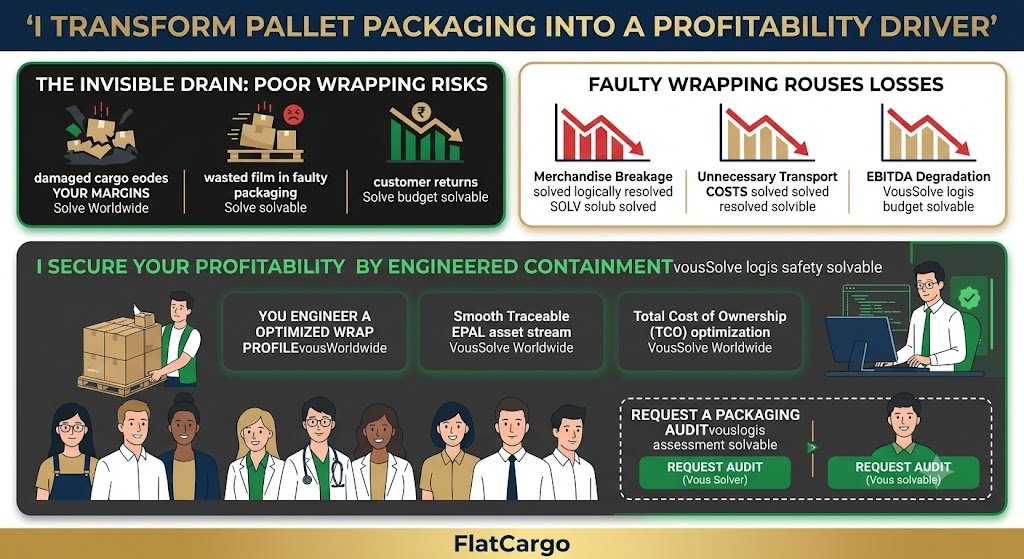
Industrial pallet packaging represents the final operational line of defense before shipping, directly determining the integrity of your assets in transit. Too often viewed as an unavoidable expense, end-of-line packaging is actually a major driver of profitability. Poorly managed wrapping is not just a logistics risk; it is an invisible drain on capital in the form of transit damage, customer returns, and wasted consumables.
In modern logistics, performance is not measured solely by warehouse throughput speeds, but by the ability to guarantee consistent unit load containment. Flat Cargo analyzes the essential equipment needed to transform your industrial pallet packaging process into a center of operational excellence, from manual wrapping stations to high-speed automation.
Selecting manual equipment to drive operational flexibility
High performance film dispensers and wrap for moderate volumes
Optimizing the wrapping station
Application precision relies on matching the right tool with the right material. Using an ergonomic stretch film dispenser is not a luxury, but a necessity to guarantee consistent wrapping tension while protecting operator health. Paired with high-performance pre-stretched films, this equipment achieves optimal load containment with minimal material. For your current shipments, this approach drastically reduces cost per package and limits environmental impact by eliminating unnecessary over-packaging.
Adhesives and protective accessories for shipment integrity
Transitioning to semi-automatic technologies and increasing wrapping speeds
Advantages of turntable stretch wrappers for consistency
Equipping the station with integrated weighing and strapping
| Technical feature | Performance impact | Direct financial benefit |
|---|---|---|
| Motorized pre-stretch | Drastic reduction in plastic volume | Lower consumable unit cost |
| Programmable cycles | Uniform containment force | Reduced customer cargo damage rates |
| Onboard weighing | Real-time compliance checks | Elimination of overload penalties |
Full automation and ROI of high throughput packaging equipment
Mobile robots and high speed wrapping systems
The major innovation of modern logistics lies in the deployment of mobile packaging robots and rotary ring stretch wrappers. Unlike turntable systems, automatic ring wrappers allow stationary pallets to be wrapped at speeds exceeding 100 units per hour. This technology is crucial for unstable or ultra-light products that would not withstand the centrifugal force of a turntable. For warehouses with variable layouts, autonomous mobile robots (AMRs) offer total flexibility by moving directly to the load, optimizing storage space and reducing forklift traffic within your current shipments.
Traceability and automatic labeling for logistics compliance
| Automation level | Target flow (Pallets/Day) | Primary ROI driver |
|---|---|---|
| Automatic stretch wrapper | > 50 pallets | Elimination of direct labor costs |
| Autonomous mobile robot | Multi-zone flows | Floor space optimization and agility |
| Ring wrapping line | > 100 pallets | Transit speed and fragile load integrity |
Comparative analysis of solutions based on current flows
| Selection criterion | Manual Equipment | Semi-Automatic | Automatic (High Speed) |
|---|---|---|---|
| Pallet volume / day | 1 to 15 pallets | 15 to 50 pallets | Over 50 pallets |
| Consumable control | Variable (high waste) | Precise (motorized pre-stretch) | Optimal (maximum savings) |
| Load stability | Operator-dependent | Uniform and repeatable | Certified and highly secure |
| Flexibility vs. Speed | Maximum agility | Productivity/cost balance | Pure industrial speed |
FAQ on equipment and unit load containment
How ergonomics impacts industrial pallet packaging performance
Workstation ergonomics is an often underestimated productivity factor in industrial pallet packaging. In a manual environment, repetitive wrapping movements can cause musculoskeletal disorders (MSDs), leading to costly absenteeism and a decline in execution quality. Introducing handling assistance equipment or upgrading to a semi-automatic stretch wrapper drastically reduces physical strain. For modern logistics, investing in ergonomics is not just an occupational health measure, but a strategic dynamic load containment approach that maintains a consistent pace throughout the workday.
Maintenance and durability of stretch wrapping equipment
The profitability of a stretch wrapping machine or an automatic strapping system depends entirely on its operational uptime. An end-of-line shutdown can halt the entire warehouse. To secure your ROI on packaging equipment, establishing a preventive maintenance plan is indispensable. Regularly cleaning the pre-stretch rollers and inspecting tension sensors ensures optimized film usage and prevents unexpected load failures. In your current shipments, a well-maintained machine retains its calibration precision, guaranteeing that every pallet leaves the dock with a containment force that fully complies with safety standards.
Strategic impact of logistics packaging
Industrial pallet packaging is far more than just a protective step; it is a leading driver of financial and operational optimization. Whether you choose the agility of manual solutions or the power of high-speed automation, the key to success lies in matching the selected equipment with the reality of your current flows. By investing in technologies capable of guaranteeing flawless unit load containment, you reduce your consumable costs, protect your margins against cargo damage, and strengthen the reliability of your supply chain. Flat Cargo stands as your strategic partner to audit, advise, and equip your end-of-line operations with solutions built to last.
Maximize your shipping security and equipment ROI
Benefit from an expert analysis of your wrapping processes and discover our high-performance industrial packaging solutions.