How to Avoid PPWR 2026 Packaging Taxes with a Reuse Certificate
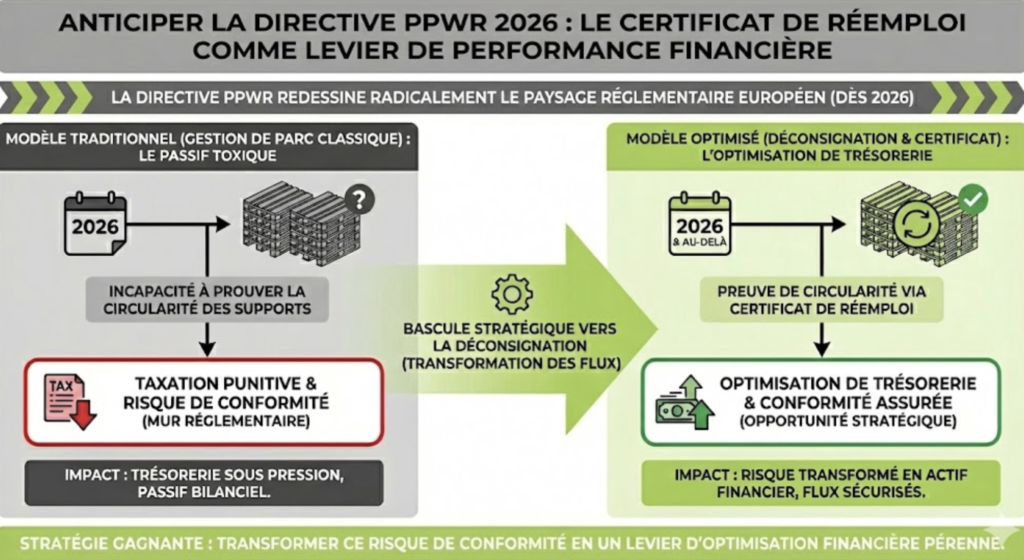
The PPWR packaging directive is radically reshaping the European regulatory landscape. Starting in 2026, manufacturers unable to prove the circularity of their load carriers will face punitive taxation.
This new regulatory wall is turning traditional fleet management into a toxic liability. The strategic solution lies in shifting your flows toward a deposit management model, transforming this compliance risk into cash flow optimization.
PPWR Directive and Packaging Tax The New Financial Risk
Inaction in the face of new European regulations is no longer a viable option for financial departments. The entry into force of the PPWR (Packaging and Packaging Waste Regulation) directive introduces a strict packaging tax penalizing the placement of single-use packaging on the market. For industrial companies, this tax directly threatens Operating Margin and Working Capital.
Financial Penalties
Direct and immediate taxation on the tonnage of non-circular industrial packaging placed on the market.
Working Capital Degradation
Massive immobilization of cash for the recurring payment of new environmental eco-taxes.
Reputation Risk
Damage to CSR reputation and exposure to greenwashing allegations by investors.
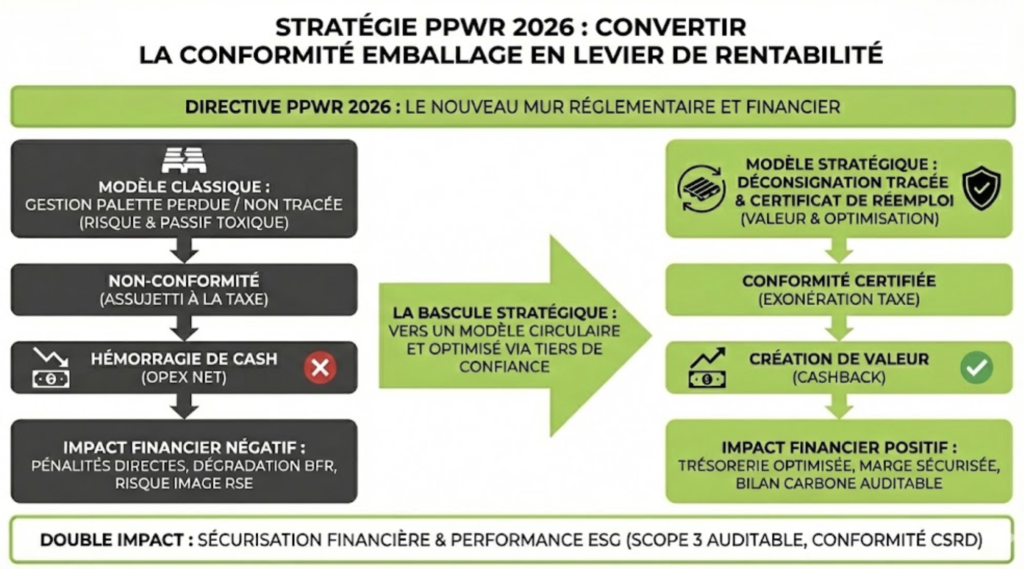
| Logistics Model | Legal Impact (PPWR 2026) | Cash Flow Impact (WCR) |
|---|---|---|
| Traditional Management (Lost/untracked pallet) |
Non-compliant (Subject to tax) |
Cash Hemorrhage (Net OPEX) |
| Circul-R Model (Tracked deposit removal) |
Compliant (Certified exemption) |
Value Creation (Cashback) |
Industrial Packaging Reuse Obligation and Scope 3 Impact
Legislation now requires rigorous digital traceability to justify industrial packaging reuse. Beyond the tax aspect, the PPWR directive aligns with CSRD (Corporate Sustainability Reporting Directive) obligations. Unoptimized fleet management increases your Scope 3 emissions. Structuring your reverse flows via an Industrial Trusted Third Party allows you to not only escape the tax but also to present an auditable carbon footprint.
Pallet Deconsignation Transforming Debt into Assets (TCO)
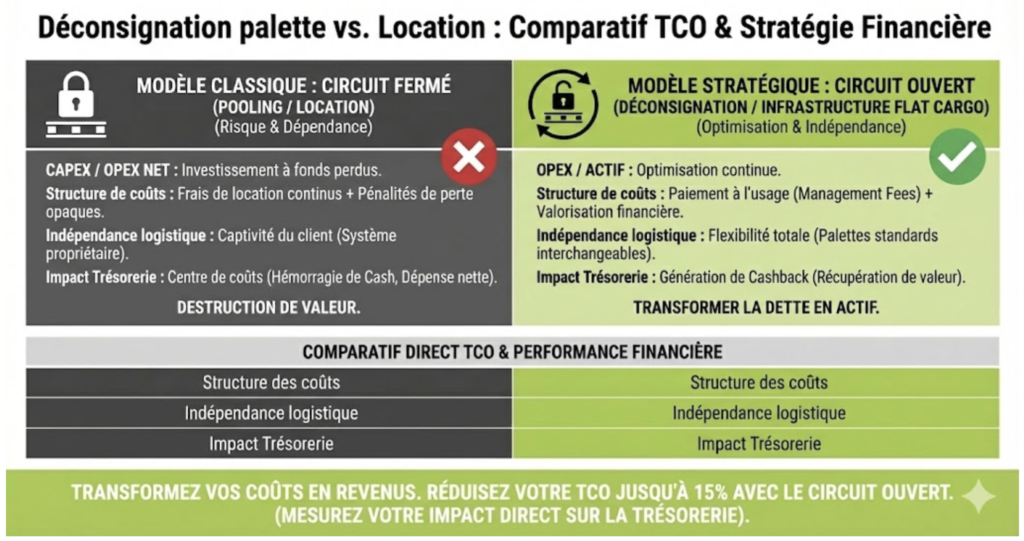
The industrial packaging paradigm must shift. Historically, purchasing shipping pallets is accounted for as a pure loss. Pallet deconsignation ends this value destruction. By organizing the financial valuation of your shipped packaging, we transform a costly waste into a revenue-generating asset. This shift reduces the Total Cost of Ownership (TCO) of your packaging by up to 15% from the first year.
Comparison Open Loop versus Closed Loop Pooling
Facing regulatory pressure, relying on rental giants (Poolers) is a strategic error. The closed-loop rental model locks the company into a proprietary, costly, and inflexible ecosystem. Conversely, our infrastructure operates in an Open Loop, guaranteeing the use of interchangeable standard carriers and total logistics independence.
| Financial Indicator (TCO) | Closed Loop (Traditional Hirers) | Open Loop (Flat Cargo Infrastructure) |
|---|---|---|
| Cost Structure | Continuous rental fees + Opaque loss penalties | Pay-per-use (Transparent Management Fees) |
| Logistics Independence | Customer captivity (Proprietary systems and assets) | Total flexibility (Use of standard EPAL pallets) |
| Cash Flow Impact | Perpetual cost center (Net expense) | Cashback generation (Value recovery at end of cycle) |
Measure the direct impact on your cash flow and WCR using our TCO Calculator.
Reverse Logistics The Operational Implementation
Deploying a circularity strategy often fails due to the operational complexity of return transport. We have designed a totally transparent Reverse Logistics infrastructure. Our model integrates into your existing flows without requiring any changes to your order preparation processes.
Centralized Management
A single point of contact to coordinate all collection points across Europe.
Flow Optimization
Using our territorial network to reduce empty transport distances and your overall carbon footprint.
Total Transparency
Real-time tracking of your fleet to visualize the financial gains generated by reducing your new carrier purchases.
Automatic Issuance of Reuse Certificates
The goal of circular management is to secure your company legally. With every rotation, our infrastructure generates a digitized reuse certificate. This document serves as irrefutable legal proof of compliance. By outsourcing your reverse flows, especially for your complex export supports, you guarantee your definitive exemption from the packaging tax.
PPWR Compliance and TCO Audit
Precisely measure your exposure to the future 2026 packaging tax and your current financial losses. Receive a personalized pre-audit including your potential for value creation (Cashback) and your Scope 3 compliance trajectory.