
PPWR Directive Pallet Fleet Management to Turn Regulatory Compliance into Financial Gains
For a Purchasing or Supply Chain Director, the PPWR directive is not just an ecological issue. It is a major budgetary challenge. In 2026, the lack of control over your load supports no longer translates only into operational losses, but into direct financial sanctions. Between the soaring price of wood and future taxes on non-reused packaging, every pallet lost at a customer's site becomes an avoidable cost line on your annual balance sheet.
Flat Cargo replaces legislative abstraction with transactional data management. The goal is simple. Stop buying new wood to compensate for a lack of traceability and secure your margins before the 2030 regulatory wall becomes insurmountable.
Transforming debt into Performance.
Every new pallet represents a carbon debt in your CSRD reporting. Flat Cargo's infrastructure transforms this burden into a sustainable performance lever.
The real financial risks of non-compliance with reuse quotas
Logistical inaction regarding new European standards has a strictly quantifiable price. For a manufacturer shipping 100,000 pallets per year, a standard loss rate of 15% represents a forced repurchase of 15,000 units. At the current rate, approximately €13 per EPAL unit, this is a hemorrhage of €195,000 per year that creates no value.
With the PPWR, this cost will be aggravated by several regulatory levers.
- The future tax on lost packaging: Financial penalties indexed to the weight of wood not reintegrated into a certified reuse loop.
- Inflation of replacement costs: Pressure on wood resources will mechanically raise spot prices for buyers who do not own their own circular fleet.
- The risk of delisting: Distributors, themselves subject to reuse quotas of up to 90% for certain flows, will prioritize suppliers capable of guaranteeing fluid and documented return loops.
Reduce your carbon footprint and environmental taxes through reuse
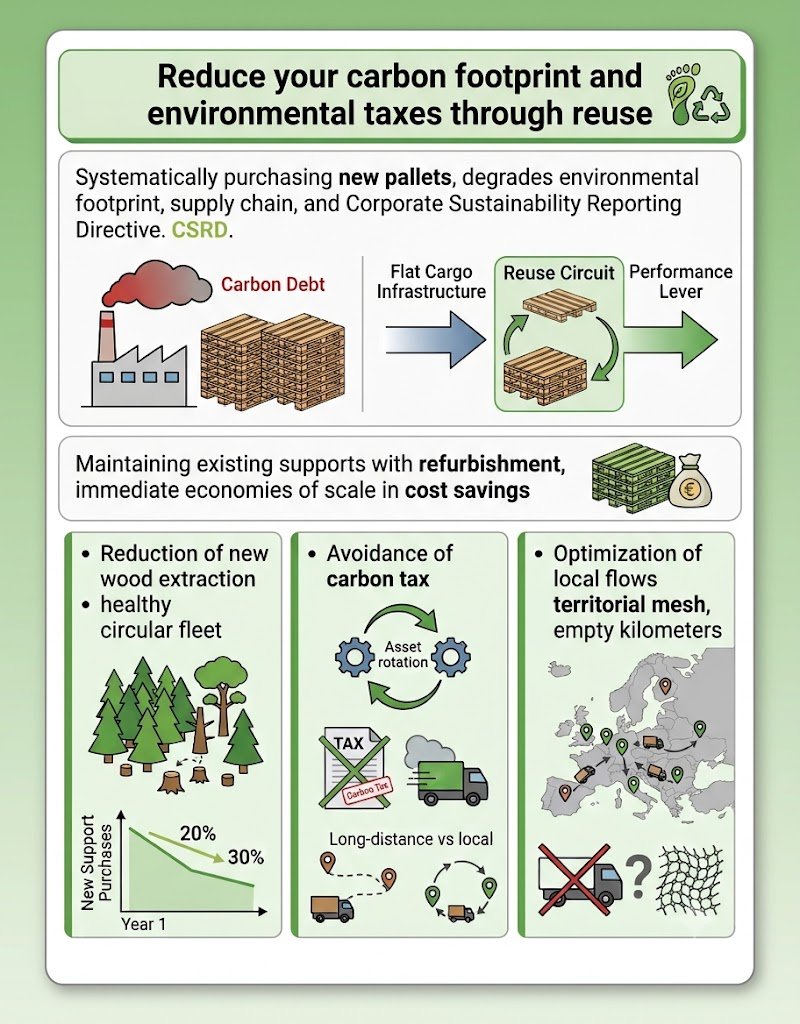
For the majority of manufacturers, the systematic purchase of new pallets degrades the environmental footprint of the supply chain. In the context of CSRD (Corporate Sustainability Reporting Directive) reporting, every repurchased pallet is an additional "carbon debt." Conversely, the Flat Cargo infrastructure allows you to transform this burden into a performance lever.
By favoring the maintenance of existing supports within the circuit, you realize immediate economies of scale.
- Reduction of new wood extraction: A well-managed circular fleet allows you to reduce your new support purchases by 20% to 30% from the first year.
- Avoidance of carbon tax: By proving the rotation of your assets, you mechanically reduce emissions linked to the manufacturing and long-distance transport of raw wood.
- Optimization of local flows: Our territorial mesh processes your pallets as close as possible to your delivery points, eliminating costs and emissions from empty kilometers.
Guaranteeing fiscal compliance through load support traceability
European regulation no longer settles for declarations of intent. Traceability is becoming the central element to avoid penalties. Without reliable and certified data, it is impossible to prove your effective reuse rate to tax authorities. Our solution replaces vague estimates with certified transactional data.
Each pallet movement between your factories, your customers, and our partner hubs is recorded. This data-driven approach offers you a real-time view of your fleet's performance. It is your best insurance against the fines provided for by the PPWR directive, without requiring the purchase of expensive and fragile physical sensors.
The reuse certificate as a shield during your CSR audits
The purpose of a circular management system is to transform logistics flows into proof of sustainability. At the end of each reporting period, Flat Cargo issues an official Certificate of Reuse. This document summarizes the volumes that have rejoined a reuse loop and the CO₂ savings achieved.
This certificate constitutes a major accounting and extra-financial document. It allows you to justify your compliance to auditors and highlights your environmental commitments to your shareholders. By delegating this certification to a trusted third party, you secure your CSRD and PPWR audits with indisputable methodological rigor.
CSRD and PPWR Audit Shield.
Flat Cargo issues an official Certificate of Reuse that transforms your logistics flows into undeniable proof of sustainability during your CSR reporting.
This document summarizes circular volumes and the CO₂ savings achieved, constituting a major accounting document to secure your audits regarding shareholders.
Frequently asked questions about the European PPWR directive
Q. What are the objectives of the PPWR directive for the industry?
The objective is to drastically reduce packaging waste within the European Union. The PPWR directive imposes mandatory reuse thresholds, with an ambitious target for 2030. For manufacturers, this means moving from a consumption-based purchasing model to a circular management model for their pallet assets.
Q. How to legally prove your pallet reuse rate?
Proof relies on transactional traceability. You must be able to provide auditable data demonstrating that your load supports have been recovered and reintegrated into a real logistics loop. Flat Cargo automates this collection to generate certificates that comply with auditors' requirements.
Q. Do you need to modify your production lines to be compliant?
No. PPWR compliance concerns support lifecycle management, not your production tool. By using standard pallets and entrusting reverse logistics to an expert network, you meet legal obligations without changing your current processes.