
Metal Pallet Supplier: Warehouse Safety and Durability
Modern industrial production rates can no longer tolerate mechanical uncertainty. Traditional wooden load carriers, although standardized, reach their critical limits in high-density and intensive turnover environments. These limitations include recurring breakage, sanitary degradation, and instability under heavy loads.
These failures are not merely operational costs; they represent a direct risk to operator safety and inventory integrity. The transition to industrial metal pallets has now become an essential operational resilience strategy.
It transforms a disposable consumable, subject to lumber price inflation, into a durable storage asset capable of withstanding extreme mechanical stress. Flat Cargo secures your logistics flows by sourcing certified metal solutions engineered for the most severe load requirements.
Interoperability & Integration
Designed in accordance with ISO standards, our metal pallets integrate natively into all your conventional racking systems.
Each deployment is preceded by a technical validation to guarantee total stability in high-bay vertical storage.
Zero infrastructure modification required: Immediate Plug & Play integration within your existing logistics operations.
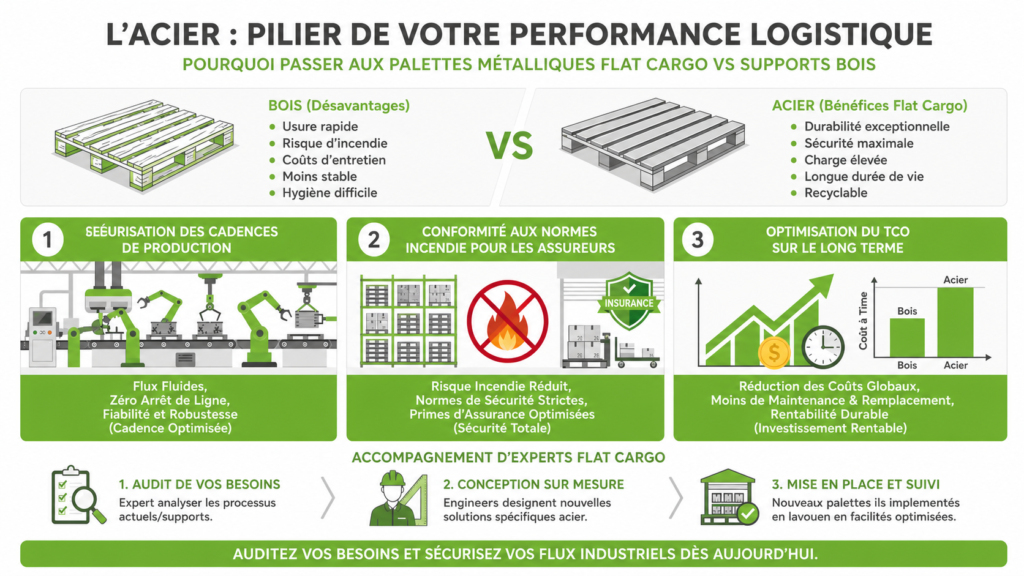
Industrial Metal Pallets: Why Steel is Your Best Investment
Transitioning to metal is not a simple material evolution; it is a strategic mutation of your internal logistics. The intensive use of wooden carriers generates a constant erosion of your margins through hidden costs: scrap, production stoppages for replacement, and waste management.
Steel Storage Pallets: Absolute Structural Resistance
The steel storage pallet is designed for environments where wood fails due to its own organic nature. In heavy industrial environments, the repetitiveness of handling cycles and the weight of the loads eventually destroy wooden carriers, creating risks of tipping and cargo damage.
Steel, on the other hand, offers perfect dimensional stability under stress. This robustness translates into the permanent availability of your equipment pool, with no maintenance required.
| Performance Criteria | Wooden Pallet (EPAL) | Metal Pallet (Steel) |
|---|---|---|
| Average Lifespan | 3 to 5 years | 10+ years |
| Annual Replacement Rate | 15 to 25% | Under 2% |
| Heavy Load Resistance | Standard | Very High |
| Fire Risk | High (Combustible) | Non-existent (Fireproof) |
| Maintenance | Waste management | None |
Profitability and TCO: Why the Purchase Price is Not the Only Indicator
The classic mistake of the industrial buyer is comparing the unit purchase price. This is a flawed vision that neglects the TCO (Total Cost of Ownership). An industrial metal pallet may have a higher initial acquisition cost, but its profitability over three years is mathematically superior due to the elimination of replacement costs.
- Economies of Scale: Drastic reduction in replacement orders (OPEX).
- Insurance Optimization: The non-combustibility of steel often reduces warehouse fire insurance premiums.
- Productivity: Zero production line stoppages due to a broken pallet under a forklift.
To audit your current pool and identify the tipping points toward metal, we invite you to explore our steel solutions adapted for heavy flows.
Maintenance Simplified to the Bare Minimum
Metal does not degrade upon contact with external agents. No risk of rotting or cracking, unlike organic carriers.
A simple observation during handling is enough to validate the equipment's integrity, drastically reducing the time allocated to fleet management.
Zero risk of protruding elements (nails, splinters), thereby protecting your operators and your goods during loading operations.
Metal Pallet Load Resistance: Ensuring Operator Safety
Managing an intensive logistics fleet requires absolute rigor regarding load capacities. Unlike wood, whose strength decreases with moisture, repeated impacts, or aging, the metal pallet offers consistent performance. In an environment where the safety of people and machinery is the top priority, the choice of load carrier becomes an integral risk management parameter.
Understanding Metal Pallet Load Resistance in Dynamic Conditions
The fatal error in choosing load carriers lies in confusing static and dynamic loads. A pallet may support a ton in floor storage (static) but undergo permanent deformation when lifted by a forklift (dynamic) if its structure is compromised.
Metal pallet load resistance is defined by its ability to maintain structural integrity under movement stress. Here are the technical factors that guarantee this stability:
- Torsional Rigidity: Steel does not flex under load, preventing goods from swaying during rapid transfer phases.
- Mass Distribution: The design of metal stringers allows for uniform transmission of forces to the floor, unlike wooden boards which concentrate pressure points.
- Dimensional Stability: Zero deformation, even after thousands of FTL cycles, ensuring perfect compatibility with automated or robotic palletizing systems.
Metal Pallet Safety Standards: Compliance Imperatives for Your Racks
Regulatory compliance in the warehouse allows for no approximations. Metal pallet safety standards are a direct lever for reducing your accident rate, particularly regarding fire risks and compatibility with your racking.
Switching to steel meets the growing demands of insurers and HSE (Health, Safety, Environment) managers:
- Fire Prevention: Steel is a non-combustible material. Using metal pallets reduces the total fire load of your warehouse, a major point during fire compliance audits.
- Rack Integrity: Wooden pallets generate debris (shavings, splinters) that pollute storage areas and can block safety mechanisms in conveyor systems. Metal guarantees a clean and operational environment.
- Standardization and Traceability: Our models are designed to adapt to standard industrial rack dimensions, thus avoiding dangerous overhangs associated with ill-suited carriers.
Securing your warehouse primarily means choosing equipment with certified and consistent capacities. To obtain detailed technical datasheets for our high-strength models, contact our team via our HUB which complies with current industrial standards.
Incombustibility and Risk Management
Steel is an inert material that does not contribute to the development of fires. This technical choice mechanically lowers your overall risk index, favoring more competitive insurance conditions and simplified compliance.
By eliminating wood, you remove tons of combustible material, thus inhibiting any vertical or lateral fire propagation.
A metal configuration facilitates the validation of your HSE audits, proving proactive control of industrial risks.
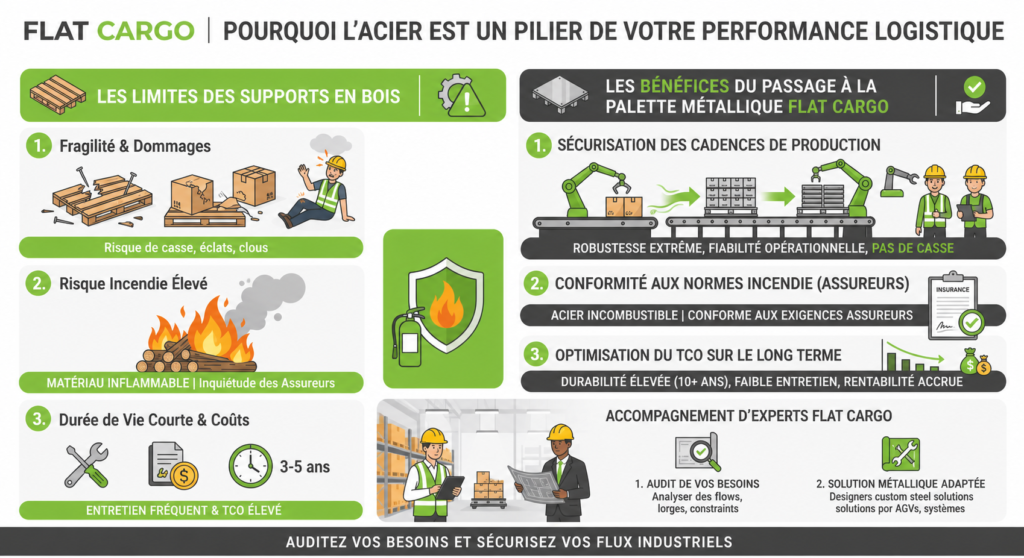
Metal vs. Wooden Pallets: Comparative Analysis for Your Supply Chain
The debate between wooden supports (EPAL) and metal pallets should not be settled based on unit cost, but on operational balance. Where wood is a highly volatile cost variable, steel acts as a high-performance fixed asset. Here are the technical facts driving this shift toward industrial metal pallets.
Durability Analysis: Why Steel Eliminates Health and Mechanical Risks
The longevity of your supply chain depends on the reliability of its load units. Wood, being a living material, undergoes accelerated structural fatigue: it warps, cracks under the effect of humidity, and becomes a vector for contamination.
Conversely, industrial metal pallets offer total inertia when faced with extreme conditions. By replacing your wooden supports with steel, you eliminate the following failure points:
- Pest-free: Unlike wood, steel requires no heat treatment (ISPM 15) and is inherently sterile.
- Dimensional stability: Zero deformation related to variations in humidity or temperature, crucial for your automated storage systems.
- Optimized weight/load ratio: Metal pallets offer a higher load capacity for the same footprint, thereby maximizing available storage space.
Risk Management: Reducing Insurance Premiums through Metal
The most underestimated financial argument in the metal vs. wooden pallet debate lies in the calculation of fire risk. Insurers classify wooden pallets as a major fire load, directly increasing the total loss risk for your warehouse.
| Performance Indicator | Wooden Pallet (Standard) | Metal Pallet (Steel) |
|---|---|---|
| Fire Rating | Combustible (Fire Load) | Non-combustible |
| Sanitary Risk | High (Fungi/Insects) | None |
| Maintenance | Operational (Repair/Sorting) | None |
| Amortization | Less than 36 months | More than 120 months |
Investing in metal means reducing your global TCO (Total Cost of Ownership) by lowering waste management costs and operational risks. To optimize your assets, consult our range of metal solutions.
Metal Pallet Dimensions: Choosing the Right Standard for Your Flows
Pallet dimensioning is not just a spatial constraint; it is a critical parameter that dictates the speed of your logistics. In heavy industry, sizing errors lead to bottlenecks on conveyors, machine stoppages, and unacceptable yield losses. Choosing the right metal pallet dimensions means aligning your storage infrastructure with your actual production capabilities.
Standardizing Metal Pallet Dimensions for Automation
For warehouses equipped with automated systems (stacker cranes, conveyors, AGVs), dimensional precision is an absolute requirement. Handling robots operate with millimeter tolerance margins; any deformation or dimensional variation in the support results in an immediate line stoppage.
Metal provides this rigor, which is essential for the operation of your automation:
- Geometric Stability: Unlike wood, which can swell or warp, steel maintains its nominal dimensions under loads of several tons.
- Increased Compatibility: Standardized metal pallets (Europe or ISO formats) integrate without needing to reconfigure your vision sensors and barcode readers.
- Repeatable Precision: Each unit is produced with near-zero variance, ensuring perfect indexing on robotic palletizing stations.
Custom Solutions: When to Move Beyond Standards to Boost Productivity
While standardization is the foundation of efficiency, it can become a hindrance for certain specific industrial use cases. When your products have complex geometries, offset centers of gravity, or specific fragilities, the standard becomes counter-productive.
Flat Cargo supports manufacturers in the design of dedicated metal supports to maximize storage density and load safety.
| Industrial Need | Standard (e.g., 1200x800) | Custom Solution |
|---|---|---|
| Robotic flows | Recommended | Not required |
| Out-of-gauge loads | Risky | Priority |
| m2 Maximization | Standard | Optimized |
| Handling type | Forklift | Overhead crane |
Moving away from the standard format often allows for reducing wasted rack space and increasing the number of products per slot. If your flow requires a specific configuration, we step in to design the technical solution adapted to your load constraints.
To audit your needs and see our steel solutions, standard or configurable, contact our experts for a technical recommendation.
Metal Pallet Pricing: Transparency Serving Your Sourcing
In an industrial context marked by raw material volatility, the pricing opacity of traditional brokers represents a major financial risk for your supply. Flat Cargo rejects this model of hidden margins. We adopt an "Open Book" approach, where value is indexed to the economic reality of production.
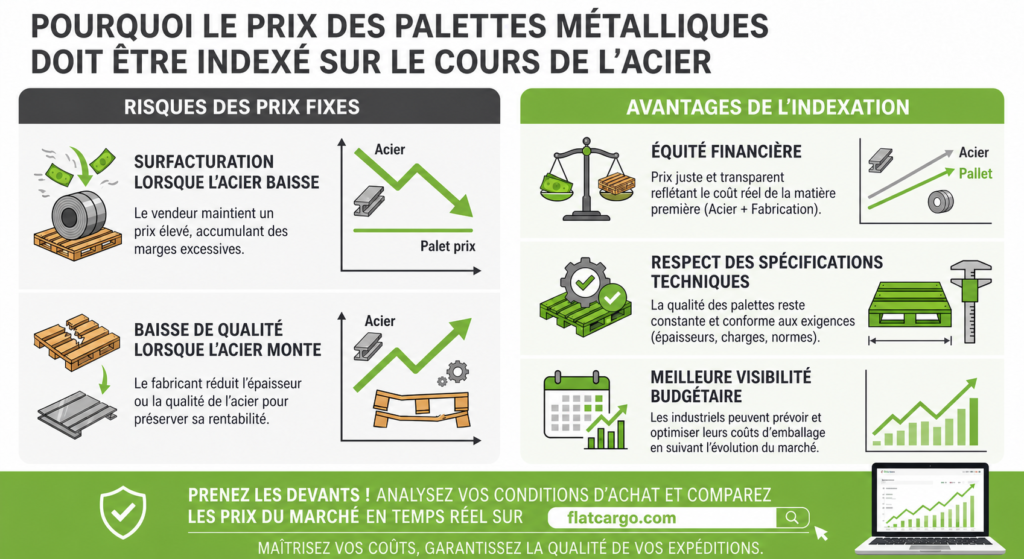
Why metal pallet pricing must be indexed to steel market rates
Steel is a commodity whose price fluctuates based on established global indices. Any fixed-price offer, disconnected from these indices over a long period, inevitably hides either excessive security surcharges for the supplier or a drop in quality (steel thickness, welds, treatment) to maintain margins.
Indexing allows for:
- Ensuring fairness: You pay the actual price of the material at the time of production, without unnecessary risk premiums.
- Ensuring sustainability: A price consistent with steel market rates ensures that your supplier can honor their commitments without cutting corners on the technical specifications of your pallets.
- Anticipating budgets: Thanks to our direct access to market data, we provide you with the visibility needed to manage your procurement decisions.
To verify if your current purchasing conditions are aligned with economic reality, we recommend analyzing real-time market prices on our platform.
Securing inventory: Direct sourcing to avoid chain stoppages
For a purchasing manager, a stockout is not an option. Indirect sourcing (multiple intermediaries) multiplies points of failure. Direct sourcing via Flat Cargo transforms this fragmented logistics into a unified infrastructure.
Direct sourcing guarantees:
- Day+1 Availability: Our territorial network of partners allows for inventory to be positioned as close as possible to your production sites.
- Total Traceability: Each batch is identified from the moment it leaves the line until it reaches your receiving dock, eliminating transport uncertainties.
- Operational Agility: In case of demand spikes, our decentralized structure allows for immediate reallocation of available volumes.
Need a high-strength storage solution for your critical flows?
Metal Pallet Dimensions: Choosing the Right Standard for Your Flows
Pallet dimensioning is not just a spatial constraint; it is a critical parameter that dictates the speed of your logistics. In heavy industry, sizing errors lead to bottlenecks on conveyors, machine stoppages, and unacceptable yield losses. Choosing the right metal pallet dimensions means aligning your storage infrastructure with your actual production capabilities.
Standardizing Metal Pallet Dimensions for Automation
For warehouses equipped with automated systems (stacker cranes, conveyors, AGVs), dimensional precision is an absolute requirement. Handling robots operate with millimeter tolerance margins; any deformation or dimensional variation in the support results in an immediate line stoppage.
Metal provides this rigor, which is essential for the operation of your automation:
- Geometric Stability: Unlike wood, which can swell or warp, steel maintains its nominal dimensions under loads of several tons.
- Increased Compatibility: Standardized metal pallets (Europe or ISO formats) integrate without needing to reconfigure your vision sensors and barcode readers.
- Repeatable Precision: Each unit is produced with near-zero variance, ensuring perfect indexing on robotic palletizing stations.
Custom Solutions: When to Move Beyond Standards to Boost Productivity
While standardization is the foundation of efficiency, it can become a hindrance for certain specific industrial use cases. When your products have complex geometries, offset centers of gravity, or specific fragilities, the standard becomes counter-productive.
Flat Cargo supports manufacturers in the design of dedicated metal supports to maximize storage density and load safety.
| Industrial Need | Standard (e.g., 1200x800) | Custom Solution |
|---|---|---|
| Robotic flows | Recommended | Not required |
| Out-of-gauge loads | Risky | Priority |
| m2 Maximization | Standard | Optimized |
| Handling type | Forklift | Overhead crane |
Moving away from the standard format often allows for reducing wasted rack space and increasing the number of products per slot. If your flow requires a specific configuration, we step in to design the technical solution adapted to your load constraints.
To audit your needs and see our standard or configurable solutions, follow the evolution of European market prices.
Conclusion: Steel as the Pillar of Your Logistics Performance
Choosing your load carriers is no longer just a matter of procurement, but a structural decision for your logistics. Where wooden pallets impose recurring replacement constraints and operational risks linked to their natural degradation, the metal pallet stands out as a true storage asset.
Investing in steel means securing your production rates, meeting strict insurer requirements regarding fire prevention, and optimizing your TCO over the long term. Flat Cargo does not just deliver carriers: we provide the infrastructure necessary for the sustainability of your flows.
Need an audit of your pallet fleet?
Our industrial experts are at your disposal to analyze your storage needs and define the metal solution that will integrate perfectly with your material handling systems.
FAQ
Are metal pallets compatible with my current storage racks?Yes. Our metal pallets are designed to meet industrial dimension standards. They are perfectly compatible with classic pallet racking systems. During your inquiry, we validate your equipment's geometry to ensure total stability under high-rack storage conditions.
Does the metal pallet require specific maintenance?Unlike wood, which requires constant inspection to detect split boards or protruding nails, the metal pallet is virtually maintenance-free. Periodic visual inspection is sufficient to ensure the structure has not suffered severe mechanical impact during handling.
How can the initial investment be justified compared to a standard wooden pallet?The argument is based on TCO (Total Cost of Ownership). While the unit cost is higher, the cost of usage over 3 years is significantly lower due to the elimination of renewal costs, scrap, and waste management. We can conduct a comparative profitability simulation when you request a quote for our range of metal pallets.
Does switching to steel really improve my fire compliance?Absolutely. Wood is a combustible material that increases your warehouse's calorific load. Steel is non-combustible. This technical change is often favorably received by HSE auditors and insurers, as it mechanically reduces the risk of fire spreading within your storage areas.